
The Standard on the Label

Updated: Jul 12

Brussels, Terra Madre Europe, and what a chocolate bar taught me about food trust
Part I of a three-part series: Brussels, Turin, France
SOURCE & STANDARD
The first time I went to Brussels I was twenty-one and fresh off a train from the Netherlands.
What I remember is chocolate, waffles, a day trip to Bruges, and the rest...
This time I was sitting mouth agape at a small front-row table, eating chocolate that was honestly excellent, and learning that the most valuable thing on its wrapper was not a certification stamp but a name.
I had asked to share the table with two strangers, a father and daughter, Giampiero and Alessia, originally from Sicily. The chocolate in front of us was smooth with none of that waxy slip that cheap chocolate leaves on the roof of your mouth. The first thing I felt was pleasure. The second thing I felt, a few minutes later, was the floor moving, because the workshop’s whole point was that a “fair trade” stamp on a chocolate bar may not tell you what you think it tells you. The bar in front of us carried what you actually want to see: the country it came from and the plantation, named, so the bean can be traced back to the people who grew it.1
That is the moment this article is about. Not because labels are a scam. The opposite.
Because a label is supposed to mean something, and most of the time we have no way to check whether it does.
This is the Brussels installment of Source & Standard, and I want to be upfront that it is a slightly different animal than the last few. The water trilogy (Singapore, Bali, India) was about an invisible system you feel in your body before you can name it. Belgium is about the moment a system becomes a sticker. A protected name. A designation. A mark a consumer can read in two seconds at a shelf or on a menu.
The Source & Standard question never changes: what makes the food on your plate what it is? In Belgium the answer kept arriving as a legal one. Place makes the taste. Law makes the trust. And the label, when it works, is where those two things meet in public. This is also the start of something: the first of three discovery trips (Brussels, then Turin, then France) digging backward from the sticker on the package to the people and the century of law underneath it.
I came home to Boston from this trip more convinced of something I had been circling for a while at Who’s Your Farmer New England, my passion project on the other side of the Atlantic. Readers of the New England piece met Who’s Your Farmer as a rewards platform, a personal bet that consumer spending could be pointed at farms instead of past them.
Brussels changed the shape of that bet. I’ll get to that. First, the food.
Brussels, then and now
I landed two days before the opening of Terra Madre Europe, the European edition of the international food gathering run by Slow Food, the movement founded in Italy to defend local food traditions. I stayed near the Grand Place, which made the city walkable and put me a short ride from the train to Ghent.

Brussels at twenty-one was a haze. Brussels in my forties was a working city, historic, alive, and visibly run on rules.
On my first evening I walked for hours and then ducked into a pub, where five English men on holiday cheerfully drafted me into their dinner plans across the street. The restaurant was a tourist trap and we all knew it, and the night was still good, because spontaneity and strangers are most of what makes travel worth doing. I had chicken with a sauce. The table shared fries with mayonnaise. By the end of the trip I had a working theory of Belgian cuisine, which is that everything comes with sauce. I mean this as praise.

That sauce is not an accident either. Belgian food sits at a crossroads. French technique, Germanic heartiness, Dutch trading habits, monastic brewing, colonial cacao routes, and centuries of dense urban guild markets all feeding into one small country.2 The stews and braises and cream-and-mustard reductions are cold-climate, merchant-city, peasant-and-burgher food. The point of this piece is not to reject that pleasure. It’s to ask what's behind it (what climate, what land, what trade, and eventually what law) so that a chicken in tarragon sauce in a Brussels arcade is reliably good and not a gamble.
The quiet terroir underneath all of it
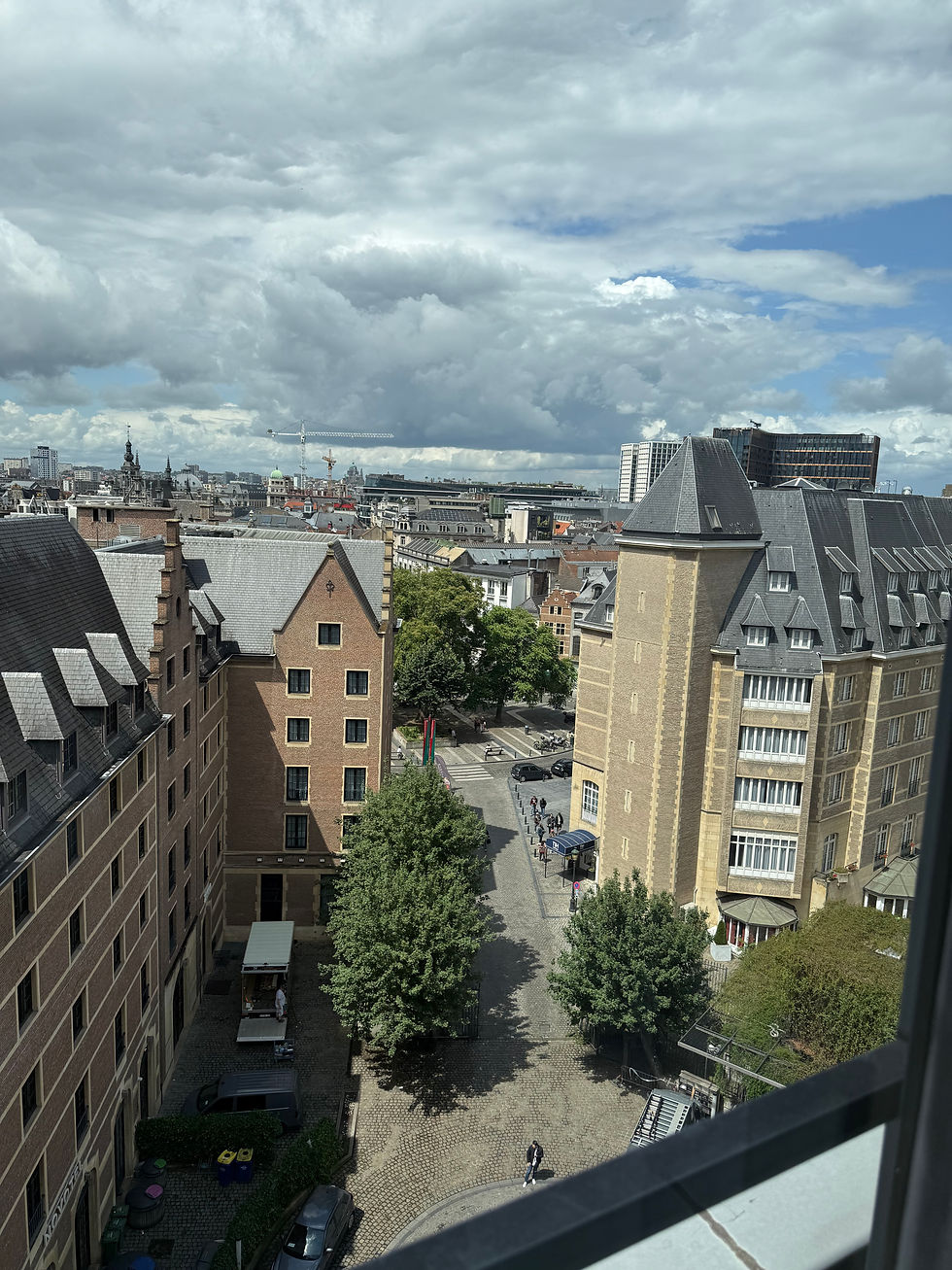
Before any of this becomes a question of European law, it’s a question of dirt and weather, and Belgium’s are easy to underrate.
This is a temperate maritime country: mild, wet, low-lying, threaded with rivers, opening onto the North Sea. The rain is reliable (seriously it rained Every day!) and the growing season is long enough, and the flat, fertile lowlands do the unglamorous work. Potatoes for the frites. Sugar beet, which Belgium turns into both sugar and, less charmingly, the industrial alcohol that will matter later in this story. Chicory, the Flemish grow the blanched white endive heads in the dark and are quietly proud of them. Wheat and barley and hops behind the bread and the beer. Dairy and beef on the pasture. Apples in the orchards. Fish and mussels off the North Sea coast. None of Belgium’s iconic food is random. Each piece of it is what you get when this particular land meets centuries of preservation, fermentation, trade, and skill.
The land also isn’t uniform, and the country knows it. Flanders, in the north, is denser, more urban, more export-driven, horticulture, vegetables, livestock, ports, and a serious agrifood logistics machine. Wallonia, in the south, is more rural and spacious, more about pasture, dairy, crops, and forest.3 That split is not just language. It’s land use, economics, and political culture, and it shows up directly in how farm policy lands.
I noticed the terroir before I had the policy words for it, at breakfast, of all places. My hotel served an apple cider I was not expecting to love, almost clear, pale yellow, light, clean, not sweet. I went back for more and started wondering why Belgian apples produce something this good and why nobody outside the country seems to know Belgian cider is a thing at all. It turned out to be the whole article in a glass.

The Source & Standard line for this section is simple. Terroir makes the source. The source, on its own, is mute. Something has to make it legible before a market can reward it. Belgium can grow an extraordinary apple and still leave its cider invisible, because excellence and recognition are two different problems.
What thrives: beer first, and then everything beer made room for
If you want to understand Belgian food identity, start with beer, because beer is the product that already solved the legibility problem.
I did a Brussels beer tour on my first full day, led by a guide who was funny and a little merciless, he pointed out genuine mistakes in the ornamentation of the gorgeous City Hall, which I enjoyed more than I should have.

He explained the part of Belgian beer history that reframes everything: monasteries brewed because the water often wasn’t safe to drink, and brewing became a way to make calories and hydration trustworthy.4 (Readers of the water pieces will understand. Singapore engineered safe water. Belgium, centuries ago, fermented around the lack of it.) I tasted my way across styles I’d never have ordered on my own. One was eleven percent... isn’t that a percentage for wine not beer (or a really crazy IPA?)? The guide told me, with the confidence of a man who has said it many times, that Belgians have little patience for IPAs because they consider them easy to make. I am not refereeing that.

Here is why beer matters to the argument. In 2016, UNESCO added Belgian beer culture to its list of intangible cultural heritage, roughly 1,500 beers, made by methods passed down in families and abbeys, woven into daily and festive life.5 Belgian beer is recognized. It has glassware, pairing customs, regional styles, and a name the whole world can read. Chocolate has that too. The praline, Belgian lore holds, was invented in a Brussels shop in 1912, and Belgian chocolate became a kind of luxury industrial craft.6 Frites, fried twice and traditionally in beef fat, are claimed by Belgium as heritage rather than snack.7

So Belgium has products that thrive biologically and products that thrive in the market, and they are not the same list. Beer is legible. Chocolate is legible. Cider, I’d argue, is not yet. And one Brussels sheep raiser I met is sitting on a product that thrives in every way except the one that pays him. Each of those gaps is a standards problem wearing a different costume.
That is what Terra Madre laid out in front of me, one workshop at a time.
Why Brussels, of all places
Before the workshops, I need to explain why this particular small city is where food trust goes to become law, because the answer is stranger and more accidental than I’d assumed.
Brussels was never designed to run a continent. It became the de facto capital of Europe without anyone ever declaring it one, and the reasons map almost too neatly onto what this article is about.
Start with the country. Belgium is itself a compromise. It sits physically and culturally between France, Germany, and the Netherlands, and it spent centuries as a buffer between larger powers, small enough not to threaten anyone, which is exactly the quality that makes a referee. It is also a negotiated state in its own internal wiring: a federal arrangement of three Regions (Flanders, Wallonia, and Brussels-Capital) and three language Communities, all holding real and overlapping powers, the Regions controlling things like the economy, agriculture, water, and the environment.8 Governing Belgium is a permanent act of accommodation. The monarchy mostly exists to hold the whole arrangement together. A country that runs on negotiated rules across internal borders turned out to be the natural host for an institution that runs on negotiated rules across national ones.
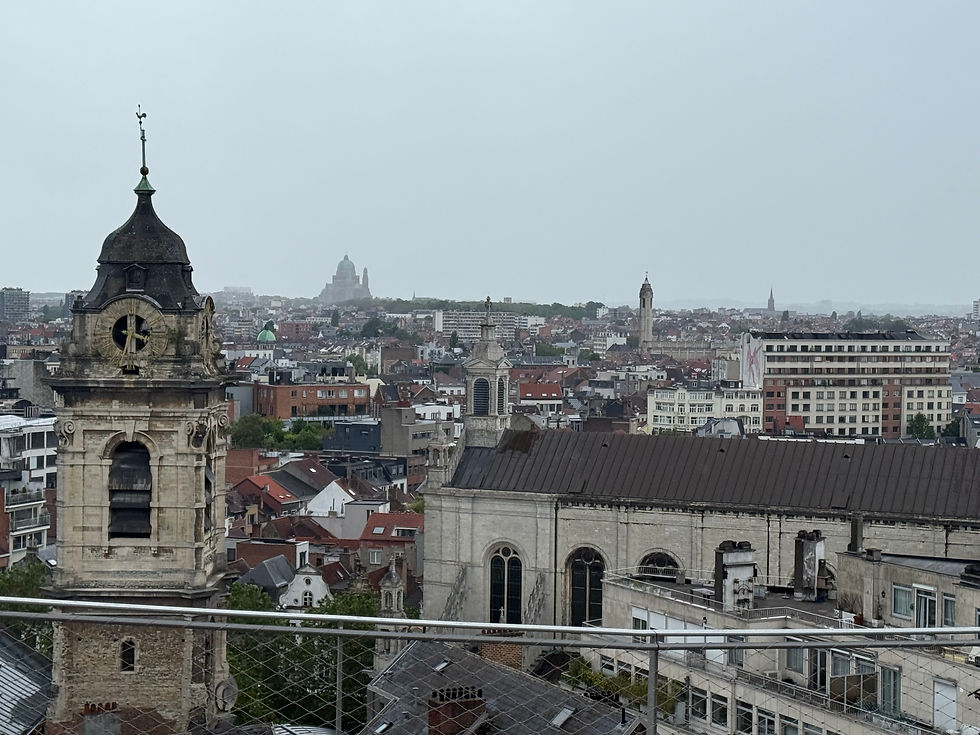
The rest was geography and inertia. Brussels was already multilingual and diplomatically wired, sitting at the rail center of dense western Europe, and after the World Wars a “neutral-ish” hub was exactly what the early institutions needed. The first European bodies were scattered across Luxembourg, Strasbourg, and Brussels; NATO settled nearby; diplomats and lobbyists clustered; and over time Brussels accumulated the Commission, much of the Parliament’s work, and the European Council, becoming the capital of Europe the way a path becomes a road, by everyone walking the same way long enough.9

So this is the city where a fragmented continent tries to write rules it can share. That’s the same shape as a good food label: a way of making something trustworthy legible across a border, to people who will never meet the person on the other side.
The EU is not a country, but it has food machinery
Most Americans, myself once included, picture the EU as a vague blob. It runs on a triangle: the European Commission proposes most legislation and runs the budget, the directly elected Parliament amends and approves, and the Council of the EU represents the member-state governments. Most major laws need Parliament and Council to agree on a Commission proposal, which makes Parliament a real co-legislator on exactly the things this article cares about: the internal market, consumer protection, food safety, and agriculture.10

I spent the morning at the European Parliament, and the first thing that hit me was the languages. Everything was available in all twenty-four official EU languages.11 I stood there thinking that Brussels is, before anything else, a translation machine. It translates languages. It also translates twenty-seven countries’ worth of farmers, consumers, markets, and legal standards into rules a continent can share.
For food, that integration does something the United States struggles to do. It puts agriculture, public health, the environment, rural development, trade, and consumer protection inside one legal architecture instead of scattering them across agencies that barely speak. The clearest example is the Common Agricultural Policy, the CAP, which began in 1962 and still anchors EU spending. Its stated purposes run from food security and farmer income to rural vitality, the environment, and climate.12 The reason it exists is not nostalgia. It’s memory. Postwar Europe had lived through rationing, occupation, and broken supply chains, and it concluded that food supply is national-security infrastructure. That is a genuinely different starting point from the more market-driven American one. It’s also why farmers protest in Brussels and not in some abstract elsewhere, because Brussels decides whether farms survive.

And here Belgium’s federal split stops being trivia. The CAP is an EU policy with EU money and EU objectives, but it is implemented through member-state strategic plans, and Belgium files two of them, one for Flanders and one for Wallonia, each tuned to its own land, farms, and politics.13 That is the whole story of European food policy in miniature: common goals, regional landing. It is also why I keep telling people that “national agriculture policy” is often a fiction. The policy is set high and lands low, filtered through local ground every time. New England, my home region, where federal USDA rules, six state agriculture departments, and a patchwork of local farms all interact, should find that familiar.
There’s a name for the way these rules ripple outward: the Brussels effect. When the EU regulates a market this large, global companies often adapt worldwide rather than build a separate EU-only version, and in food that shows up in traceability, animal welfare, pesticide limits, organic rules, and protected names.14

The legal life of a food label
I can’t help it. I see everything through the legal lens first, which is why my understanding of geographical indications had to start in Brussels, the city where food trust gets written down.
I’m a procurement lawyer by day with a background in intellectual property, so the chocolate workshop did not make me cynical about labels. It made me more demanding of them.
A serious food label is not decoration. It’s a compressed legal promise. The visible mark is the surface. Underneath sits a standard, a method of verification, documentation, and somebody whose job is enforcement. Europe has spent decades building the underneath. Its protected designations (PDO, Protected Designation of Origin, and PGI, Protected Geographical Indication) tie a food or drink name to a place, a method, and a reputation. Champagne. Roquefort. Parmigiano Reggiano. Prosciutto di Parma. The EU does not treat those as brands. It treats them as cultural heritage, rural economy, and a trust mechanism with the force of law behind it.15 In a real sense, Europe institutionalized “who’s your farmer?” decades ago, through law.
The American tool that comes closest is the certification mark, and this is where my day job and my food work collide. Under U.S. trademark law, a certification mark is a mark used not by its owner but by third parties, to show their goods or services meet standards the owner sets. The owner writes the standards, polices them, and crucially is not allowed to put the mark on its own products, that’s the objectivity rule. The owner also can’t discriminate; anyone who meets the standard gets to use the mark. The statute even contemplates marks that certify regional origin, which is how Darjeeling tea and Roquefort cheese are protected in the United States.16
This is the intellectual hinge of the whole trip. We usually talk about intellectual property as ownership, branding, exclusivity, keeping other people out. But a certification mark is the opposite shape.
It’s IP as verification.
The consumer cannot personally audit a cocoa supply chain, inspect a lamb farmer’s invoices, or confirm a restaurant’s sourcing. A well-built mark carries that trust function on their behalf. That is the idea I kept testing against everything I tasted in Belgium, and it kept holding.
Terra Madre clicks
The conference itself threw me at first. I walked in and genuinely wondered if I was in the wrong building. I had never been to a gathering that wasn’t in a hotel ballroom, and Terra Madre felt more like a warehouse, vendors, a cider bar, chocolate for sale, an advocacy-meeting energy that was practical rather than polished. I bought a few bars to bake with and tried to figure out where I belonged.
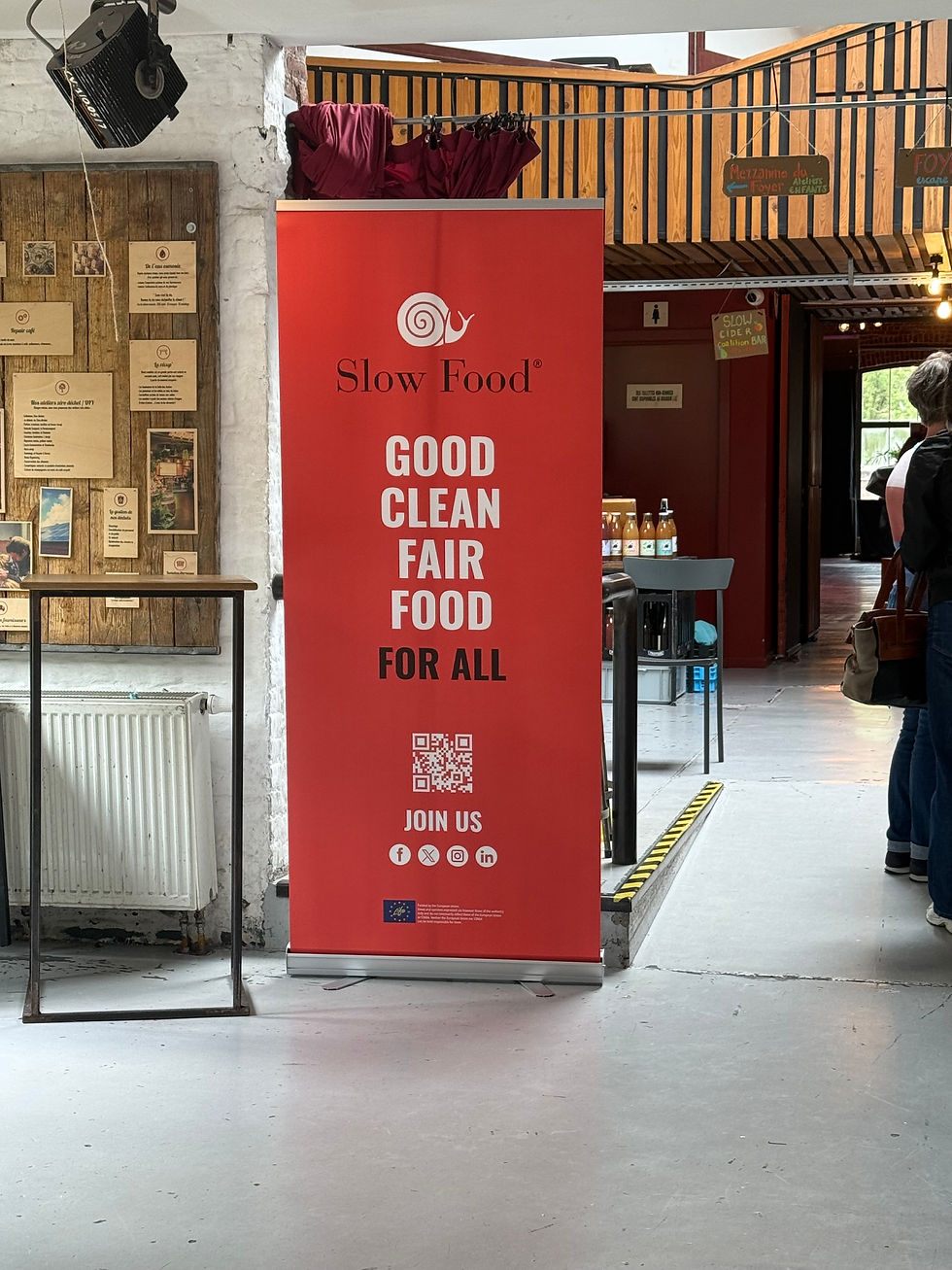
It clicked when I sat down with Giampiero and Alessia. The workshops used small tables for three, so I asked to join them, and within minutes we were trading reasons for being there. I explained my research and my farmer project. They told me about Slow Food, how it began in Italy and how seriously Italy takes it. Alessia turned out to be a biodiversity-conservation intern in Brussels with a master’s in environmental policy from Wageningen, a university I am frankly obsessed with for food-systems research, so I had to play it cool and mostly failed. Giampiero, her father, is a computer engineer and a fisherman who fishes the old way, by hand, essentially spearfishing. He’ll tell you the modern methods catch more, and that’s exactly his objection, they take everything, including the strong fish that should survive and carry the species forward. His method takes the weak and leaves the rest. He is not certified by anyone. He just fishes to a standard he inherited. That stuck with me, because it’s the clearest possible reminder that a standard can exist long before a law writes it down. Sometimes the law’s whole job is to catch up to people who were already doing the right thing.
This was the feeling I had not expected to have at a conference: these people spoke my language. Farmers first. Regionality. Distrust of empty labels. Food as culture and policy and livelihood at the same time. I had thought I was traveling to learn a movement. I was actually traveling to find out the movement already existed and had a seat saved.

Belgian cider and the problem of recognition
The first workshop was Belgian cider, hosted by a producer named Joran from a project called the Cidrothèque, and it confirmed my breakfast hunch. Belgian cider tastes more like wine than like the sweet stuff Americans usually mean by the word, pale, light, elegant, dry.
It’s good. It’s genuinely good.
And almost nobody knows it exists.
The core problem Joran laid out wasn’t quality. It was legibility. Belgian cider is trying to build a recognizable identity in a country whose drinks identity is already spoken for by beer, with chocolate close behind. There’s no strong category in a consumer’s head labeled “Belgian cider” the way there is for Belgian beer. Without that category, without a name, an origin story, a protected designation, a producers’ association, something that makes the product readable, a person standing in a shop has no way to reach for it on purpose.
This is the part people miss about recognition. It sounds like marketing fluff. It is actually market infrastructure. A geographic designation, or even just a coherent category identity, is the difference between a product you can choose and a product you can only stumble onto. The cider is the source. The recognition is the standard made legible. Belgium has the first and is still building the second, and you can taste exactly how much is being left on the table.

Chocolate, and the limits of a weak label
The second workshop brought me back to the chocolate, the bars from Mike & Becky and Booma Flora.17

The chocolate was, again, excellent, and the wrappers did it right: source country named, and where there was one, the plantation or cooperative. The lesson was sharp. A “fair trade” mark, on its own, may not carry the weight a shopper hangs on it. What you want is exactly what these makers printed, so the claim can be traced rather than trusted on faith. Cocoa grows in a narrow band roughly twenty degrees north and south of the equator, and the bulk of the world’s beans come from a small number of West African countries, which is precisely why traceability matters so much and is so hard.18

And I can’t write a chocolate lede in Brussels and step around where Belgian chocolate came from. The industry’s modern rise, in the late nineteenth and early twentieth centuries, coincided with Belgium’s colonial enterprise in the Congo under Leopold II, a regime remembered for atrocities tied mostly to rubber and ivory, with a death toll counted in the millions. Belgium never grew cocoa; its beans came, and still come, largely from West Africa, Central and South America. But raw cocoa flowed into Antwerp through that colonial system, and the chocolate became a point of national pride while its origins stayed mostly unspoken.19 The praline I was happily buying to bake with sits on top of that history. The Source & Standard frame doesn’t let me pretend the source is only soil and sun. Source is also trade, empire, and labor, and sometimes the most beautiful product in the case is the one with the longest shadow behind it.
One more thing from the workshop, because it’s the story I couldn’t shake: a chocolatier famous for anti-child-labor advocacy that was later found to have child labor in its own supply chain. The company was Tony’s Chocolonely. I finally found the name in my notes. It was founded by a Dutch journalist as a protest against child labor in cocoa, and its own monitoring (and it monitors, which most of the industry does not) reported 1,701 cases of child labor in its supply chain in a single year; in 2021 the brand was dropped from an American “slave-free” list over its partnership with the processing giant Barry Callebaut.20 The fair reading is the uncomfortable one: the company that looks hardest finds the most, and the companies that find nothing mostly aren’t looking. That’s not a scandal about one chocolatier. It’s a fact about labels. What I can anchor is the underlying reality the story was reaching for. A 2020 study by NORC at the University of Chicago, commissioned by the U.S. Department of Labor, estimated about 1.56 million children working in cocoa production in Côte d’Ivoire and Ghana, the overwhelming majority of them in hazardous conditions, and those two countries supply most of the world’s cocoa.21 That is the gap between a comforting word on a wrapper and what’s actually happening upstream.
The fix for a weak label is a better one, not a shrug.
The sheep raiser and the cost of an unlabeled standard
The third workshop was about Slow Food products at risk of extinction, and it produced the story I’ve thought about most since I got home.
A sheep raiser (I’d put him in his thirties or forties, and I’m sorry to say I didn’t get his name) raises sheep in and around Brussels. He cares, visibly and a little fiercely, about the animals’ lives and about keeping a tradition alive. His sheep are reportedly some of the best around, and he brought cured lamb for us to taste. Some of it had been cured together with pork, which made Alessia laugh (an Italian, she said, would never cure two different meats together) and then she ate it and admitted it was good. That’s the whole spirit of the weekend in one bite, honestly: a rule broken, and an honest verdict.
Then he explained the economics. New Zealand lamb can reach Belgian restaurants for roughly what it costs him just to slaughter his own sheep.22 Not raise. Not feed. Not care for across a whole life. Slaughter. He’s looking at something like a sheep time-share to survive it, a model where a family commits in advance to a share of an animal, so he isn’t left chasing individual retail buyers one chop at a time.
There’s a policy irony here that’s worth naming. In 2024 Belgium wrote animal welfare into its Constitution, obliging the federal state, the Communities, and the Regions to protect animals as sentient beings.23 On paper, this farmer’s values are now a constitutional commitment. In the market, his welfare standard earns him nothing, because a cheaper import undercuts him before the diner ever learns it had a choice. A country can hold animal welfare as a founding value and still let the farmer who actually practices it go under. Constitutional text and market signal are not the same instrument, and the gap between them is exactly where my work lives.
Because this is the sharpest version of the article’s whole argument. This farmer already meets a standard. Animal welfare. Local production. Cultural preservation. Quality you can taste. What he does not have is a label, anything that turns that standard into recognition at the moment a diner is choosing a restaurant or a dish. His welfare practice is real and completely invisible to the person eating dinner two miles away. Slow Food has a phrase for the deeper fix, “reterritorialise the food supply,” which means rebuilding the local infrastructure (slaughter access, the link between farmer and cook and eater) that global commodity chains hollowed out.24 But even with that infrastructure, there’s a last-mile trust problem. If a diner can’t tell which restaurants are buying his lamb, his standard earns him nothing.
He actually said it himself, more or less: how would people even know which restaurants had his sheep on the menu? I have been chewing on that question for months, because it is, almost word for word, the question my own work is trying to answer.
When culture needs a market signal
The other product that stuck was a set of traditional French cheeses, and Alessia translated the discussion from French for me and her father. The names matter less than the pattern. These cheeses are so unique, so expensive, and so labor-intensive that the traditions are dying, not because the cheese isn’t good, but because the math no longer works for the people making it.
That’s the part that should bother anyone who romanticizes “tradition.” Tradition does not preserve itself. A food culture survives when two things are true at once: the producer can make a living, and the consumer can identify what’s worth choosing. Protected names and certification systems are not sentimental add-ons to that survival. They can be the survival, because they’re the mechanism that lets a market reward the harder, slower, better thing instead of defaulting to the cheap import every time.

That night I was supposed to go to the conference’s informal disco social. Three workshops and jet lag had other plans.

I went instead to the arcades near the Grand Place, followed a bartender’s tip to a place called Taverne du Passage, and had Chicken in a Sambre & Meuse Sauce that I am still thinking about.
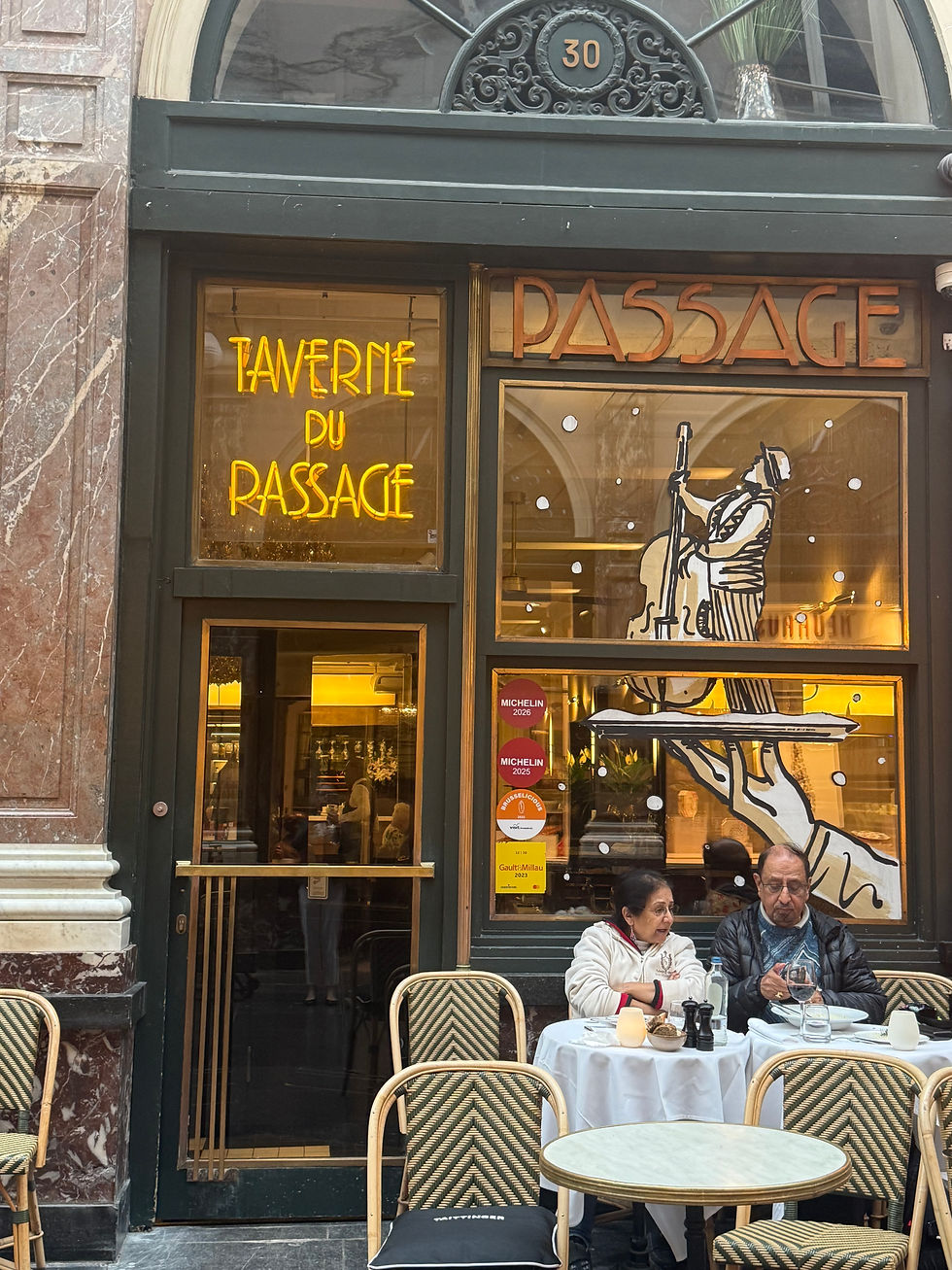
Then I went to bed.
I skipped the disco for tarragon sauce and sleep, and I regret nothing.

Ghent: rivers, guilds, and the old infrastructure of provenance
By Monday I’d identified regionality as the spine of the trip, so I took the train to Ghent to see Flanders and the medieval guild city up close. I hired a private guide, Jana, who’s from Czechia, has lived in Ghent for fifteen years, and clearly loves it.

We started at the Belfry, and Jana immediately did the thing I’d hoped a good guide would do, she read the city as a system, not a postcard. She pointed out the two rivers, the Leie and the Scheldt, that meet at Ghent and once carried trade up from France and over from the Netherlands.

That confluence is the whole reason Ghent exists as a market city. Before railroads and refrigeration, river access was the supply chain: grain, wool, fish, fuel, and people moved on water or didn’t move at all. The beautiful waterfront is not decoration. The Graslei and Korenlei are named for grain and river commerce. They’re a logistics platform that happens to be gorgeous.25
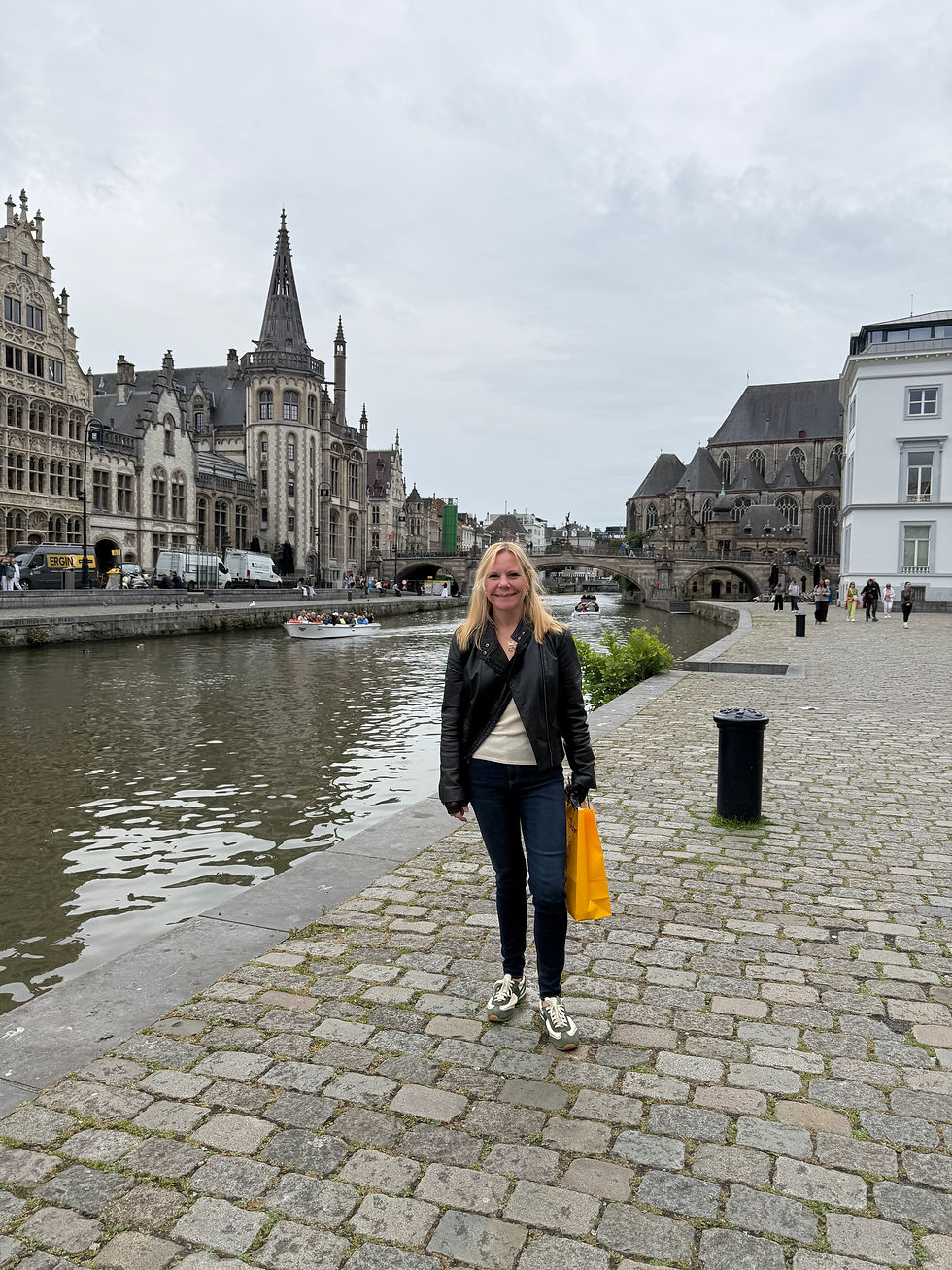
By the thirteenth century Ghent was one of the great cities of northern Europe, rich on luxury cloth woven from imported English wool, and that wealth bought it something unusual, near-autonomy from the counts of Flanders and later the Burgundian dukes.26 The guild houses, the Cloth Hall, the churches, and especially the Belfry are claims of authority in stone. A cathedral says God and bishop. A castle says count and force. A belfry says city, charter, bell, market, and law.

Ghent got rich enough to argue with princes, and it did. Charles V, Holy Roman Emperor, was born there in 1500, and decades later he punished the city brutally for resisting his taxation, stripping its privileges.27 That arc (local labor creates wealth, central power moves to tax and control it) is the medieval version of a fight food systems are still having.

Jana also brought me to Mokabon, Ghent’s first coffee roaster, pouring on the Donkersteeg since 1937, and I bought coffee to bring home.28 We passed Saint Bavo’s Cathedral, home of the 1432 Ghent Altarpiece, a religious masterpiece paid for by urban commercial wealth (unfortunately it was not open for viewing that day).29
There’s a lesson in Ghent for the IP argument that predates IP entirely. Before there were protected designations, provenance was built through guilds, reputation, place, and controlled production. The geographic indication is just the modern legal form of a very old truth: where a thing is made, and how, is part of what it is. Ghent also reminds you that excellence isn’t enough. The city had skill, wealth, and institutions, and still declined when English cloth out-competed it and trade routes shifted.30 Local greatness loses to structural change unless something protects it. That sentence applies to Flemish cloth in 1550 and to a Brussels sheep raiser in 2025.

Ghent as a modern food-policy laboratory
Ghent is not a museum, which is the other reason it belongs in this piece. It’s one of Europe’s more interesting urban food-policy cities right now.
Jana and I talked about its strong vegetarian and vegan culture, and I’ll correct my own first instinct here: I remembered it as “meatless Mondays,” but Ghent’s program is Thursday Veggie Day, Donderdag Veggiedag, launched in 2009 and often described as the first time a city officially introduced a weekly vegetarian day.31 The city also runs a broader food strategy, Gent en Garde, started in 2013 and built with a Food Council, aimed at shorter and more visible food chains, more sustainable production and consumption, social value, and cutting and reusing food waste.32 That’s not lifestyle branding. It’s municipal food governance, procurement, waste, access, and climate treated as city business. The same city that once got rich moving grain and wool now runs experiments in how a place can feed itself better.

We also, at some point, got onto multilingual Flanders, and Jana laughed that almost everyone there speaks several languages, except, she said, some French speakers who refuse to learn anything but French. I laughed too, mostly at myself, because I am the classic American with one language and the nerve to travel anyway. It connected back to the Parliament’s twenty-four languages and to Alessia translating French for me and her father over cheese. Brussels translates for a continent. I needed translating for a cheese.
“Rum-like”: the complication I don’t want to smooth over
Then Jana told me a story that complicated my whole position, and I want to keep it sharp rather than resolve it too neatly.
Back home in Czechia, she said, people had always called a certain drink rum. Then, under EU rules, they were no longer allowed to call it rum, because it isn’t rum in the formal legal sense. They were told to call it “rum-like.” She did not love this. She is, fairly, skeptical of the kind of name-protection I tend to champion.
The drink is tuzemák, historically tuzemský rum, “domestic rum,” made in the old Austro-Hungarian lands from beet or potato spirit and rum essence, because the empire had no tropical colonies of its own. Under EU spirit-drink rules, only sugarcane-based spirits may be called rum, so around the time of the Czech Republic’s EU accession the name had to change.33 To a regulator, that’s consumer protection working exactly as designed. To a lot of Czechs, the EU took a familiar word out of their mouths.
I explained to Jana my side, and I believe it. Standards protect trust.
The example I reached for was the 1986 Italian methanol scandal, when wine adulterated with methanol to boost its alcohol content killed roughly two dozen people and shattered consumer confidence across Europe, and pushed Italy toward exactly the certification-of-origin systems that rebuilt that trust.34 When a standard guarantees that a product from a place is made a certain way with certain ingredients, it can be the thing standing between a shopper and a poisoning. That’s not abstract.
There’s a second thing 1986 set in motion, and it runs straight through this series. That same year, in Bra, a small town in Piedmont an hour from Turin, Carlo Petrini and a group of friends founded Arcigola, the association that became Slow Food. The methanol scandal is stitched into the movement’s origin story: Italian wine’s credibility had collapsed, and the founders’ answer was not more chemistry but more identity, food and wine you could trace to a place, a grower, and a way of making. Three years later the movement went international with a manifesto signed in Paris, and today its network fills warehouses like the one in Brussels where this article began.35
But Jana’s “rum-like” isn’t wrong either, and the honest version of my argument has to hold both. A protected name can preserve trust and feel like a legal system confiscating ordinary language. Food IP works best when the legal standard actually tracks consumer trust, producer reality, and cultural legitimacy, and worst when it’s a definition handed down to people who feel no part in it. If I’m going to push for marks and standards, I have to push for ones the governed actually recognize as fair. Jana made my argument better by refusing to agree with it.

That night, back in Brussels, I got caught in pouring rain doing chocolate-shop gift shopping, gave up wet and tired, and washed up in a tiny Italian place for aglio olio pepperoncini that was perfect precisely because it was simple. Some nights the standard is just garlic, oil, and a cook who cares.

Brussels as the machinery behind the mark
Tuesday was the policy day, and it pulled the whole trip together.

I started at the House of European History, which situates the modern European project in a much longer story, and then went to Terra Madre’s main policy event on agroecology, voices from across the Slow Food network.

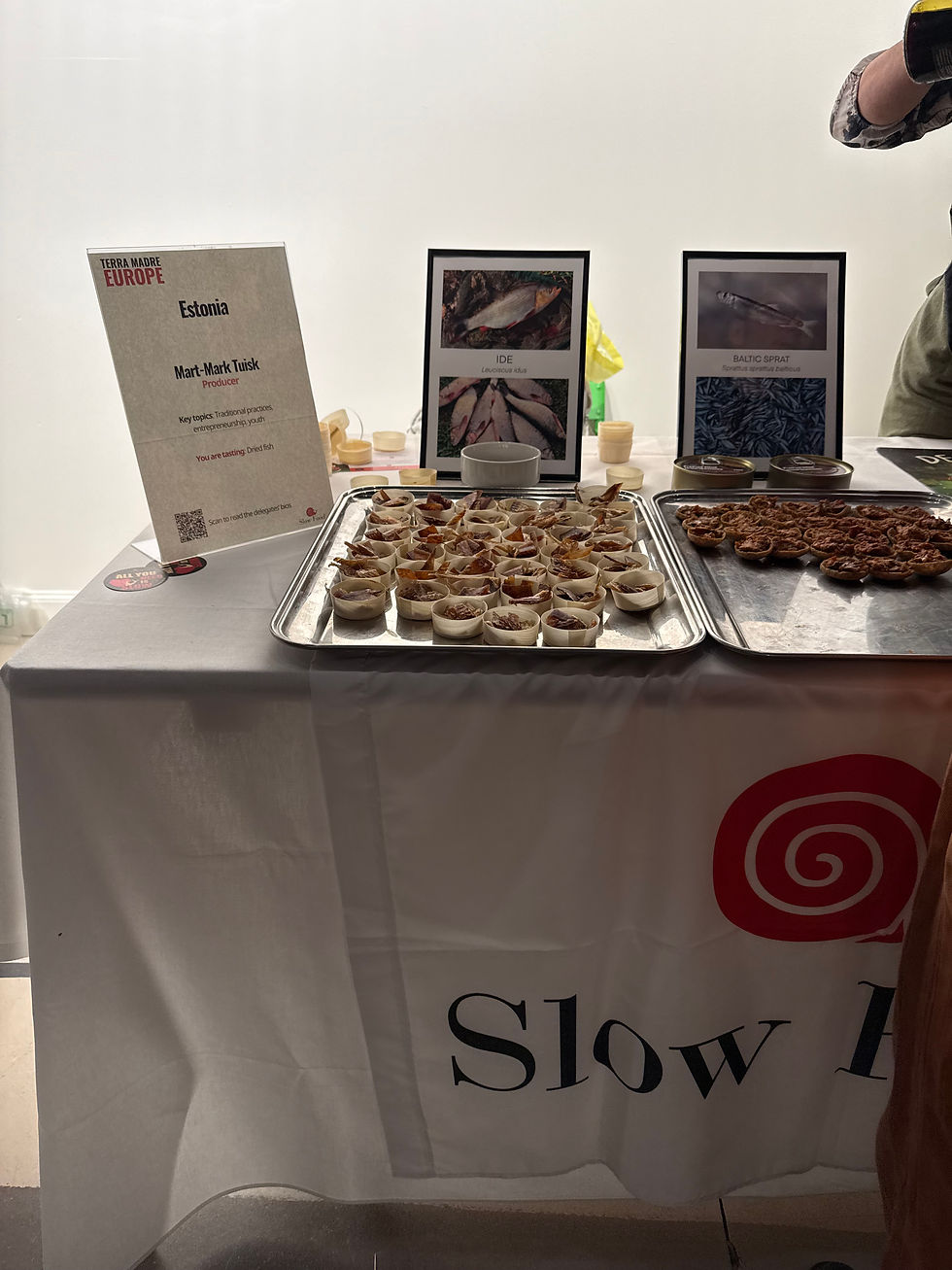
The first thing that struck me was how many countries had shown up, each with products on the table. The room felt international in a way that matched my work rather than performing internationalism at it.
Then the access moment, the kind you can’t plan. I found myself standing next to the EU’s agriculture and food chief. Christophe Hansen, the Commissioner for Agriculture and Food, who took office in late 2024 and within his first hundred days produced a new Vision for Agriculture and Food, presented in February 2025.36 I reached out to him afterward, and the follow-up eventually led to a video call with three experts on the EU’s geographical-indication system.
This is the part of Brussels that the chocolate, the cider, and the lamb were all pointing toward. Behind every label is an architecture: the law that defines it, the inspection that backs it, the producer standards, the public procurement that can reward it, and the market expectations that give it weight. Europe is not a food-policy paradise, I’ll get to its problems, but it understands one thing the U.S. often misses.
A label can be part of an integrated system instead of a lonely marketing claim.
The Farm to Fork strategy, part of the European Green Deal, tried to wire production, processing, distribution, consumption, and waste into one plan.37 Whether it fully worked is a fair fight. That it treated the food label as connected to everything behind it is the part worth importing.
What the EU experts told me
The call ran longer than scheduled, and four things from it rearranged this article.
The premium is real, and it is uneven. The Commission’s economic study puts the sales value of products sold under geographical indications at roughly €75 billion a year, about 7 percent of the EU’s food and drink sector, at around twice the price of comparable products without the designation.38 But wine carries most of that value, and most GIs never break out. Origin can become durable money. It usually doesn’t.
Where it does, the experts were clear about why, and it isn’t the label. It’s the producer group organized behind the name, and the national architecture each member state builds around it. That governance decides whether the premium reaches the farmer or gets captured somewhere on the way down the chain. A mark without an organized group behind it is a sticker.
One of the experts made the point that surprised me most, though it shouldn’t have. The value of the whole system is built on diversity, of territory and of production practice. Difference is the asset the law exists to protect, not a variance to be standardized away. At one point it was plainly put: “diversity is strength.”
You don’t hear that sentence much in the United States right now. A few months ago I took a tour of the UN headquarters in New York, listening to the initiatives and the stubborn, decent ideas that have come out of that building, and carrying with me the fact that in March, for the first time in the Commission on the Status of Women’s seventy years, the annual conclusions on gender equality had to be put to a vote, because one country forced one. It passed 37 to 1. The one was us.39
Diversity is strength in the garden, in nature, and in life.
Europe built a food-law system on believing that.
And then the candid part, which I respected them for. Even here, in the most developed origin system on earth, the demand side is underachieved. Awareness of the GI logos is low, even among locals, the Commission’s published evaluation of the policy found as much40, and the levers they named were the ones I would have named: chefs and culinary schools, the people who make sourcing visible on a plate, with Ireland’s whiskey revival offered as proof of what recognition can rebuild. The throughline, in one expert’s words, was that what matters in the end is the consumer having the correct information. I flew home with my own working thesis in my notebook, except an EU expert had said it first.
Two more things went into my notebook before we hung up. Criteria have to be objective, or people farm the criteria instead of the goal they were meant to serve, which is exactly why the mark I describe below certifies a verifiable fact, documented sourcing, and not a vibe. And protected names get misappropriated by people not entitled to them, persistently, everywhere. A mark is only as strong as its enforcement.
Where a label gets its teeth
Between the expert call and this draft, I went down the rabbit hole I’d been circling all trip: where does a mark’s strength actually come from? The answer runs about a hundred and seventy years deep, and the detour is worth taking, because everything a food label promises sits on top of it.
People have marked goods for as long as goods have traveled, potters in Rome, guilds in medieval Europe, makers stamping origin and quality onto things bound for strangers.41 But marking is old; the legal system under it is young. France wrote the first comprehensive trademark statute in 1857. The United States registered its first federal trademark in 1870, to a paint company. And on the first day of January 1876, Bass’s red triangle became UK Trade Mark No. 1, it turned 150 this past winter, still on the bottle.41
The international layer came fast after that: the Paris Convention in 1883, which made a foreign filer equal to a local one; the Madrid system in 1891, which let one application reach many countries; TRIPS in 1994, which made trademark and GI protection a condition of belonging to the world trading system.42 Here’s what the IP lawyer in me notices in that stack: none of it creates a world trademark. There is no such thing. Rights are territorial (country by country, court by court) and WIPO, which administers the filing systems, polices nothing. A mark is only ever as strong as the national law under it and the owner willing to enforce it.
Then comes the fork in the road, and it explains this whole trip. The United States protects geographical origin mainly through the trademark system, certification marks, a Lanham Act route the USPTO has used for origin names since at least 1946.43 Europe went the other way: a sui generis GI regime, public and collective, where a protected name isn’t a private brand at all, so much so that EU law won’t even let a certification mark certify geographic origin; that job belongs to the GI system.43 And the GI system has the sharpest teeth in food law. The 2024 regulation protects registered names not just against copying but against evocation, “style,” “type,” “method,” “as produced in,” the entire vocabulary Jana’s tuzemák ran into.44 The chocolate workshop taught me to trust a name over a stamp. This is the machinery that decides whether a stamp can ever earn the same trust.
This is why the IP matters, and why I can’t stop seeing food through it. A certification mark is the only instrument I know that turns a value into a property right, something with an owner, a registry, a standard on file, and a courtroom behind it. A pledge can be quietly abandoned, and a marketing claim quietly redefined. Once registered, a mark that certifies a documented fact can be enforced against anyone who fakes it, and canceled if its own certifier goes soft. The label stops being a vibe and becomes a legal object.
What happened to Fair Trade
The “fair trade” stamp, the one the workshop taught me to look past, deserves its own chapter, because Fair Trade is the older sibling of every ethically motivated certification mark: built by people who meant it and tested hardest by its own structure. Its history is the one I most need to learn from.
It started in church basements, Mennonite volunteers selling handcrafts through their communities from 1946 on, and for four decades “fair trade” meant dedicated solidarity shops moving small volumes.45 The breakthrough came in 1988, and it was a legal-structural idea, not a moral one: Max Havelaar, launched in the Netherlands by a priest working with Mexican coffee farmers and an NGO director, certified the supply chain instead of the store. Any brand meeting the standard could carry the mark, which meant certified coffee could sit on an ordinary supermarket shelf. National labels multiplied, federated in 1997, and unified under the blue-and-green Fairtrade mark in 2002.45
The model underneath was real: smallholder co-ops, a guaranteed minimum price with a premium on top that the co-op votes on spending, standards on child labor and environment, audits by an independent certifier. For cocoa, the floor currently sits at $2,400 a metric tonne plus a $240 premium.45 If you designed an ethical mark from scratch, you might design this.
Then it eroded, and the erosion was structural, not scandalous, which is what makes it useful. In 2011 the American arm split off to certify plantations as well as smallholder co-ops, leaving two similar-looking labels with different standards in the same market, and certifiers who compete for clients tend to compete on leniency.46 For cocoa, sugar, and tea, the system permits “mass balance” sourcing: a company buys certified beans somewhere in its supply chain, but the beans in the labeled bar may not be those beans.

The label certifies an accounting entry, not the chocolate in your hand. Most consumers have no idea.46 Some marks require only one certified ingredient at around a twenty percent threshold, with the fine print carrying the weight. And when the standard chafed, big brands simply left (Cadbury for its own in-house program in 2016, KitKat for a different certifier in 2020) which is self-certification, the exact conflict of interest third-party marks were invented to solve.47
The deeper wound is legislative, and as a procurement lawyer this is the part I’d teach. In 2001 the U.S. House voted 291 to 115 to fund a “slave free” label for chocolate, a mandatory label, with law behind it. The chocolate industry hired two former Senate majority leaders to lobby, the measure never reached a Senate vote, and in its place industry signed the voluntary Harkin-Engel Protocol, promising to certify cocoa free of the worst forms of child labor by 2005. The deadline slipped to 2008, then 2010, then into the vague middle distance.48 Two decades later, the numbers from the chocolate workshop are the result.21 In 2019 the Washington Post found child labor on certified farms.49 Studies put certification’s income effect at maybe ten to sixteen percent (better, and still under the poverty line) while co-ops pay steep fees to hold the certificate.49
And when the children themselves reached for the courts, the courts weren’t there. Six Malians, trafficked as boys of twelve to fourteen onto Ivorian cocoa farms that supplied Nestlé and Cargill, sued under a 1789 statute that lets foreign nationals bring claims in U.S. courts for violations of international law. Sixteen years of litigation ended in 2021, when the Supreme Court ruled eight to one that the alleged conduct (the training, the equipment, the cash to the farms) happened in Côte d’Ivoire, and that general corporate decision-making at home isn’t enough to bring it within U.S. law.50 Read the opinion closely and notice what it doesn’t say. No court ever ruled the children weren’t enslaved. The companies won on where the conduct happened, not on whether it happened. The legal system will not backstop a food label. That job belongs to the label itself.
So the lesson isn’t that Fair Trade failed. Coffee from smallholder co-ops under the international mark still means something, and the people who built the system moved real money to real farms. The lesson is where the trust leaked: the mark promised outcomes its audit model couldn’t verify, and it let the physical link between the label and the product dissolve. A certification mark can only honestly promise what its records can prove. Everything past that line is borrowed credibility, and the loan always comes due.
Why wine worked
Wine is the counterexample, and the experts’ numbers already told you: wine carries most of that €75 billion. Why did an origin label work for Burgundy when an ethics label struggled for cocoa? Not virtue. Structure.
The bottle is the wine: there is no mass-balance version of a Chablis; the certified thing and the purchased thing are physically the same thing. The territory is defined by law, and the producer group behind each name is organized and self-policing. The protection runs all the way to evocation, so nobody gets to sell “Chablis-style.” And after 1986, when methanol killed twenty-three people and cratered Italian wine exports, the industry rebuilt trust the hard way, through verifiable origin, the same year Slow Food was born up the road in Piedmont to argue for exactly that.
And wine just did something Fair Trade never could. Since December 2023, EU rules require wine to disclose its ingredients and nutrition, and they allow it by QR code, an e-label printed on the bottle that has to stay clean: no marketing, no tracking, just the facts behind the label, one scan away.51 Quietly, that changes what a label is. The stamp used to be the end of the information; now it can be the door to it. A strong certification whose standard is visible (scan the mark, see the standard, see the evidence) closes the exact gap that swallowed Fair Trade: the distance between what the consumer believes and what the farmer lives.
That’s the version of a certification mark worth building: the mark on the door, and behind a QR code not a slogan but the thing itself: the named farms, the documented relationship, the records that make the certification true. Fair Trade’s critics once carried certified chocolate bars back to the villages that grew the cocoa and measured the gap between what shoppers believed and what farmers lived.49 I want a mark you can ground-truth from the dining room, where the scan is the trip to the village.
Procurement: where a standard turns into demand
Here’s where my day job stops being a footnote.
A standard that doesn’t move anyone’s purchasing is just a statement of values.
Procurement is the lever that turns a standard into demand, and Europe takes it seriously as market governance rather than mere buying. EU procurement still runs on transparency, equal treatment, non-discrimination, proportionality, and competition, but within those rails, buyers are increasingly pushed to weigh lifecycle cost, environmental performance, and social outcomes, not just unit price.52 For food specifically, the Commission and its Joint Research Centre have developed sustainable public food procurement criteria that let a school or hospital consider nutrition, seasonality, production method, food waste, shorter supply chains, fair labor, animal welfare, and regional economic value, as long as the criteria are drafted lawfully.53
The U.S. lesson is not “buy local no matter what.” A naked geographic preference can run straight into procurement and trade law, and it deserves to. The better lesson is the one I’d write into a spec myself: reward the measurable things you actually want, freshness, traceability, seasonality, transparent sourcing, reduced packaging, fair pricing, regional resilience, and let local producers win because they meet those criteria, not because of a flag. And a certification mark helps here in a very specific way. It standardizes the proof. It gives a public buyer or a private restaurant a credible, repeatable way to identify who actually meets the sourcing standard, instead of taking each vendor’s word one at a time.
Private procurement: restaurants need a trust mark too
Which brings me to the conversation that turned a hunch into a conviction.

One of the speakers at the agroecology event was an immigrant restaurateur running a place in Finland, and she was interested in the exact question I keep circling: how do you get more people buying from farmers? She warned me, hard, against complicated tech platforms, farmers hate them, she said, and she’s right; I’ve watched good ideas die on the friction of an app nobody wants to maintain. But when I described a consumer-facing rewards-and-recognition idea, she lit up and said something I wrote down immediately: she loved hearing an idea like this coming out of the U.S.
That landed, because the sheep raiser’s problem and her question are the same problem.
Private markets (restaurants, distributors, hotels, caterers) change their behavior when provenance becomes visible, comparable, and trusted. Europe has spent decades making origin legible through protected names, organic standards, and traceability rules, and provenance there has become a real commercial asset.54 The U.S. has enormous local-food feeling and very little local-food infrastructure. We have the emotion and almost none of the plumbing.
So here is the thing I came home certain about.
Certified WYF™: the standard on the label
I’d been treating the rewards program as WYF’s first product. Brussels convinced me the first product is the standard.

Who’s Your Farmer New England should lead with a certification mark for restaurants that directly source from named New England farms and fisheries. Not another vague “local food” badge. A legally credible, consumer-readable mark, a third-party certification mark of the kind U.S. trademark law already provides for, that does for restaurant sourcing roughly what a geographic indication does for a regional product: makes the claim legible, verifiable, and worth choosing.
The design principles fall out of everything above. The mark certifies sourcing transparency, not taste, not luxury, not “farm-to-table vibes.” The standard is written and clear. The proof burden sits with the restaurant and with WYF, never with the farmer, farms don’t pay and don’t administer anything, because the moment you make a farmer maintain a platform you’ve lost. Certification runs annually, so it can’t go stale. And the diner can verify it: a QR code on the sticker opens a page naming the actual farms and fisheries the restaurant buys from, the categories sourced, and the date it was checked, with a plain disclaimer that the mark certifies sourcing and nothing else.
None of this is exotic legally. It’s the certification-mark doctrine I described earlier, applied to a problem it fits almost perfectly, the owner sets and polices the standard, can’t use the mark on its own goods, and must let in anyone who qualifies.55 And every structural choice, the thing itself, not an accounting entry; a promise no bigger than the records; one mark, no fees on farms, is a Fair Trade lesson, learned at someone else’s expense.
The IP isn’t there to build a brand. It’s there to certify a standard.
The label is the standard, made small enough to read on a door.
What the U.S. can learn from Brussels, and what it can’t
While I was finishing this piece, Norway’s World Cup team set up camp in North Carolina, and the internet decided within hours that the 580 kilos of salmon, trout, halibut, brunost, and Jarlsberg they’d shipped over meant Norwegians don’t trust American food. The team’s chef says the truth is duller (consistency for athletes on a schedule, and a taste of home) and the viral oranges were actually squeezed from fruit bought locally in the U.S.56 Nobody questioned the premise, though. A story about a wealthy country refusing American food needed no evidence to be believed, including by Americans. And the team packed brunost and Jarlsberg, foods so legible they function as passports. That’s the trust gap, measured in brown cheese.

I don’t think America should copy Europe. Our constitutional structure, farm economy, land-ownership history, and procurement law are different enough that lifting the EU’s system wholesale would fail. But the underlying logic transfers cleanly, and it’s worth naming.
Treat local food as infrastructure, not as a lifestyle preference.
Europe’s genius is that it made origin economically meaningful (protected, marketed, regulated, monetized) so regional foods became durable assets instead of nice stories. Make provenance legally credible and consumer-readable, so a sourcing claim is something a diner can verify rather than something a restaurant merely asserts. Use IP as verification rather than just branding. Let procurement, public and private, reward sourcing it can actually identify and document. And do not ask farmers to carry public goods without support, if we want humane, local, transparent, climate-aware food, we have to pay for the labor and risk inside it, which is exactly why a good mark puts the cost on restaurants and on the certifier, not on farms.
What doesn’t transfer is the rest of the European apparatus. Brussels’ power depends on EU institutions New England doesn’t have. The PDO and PGI systems rest on European legal history. The EU can act as one giant integrated market in ways a six-state region cannot. So we adapt the trust logic, not the structure. New England doesn’t need a CAP. It needs a credible mark.
Earlier pieces in this series. Ireland’s national traceability, the State of Food Sourcing’s diagnosis of a local-food culture with no spine to hold it up, were reaching for exactly this: what it looks like when provenance gets a spine.
What Europe still hasn’t solved
I don’t want to hand you an admiring travelogue, because Europe is not settled, and the unsettled parts are exactly why it’s useful to study.
The CAP, for all its power, still channels a lot of money through acreage-based and administratively heavy systems that don’t always reward the most socially valuable farming. Farm to Fork was directionally serious and ran straight into a wall of farmer protest, inflation, war-driven food-security fears, and rightward politics, which is why Hansen’s 2025 Vision pivots so hard toward keeping farmers economically viable while still moving toward sustainability.36 That tension is not a failure. It’s the actual work, and it’s a warning. Food-system change designed as a lecture from Brussels to farmers will lose. Sustainable procurement, even with strong principles, is hard to implement well; without lawful criteria, market knowledge, and real supplier support, “sustainability” curdles into boilerplate. And Europe still struggles with the demand side, meat consumption, ultra-processed food, affordability. It’s easier to regulate how food is produced than to change how people eat.

The honest lesson, then, is double. A strong mark requires a strong standard underneath it.
But the mark also has to stay usable by the people it’s meant to help, or it becomes one more burden that only the big players can carry. Jana’s “rum-like” is the small version of that warning. The CAP’s distribution fights are the large one. WYF should take both seriously and build something rigorous enough to mean something and simple enough that a real restaurant and a real farmer can actually live with it.
The label as a promise kept
I keep coming back to that first table, the chocolate, Giampiero and Alessia, the floor moving under a stamp I’d never thought to question.
By the end of the week the chain was clear. The chocolate needed traceability. The cider needed recognition. The lamb needed visibility at the moment a diner chooses. The cheeses needed a market signal strong enough to keep their makers in business. The “rum-like” drink needed a legal definition that protected consumers without erasing the word people grew up using. The EU showed how law can make all of that economically real, and also how it can overreach. And the restaurants of New England need a mark that tells a diner who is actually sourcing from farmers and fishermen, in a form she can read in two seconds and verify in one tap.
A label is not just a sticker when the standard behind it is real. It’s how the source becomes visible and the producer legible, how a consumer knows what to trust without having to investigate every plate she’s served.
I went to Brussels to learn from a movement and came home having had my own idea handed back to me, sharper. The thing I’d been calling a rewards program is really a trust layer, and the first product isn’t an app or a map. The first product is a standard, worn on a door. But international knowledge is raw material, not a finished good. The treaties and the registers don’t feed anyone until somebody translates them into regional policy: a state procurement preference, a school menu, a city market rule, a certification mark sized to its own foodshed. The EU’s real achievement isn’t that it wrote one food law for a continent. It’s that it built a system where a continent’s knowledge can land in a region and support the local, healthy food that was already there. The work now is doing that translation at home.
One question came home unanswered, and the expert call is what sharpened it.
The premium is real; whether it reaches the farmer depends on the people organized behind the name. So: who’s behind the label, and does it pay them? That’s the next trip in this series.
For once though, on this trip, everyone in the room was already speaking my language. The job is to bring the language home.
Jennifer, Source & Standard
Next in the series: Turin, where the movement that filled that Brussels warehouse turns forty, and where I go looking for the people behind the label, to ask whether the label pays them.

Endnotes
1. Account of the Terra Madre Europe chocolate workshop is drawn from my own field notes. The general point, that broad ethical labels often lack plantation- or origin-level traceability, is supported by the cocoa-sector research cited at notes 18 and 21. Workshop presenter materials still to be obtained for confirmation.
2. On Belgium as a culinary crossroads of French, Germanic, Dutch, monastic, colonial, and urban-guild influences: Peter Scholliers, Food Culture in Belgium (Greenwood Press, 2009); Visit Flanders and visit.brussels culinary-heritage materials. Treated here as general context.
3. On the Flanders/Wallonia agricultural divide (Flanders denser and more horticulture- and export-oriented, Wallonia more rural and pasture- and crop-oriented): Statbel, the Belgian statistical office, agricultural census figures, https://statbel.fgov.be; Flemish Department of Agriculture and Fisheries reporting, https://lv.vlaanderen.be; Service public de Wallonie, État de l’agriculture wallonne.
4. The historical link between monastic brewing and unsafe drinking water is part of standard Belgian beer history and was relayed by the Brussels beer-tour guide; presented here as widely held context rather than a precise claim.
5. UNESCO, Intergovernmental Committee for the Safeguarding of the Intangible Cultural Heritage, Decision 11.COM 10.B.5, “Beer culture in Belgium” (Addis Ababa, 30 November 2016), https://ich.unesco.org/en/decisions/11.COM/10.B.5. The inscription notes roughly 1,500 Belgian beers and the transmission of brewing knowledge through families and breweries.
6. Neuhaus, “Our history” (Jean Neuhaus Jr.’s creation of the filled praline at the Galerie de la Reine shop in Brussels, 1912), https://www.neuhauschocolates.com. Widely repeated Belgian chocolate history, included here as the company’s own account.
7. The Belgian claim to frites (fried twice, traditionally in beef fat, often associated with the Meuse Valley) is contested popular history; presented as a Belgian heritage claim, not an adjudicated origin.
8. On Belgium as a federal state of three Regions (Flanders, Wallonia, Brussels-Capital) and three language Communities exercising real and overlapping powers, with Regions holding authority over areas including the economy, agriculture, water, and the environment: Belgium.be, the Belgian federal government portal, “Belgium, a federal state,” https://www.belgium.be/en/about_belgium/government/federale_staat; Belgian Constitution, arts. 1 to 7 and Title III on the Communities and Regions, official coordinated text via the Belgian Official Gazette, https://www.ejustice.just.fgov.be.
9. Protocol No 6 annexed to the EU treaties, on the location of the seats of the institutions (Official Journal of the European Union); European Parliament historical materials on the seats of the institutions and the development of Brussels as the de facto capital, https://www.europarl.europa.eu. The buffer-state and accumulation-by-inertia framing is standard European political history.
10. Treaty on European Union, arts. 14 to 17 (Parliament, European Council, Council, Commission), https://eur-lex.europa.eu; European Union, “Institutions and bodies,” https://european-union.europa.eu; European Parliament, “About Parliament,” https://www.europarl.europa.eu.
11. The European Parliament’s visitor center (the Parlamentarium) and EU public materials are provided in all 24 official EU languages. European Union / European Parliament public information. See europarl.europa.eu.
12. European Commission, “The common agricultural policy at a glance,” https://agriculture.ec.europa.eu. The CAP dates to 1962; its stated objectives include food security, farmer income, rural development, and environmental and climate action.
13. On the CAP being implemented through member-state strategic plans, with Belgium filing separate plans for Flanders and Wallonia for the 2023–2027 period: EU CAP Network and European Commission CAP Strategic Plan materials, https://agriculture.ec.europa.eu.
14. The “Brussels effect” is the coinage of legal scholar Anu Bradford: Anu Bradford, The Brussels Effect: How the European Union Rules the World (Oxford University Press, 2020).
15. European Commission, “Geographical indications and quality schemes explained,” https://agriculture.ec.europa.eu/farming/geographical-indications-and-quality-schemes_en; on PDO (Protected Designation of Origin) and PGI (Protected Geographical Indication) protecting names tied to place, method, and reputation (e.g., Champagne, Roquefort, Parmigiano Reggiano, Prosciutto di Parma).
16. 15 U.S.C. § 1054 (Lanham Act § 4), providing for registration of certification marks “including indications of regional origin”; 15 U.S.C. § 1127 (definition of “certification mark”); 15 U.S.C. § 1064 (owner restrictions). On the owner’s duties to set standards, maintain objectivity (not use the mark on its own goods), control use, and not discriminate, see Legal Information Institute, “Certification mark,” https://www.law.cornell.edu/wex/certification_mark; and the Darjeeling and Roquefort regional-origin examples discussed in the USPTO Trademark Manual of Examining Procedure § 1306 et seq.
17. Mike & Becky (bean-to-bar chocolate, Brussels) and Booma Flora, presenters at the Terra Madre Europe chocolate workshop.
18. Cocoa grows in a band roughly 20° north and south of the equator; Côte d’Ivoire and Ghana together account for the majority of global cocoa-bean production. International Cocoa Organization, Quarterly Bulletin of Cocoa Statistics, production tables, https://www.icco.org; FAOSTAT crop statistics, https://www.fao.org/faostat.
19. On the Congo Free State under Leopold II, remembered chiefly for atrocities tied to rubber and ivory with a death toll in the millions: Adam Hochschild, King Leopold’s Ghost (Houghton Mifflin, 1998). On cocoa entering Europe through Antwerp and the Belgian industry’s 19th- and early-20th-century growth: Choprabisco, the Royal Belgian Association of the biscuit, chocolate, pralines and confectionery industry, industry materials, and Port of Antwerp-Bruges cocoa-trade materials. The colonial backdrop of Belgian chocolate is increasingly scrutinized in Belgium itself; the rubber and ivory emphasis is noted to avoid overstating cocoa’s specific role.
20. On Tony’s Chocolonely: founded 2005 by journalist Teun van de Keuken as a protest against child exploitation in cocoa (see the company’s history at tonyschocolonely.com); its 2020–21 annual FAIR report disclosed 1,701 identified cases of illegal child labor in its supply chain, found through its Child Labour Monitoring and Remediation System, see Business & Human Rights Resource Centre, “Netherlands: Tony Chocoloney reveals over 1000 child labourers were found in its supply chain,” February 6, 2022, https://www.business-humanrights.org/en/latest-news/tony-chocoloney-reveals-over-1000-child-labourers-were-found-in-its-supply-chain/; on removal from the Slave Free Chocolate list over the Barry Callebaut relationship, FoodNavigator, “Tony’s Chocolonely axed from Slave Free Chocolate list, defends ties with Barry Callebaut,” February 16, 2021, https://www.foodnavigator.com/Article/2021/02/16/Tony-s-Chocolonely-axed-from-Slave-Free-Chocolate-list-defends-ties-with-Barry-Callebaut/; Tony’s response, “Why we are not on all lists of ethical chocolate brands,” tonyschocolonely.com, February 2021. The company states it has never found modern slavery in its chain.
21. NORC at the University of Chicago, Assessing Progress in Reducing Child Labor in Cocoa Production in Cocoa Growing Areas of Côte d’Ivoire and Ghana (commissioned by the U.S. Department of Labor, October 2020). The study estimated approximately 1.56 million children in cocoa-related child labor in the two countries in 2018–19, the large majority in hazardous conditions. https://www.norc.org.
22. The New Zealand-lamb-versus-slaughter-cost comparison is as the Brussels sheep raiser described it during the workshop. I have not independently verified the figure; it is presented as his account. Farmer identity, farm/project name, and the precise economics require confirmation.
23. On Belgium adding animal welfare to its Constitution: the revision inserting Article 7bis, obliging the federal state, the Communities, and the Regions to protect and care for animals as sentient beings, was adopted by the Chamber of Representatives on 2–3 May 2024 by the required two-thirds majority (70 in favour, 23 against, 29 abstentions). See GAIA, “Animals in the Constitution” (3 May 2024), https://www.gaia.be; VRT NWS coverage, May 2024.
24. Slow Food International, Advancing Agroecology: A Systemic Approach to Good, Clean and Fair Food for All (policy brief), on “reterritorialising” the food supply (rebuilding local infrastructure linking farmers, processors, cooks, and eaters) and on fair pricing and One Welfare animal farming. Provided to me at the conference; Slow Food position papers are published at https://www.slowfood.com.
25. City of Ghent and Visit Gent historical materials on the city’s position at the confluence of the Leie and Scheldt and its development as a river-based market and provisioning city (the Graslei and Korenlei names derive from grain and river commerce), https://visit.gent.be; see also Encyclopaedia Britannica, “Ghent.”
26. Visit Gent and City of Ghent historical materials on the city’s 13th-century prosperity from luxury cloth woven with imported English wool and its resulting political autonomy from the counts of Flanders and the Burgundian dukes, https://visit.gent.be; see also Encyclopaedia Britannica, “Ghent.”
27. On Charles V’s birth in Ghent in 1500 and his 1540 punishment of the city for resisting imperial taxation, commemorated in the city’s “noose bearers” tradition: City of Ghent historical materials, https://visit.gent.be; see also Encyclopaedia Britannica, “Ghent.”
28. Mokabon, Donkersteeg 35, Ghent, the city’s first coffee roaster, in operation since 1937; https://www.mokabon.be.
29. Saint Bavo’s Cathedral, “The Ghent Altarpiece,” on the 1432 installation of the polyptych commissioned by Joos Vijd and Elisabeth Borluut; Visit Gent, “The adventures of the Ghent Altarpiece.” The work’s food-and-land imagery (the mystic lamb, gardens, fountains) reflects the entanglement of salvation and abundance in premodern civic art.
30. On Ghent’s late-16th-century decline as its cloth could no longer compete with England’s, the structural-trade-shift point: Visit Gent and City of Ghent historical materials, https://visit.gent.be; see also Encyclopaedia Britannica, “Ghent.”
31. Visit Gent, “Green travel and mindful food consumption,” and UNFCCC materials describing Ghent’s Thursday Veggie Day (Donderdag Veggiedag), launched in 2009 and often cited as the first officially introduced weekly vegetarian day by a city. (My initial “Meatless Monday” recollection was incorrect.)
32. City of Ghent, “Sustainable food,” and City of Ghent / RUAF, “Gent en Garde Food Policy,” describing the strategy (2013–2025), its Food Council, and goals including a shorter and more visible food chain, more sustainable production and consumption, social added value, and food-waste reduction and reuse.
33. On the renaming of tuzemský rum to tuzemák: EU spirit-drink rules reserve the name “rum” for sugarcane-based spirits (Council Regulation (EEC) No 1576/89; later Regulation (EC) No 110/2008; now Regulation (EU) 2019/787), requiring renaming of the beet/potato-based Czech product around EU accession (effective 1 January 2003 / accession 2004). See Radio Prague International, “Czech farm minister defends domestic rum,” and The Drinks Business, “Czech rum gets five year reprieve from EU ban” (2018). Jana referred to the drink generically as a “rum-like” product; tuzemák is the documented case.
34. On the 1986 Italian methanol wine scandal, methanol added to cheap wine to raise alcohol content, roughly two dozen deaths, an export-certification response, and a longer-term turn toward designation-of-origin quality systems: TIME, “Poison Plonk: A Deadly Wine Scandal in Italy” (April 1986); The Washington Post, “Poisoning Scandal Rocks Italian Wine Export Business” (9 April 1986). (Methanol, not methane.)
35. Slow Food, “Our History,” https://www.slowfood.com/about-us/our-history/. Arcigola founded 1986 in Bra, Piedmont, by Carlo Petrini and colleagues; the international Slow Food manifesto was signed in Paris in December 1989. On the 1986 methanol scandal, see note 34.
36. European Commission, “Christophe Hansen. Commissioner for Agriculture and Food,” https://commission.europa.eu; and the Commission’s “Vision for Agriculture and Food,” presented 19 February 2025, emphasizing farmer income, competitiveness, generational renewal, resilience, simplification, and sustainability. Hansen took office under the 2024 von der Leyen II Commission. My hallway encounter and subsequent email follow-up are my own account.
37. European Commission, “Farm to Fork Strategy,” part of the European Green Deal, aimed at making food systems fair, healthy, and environmentally friendly across production, processing, distribution, consumption, and waste. https://food.ec.europa.eu.
38. European Commission, “Study on economic value of EU quality schemes, geographical indications (GI) and traditional specialities guaranteed (TSG)” (study conducted by AND International; data year 2017, published 2020, updated February 2021): sales value of products under GI protection of €74.76 billion in 2017, approximately 7% of the EU food and drink sector, with GI products sold on average at about twice the price of comparable non-GI products and wine accounting for the majority of GI sales value. https://agriculture.ec.europa.eu/common-agricultural-policy/cap-overview/pmef/products-and-markets/study-economic-value-eu-quality-schemes-geographical-indications-gi-and-traditional-specialities_en
39. United Nations, Meetings Coverage and Press Releases, Commission on the Status of Women, seventieth session (March 2026), adoption of the agreed conclusions on gender equality by recorded vote, the first vote in the Commission’s seventy-year history of consensus adoption, with 37 in favor and the United States casting the sole vote against, after the United States requested the vote, https://press.un.org; see also PassBlue, “How US Tried but Failed to Wipe Out 70 Years of Global Consent on Women’s Rights,” March 10, 2026, https://passblue.com/2026/03/10/how-us-tried-but-failed-to-wipe-out-70-years-of-global-consent-on-womens-rights/; Health Policy Watch, “Only US Votes Against Women’s Rights Document at UN Commission,” March 2026, https://healthpolicy-watch.news/us-isolated-in-opposition-to-un-womens-rights-document/. Exact UN meeting-record symbol to be confirmed before publication.
40. European Commission, “Evaluation of geographical indications and traditional specialities guaranteed protected in the EU” (evaluation published December 2021), finding the schemes broadly effective at protecting registered names and adding value, while consumer awareness of the GI logos remains low and uneven across member states and enforcement varies by country. https://agriculture.ec.europa.eu/common-agricultural-policy/cap-overview/pmef/products-and-markets/geographical-indications-and-traditional-specialities-guaranteed-protected-eu_en
41. WIPO, “A History of Trademarks: From the Ancient World to the 19th Century,” Madrid System podcast transcript, https://www.wipo.int/en/web/podcasts/madrid/transcripts/international_trademark_system_talk_01; Loi du 23 juin 1857 sur les marques de fabrique et de commerce, Legifrance, https://www.legifrance.gouv.fr/jorf/id/JORFTEXT000000332385/; USPTO, “Trademark Trail” (first U.S. federal trademark registration to Averill Chemical Paint Company, October 25, 1870), https://www.uspto.gov/about-us/history/freedom-250/trademark-trail; UK Intellectual Property Office, “The red triangle that made history: celebrating 150 years of UK Trade Mark No. 1,” January 8, 2026, https://ipo.blog.gov.uk/2026/01/08/the-red-triangle-that-made-history-celebrating-150-years-of-uk-trade-mark-no-1/.
42. Paris Convention for the Protection of Industrial Property (1883), WIPO treaty materials, https://www.wipo.int/en/web/treaties/ip/paris/index; Madrid Agreement Concerning the International Registration of Marks (1891) and Madrid System membership, https://www.wipo.int/en/web/madrid-system/members/index; Agreement on Trade-Related Aspects of Intellectual Property Rights (1994), arts. 15–16 and 22–23, https://www.wipo.int/wipolex/en/text/305907. Trademark rights are territorial; WIPO administers filing systems and does not enforce marks.
43. USPTO, “Geographical Indication Protection in the United States” (GIs protected through the trademark system, chiefly certification and collective marks, since at least 1946), https://www.uspto.gov/ip-policy/trademark-policy/geographical-indications-gi-protection; EUIPO, “Certification and collective marks” (an EU certification mark cannot certify geographical origin), https://www.euipo.europa.eu/en/trade-marks/before-applying/certification-and-collective-marks.
44. Regulation (EU) 2024/1143 of the European Parliament and of the Council on geographical indications for wine, spirit drinks and agricultural products, protecting registered names against direct or indirect commercial use, misuse, imitation, and evocation, including use accompanied by expressions such as “style,” “type,” “method,” “as produced in,” or “imitation,” https://eur-lex.europa.eu/eli/reg/2024/1143/oj/eng.
45. Fairtrade International, “Our history” (Max Havelaar launched in the Netherlands, 1988; national initiatives federated as Fairtrade Labelling Organizations International, 1997; unified international Fairtrade mark, 2002), https://www.fairtrade.net; Ten Thousand Villages, “Our Story” (Edna Ruth Byler, 1946); Fairtrade International minimum price and premium table for cocoa (US$2,400 per metric tonne conventional plus US$240 Fairtrade Premium). Verify current price-table figures before publication.
46. Fairtrade International, “Mass balance” and Fairtrade Sourced Ingredient sourcing-model documentation, https://www.fairtrade.net; on certifier competition and the gap between consumer perception and farm-level reality, Corporate Accountability Lab cocoa-program field research, https://corpaccountabilitylab.org; Food Empowerment Project, “Child Labor and Slavery in the Chocolate Industry” (2022), https://foodispower.org/human-labor-slavery/slavery-chocolate/.
47. Primary statements: Mondelēz International, Cocoa Life program announcement covering Cadbury (November 2016), https://www.cocoalife.org, with the Fairtrade Foundation’s contemporaneous statement on the Cadbury partnership, https://www.fairtrade.org.uk; Nestlé UK announcement on moving KitKat to Rainforest Alliance certification, with the Fairtrade Foundation’s response (June 2020), https://www.nestle.co.uk and https://www.fairtrade.org.uk. See also contemporaneous BBC News and Guardian coverage. Confirm exact URLs before publication.
48. Congressional Record, June 28, 2001: House adoption, 291 to 115, of the Engel amendment to the FY2002 agriculture appropriations bill, H.R. 2330, https://www.congress.gov; the Harkin-Engel Protocol (signed September 19, 2001), text available through the U.S. Department of Labor, https://www.dol.gov; on the lobbying campaign led by former Senators George Mitchell and Bob Dole and the slipped deadlines (2005, 2008, 2010), International Labor Rights Forum materials and Slave Free Chocolate, https://www.slavefreechocolate.org. Confirm the roll-call number against the Congressional Record before publication.
49. Peter Whoriskey and Rachel Siegel, “Cocoa’s child laborers,” The Washington Post, June 5, 2019 (finding child labor on farms serving certified supply chains), https://www.washingtonpost.com/graphics/2019/business/hershey-nestle-mars-chocolate-child-labor-west-africa/; on certification’s farm-income effect of roughly 10–16 percent and certification fees borne by cooperatives, Food Empowerment Project (2022) and sources collected therein; on the village ground-truth exercise, Corporate Accountability Lab field research. Confirm URLs before publication.
50. Nestlé USA, Inc. v. Doe, 593 U.S. 628 (2021) (No. 19-416, consolidated with Cargill, Inc. v. Doe, No. 19-453; decided June 17, 2021; 8–1), holding that the Alien Tort Statute claims sought impermissible extraterritorial application because nearly all the alleged aiding-and-abetting conduct occurred abroad, and that allegations of general corporate activity in the United States do not suffice. The Court did not decide the merits of the enslavement allegations. Case materials at https://www.oyez.org/cases/2020/19-416.
51. Regulation (EU) 2021/2117 (wine ingredient and nutrition labelling, applicable to wine from December 8, 2023; disclosure permitted through an electronic label such as an on-bottle QR code, which must contain no sales or marketing content and may not track users); European Commission, “New rules for wine labelling enter into application,” December 7, 2023, https://agriculture.ec.europa.eu/media/news/new-rules-wine-labelling-enter-application-2023-12-07_en.
52. EU public-procurement principles (transparency, equal treatment, non-discrimination, proportionality, competition) and the move toward lifecycle cost, environmental performance, and social/strategic criteria: EU procurement directives and European Commission, “Green Public Procurement,” https://green-business.ec.europa.eu.
53. European Commission, Joint Research Centre, EU Green Public Procurement Criteria for Food, Catering Services and Vending Machines (2019), https://publications.jrc.ec.europa.eu, addressing nutrition, seasonality, production methods, food waste, supply chains, and animal welfare within lawful procurement frameworks.
54. Regulation (EC) No 178/2002 (the General Food Law), art. 18, establishing traceability at all stages of production, processing, and distribution, https://eur-lex.europa.eu/eli/reg/2002/178/oj; Regulation (EU) 2018/848 on organic production and labelling, https://eur-lex.europa.eu/eli/reg/2018/848/oj; on protected designations creating premium markets where provenance becomes a commercial asset, the European Commission quality-scheme materials at note 15 and the economic study at note 38.
55. Certification-mark doctrine as applied to a restaurant-sourcing mark: 15 U.S.C. §§ 1054, 1064, 1127; USPTO, Trademark Manual of Examining Procedure § 1306 (certification marks), https://tmep.uspto.gov. The Certified WYF™ concept is the author’s own and remains subject to trademark-counsel review.
56. Norwegian Seafood Council statement, June 18, 2026, and statements by the Norwegian team’s head chef on the roughly 580 kg of provisions shipped from Norway (about 300 kg of salmon and trout, 100 kg of halibut, 80 kg of brown cheese, and 100 kg of Jarlsberg) for dietary consistency and familiarity, with the players’ orange juice pressed from locally sourced fruit; Associated Press, “FACT FOCUS: Norway brought its own food to the World Cup. But not because it distrusts US products,” June 2026, https://apnews.com; Snopes, “Why Norway’s World Cup team brought its own food and chefs to US,” June 2026, https://www.snopes.com/fact-check/norway-world-cup-team-food/.


Comments