
Following the Water in Bali

Rain, rice, coffee, seaweed, safe drinking water, and the fragile systems that shape what the island tastes like.
SOURCE & STANDARD | All About the Water, Part II

Rain First
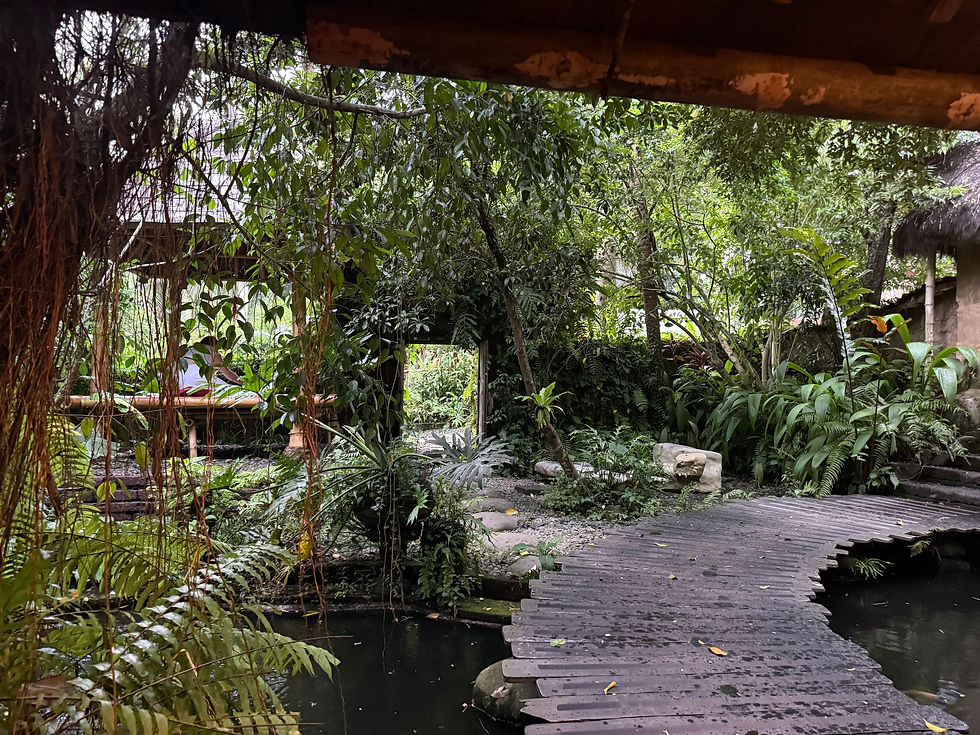
It was pouring when I arrived at Bambu Indah. Arriving anywhere in a downpour tends to carry a certain low-grade disappointment…the slippery wet flip flops, the immediate sense of having miscalculated. But climbing out of the car onto stone paths slick with rain, the bamboo dark and dripping, the jungle pressing in on every side, I felt none of that. Instead, the rain made everything feel better. Cleaner. More alive.
I was staying in a treehouse. Not in the metaphorical, boutique-hotel-marketing sense, but an actual elevated structure made of bamboo and cantilevered over a river valley. It was set into a landscape so thoroughly shaped by water that the property felt less like a place where someone had decided to build, and more like somewhere water had decided to be. It felt and smelled clean and fresh from the rain. The word "magical" kept arriving and, for once, I didn't resist it. It was a magical oasis, and the storm had made it more so.
This was my first hour in Bali after flying in from Singapore, and the contrast announced itself without ceremony. In Singapore, I had spent days watching a city that had engineered water into invisibility. Every drop managed, reclaimed, channeled, and accounted for through systems designed to ensure the nation never ran out. Singapore's water story is one of state-led confidence: water disappears into infrastructure because the infrastructure works. The country's survival has depended on it.
Bali offered something almost opposite. Here, water did not disappear. It showed up in rain on bamboo, in the rush of the Ayung River far below, in spring-fed pools connected by gravity to the valley's natural hydrology, in the smell of wet earth and green things pushed toward the light. Bali's water announced itself. It always had.
“The water helped calm the chaos.”
That line came to me at Bambu Indah, though it would take the rest of the trip to understand what it meant. Bali has chaos in abundance . The traffic, the scooters, the competing claims on space and coast and creek, the floating trash in otherwise brilliant water, the monkeys with their very particular standards. But the water moved through all of it as a kind of evidence: of older systems, of seasonal rhythms, of care. Following it turned out to be the best way to understand what the island was actually about.
Water Is Not an Amenity

The next morning, Pok Budi walked me through the property. He is a guide at Bambu Indah, and he speaks about water the way a very good sommelier might speak about soil and terroir, not as background detail, but as the thing that explains everything else.
The property's pools are spring-fed, he explained, drawing from the water table of the valley through a system that relies primarily on gravity. The buildings have been positioned to work with the river's landscape rather than level it. Bamboo structures, composting, a kitchen that sources from the property's own cultivation, all of it organized around natural flow rather than imposed upon it. The architecture is not rustic by default. It is deliberate: luxury designed to exist inside an ecological system rather than on top of one.
“Water is not an amenity there; it is the foundation of everything.”

That line is not promotional copy. It is a description of how the property actually works. And it points toward something larger than Bambu Indah: a Balinese relationship with water that long predates ecotourism.
The most visible expression of that relationship is subak; the traditional Balinese cooperative irrigation system that has governed rice agriculture on the island for more than a thousand years. Under subak, water is not owned. It is coordinated. Farmers whose fields depend on the same upstream flow organize through networks that include local water temples, whose priests adjise on timing, allocation, and the rituals that accompany the movement of water through the land. In 2012, UNESCO recognized the Subak system as a cultural landscape specifically citing its animating philosophy, Tri Hita Karana, which holds that human well-being depends on harmony among people, nature, and the spiritual world.1

Water, in this framing, is not a resource to be extracted. It is a relationship to be maintained. That is an idea that travels well beyond rice paddies. At Bambu Indah, it shows up in the pools and the composting toilets. At the coffee farms of Kintamani, it shapes the taste in the cup. At the seaweed farms of Nusa Lembongan, it determines whether anyone can eat.
Singapore asked: how do we engineer our way to water security? Bali has asked, for much longer: how do we organize ourselves around water's natural movement, and what do we owe it? Neither question has a permanent answer. But Bali's question is older, and the evidence for it is everywhere — in the terraces, the temples, the rivers running through resort property, and the single gravity-fed pump at the center of a treehouse compound designed to leave the valley largely as it found it.
The Taste of Flow
Dinner at Bambu Indah was a probiotic chicken curry served in the candlelit stone-and-bamboo dining room, with rice from the field I could see from my table. The purified water was cold and clearly trustworthy. I had been warned about ice and tap water and "Bali Belly" before the trip, enough warnings that safe water had begun to feel like a luxury I hadn't quite earned yet. Here, it was simply provided, quietly and without ceremony, like the rest of the hospitality.
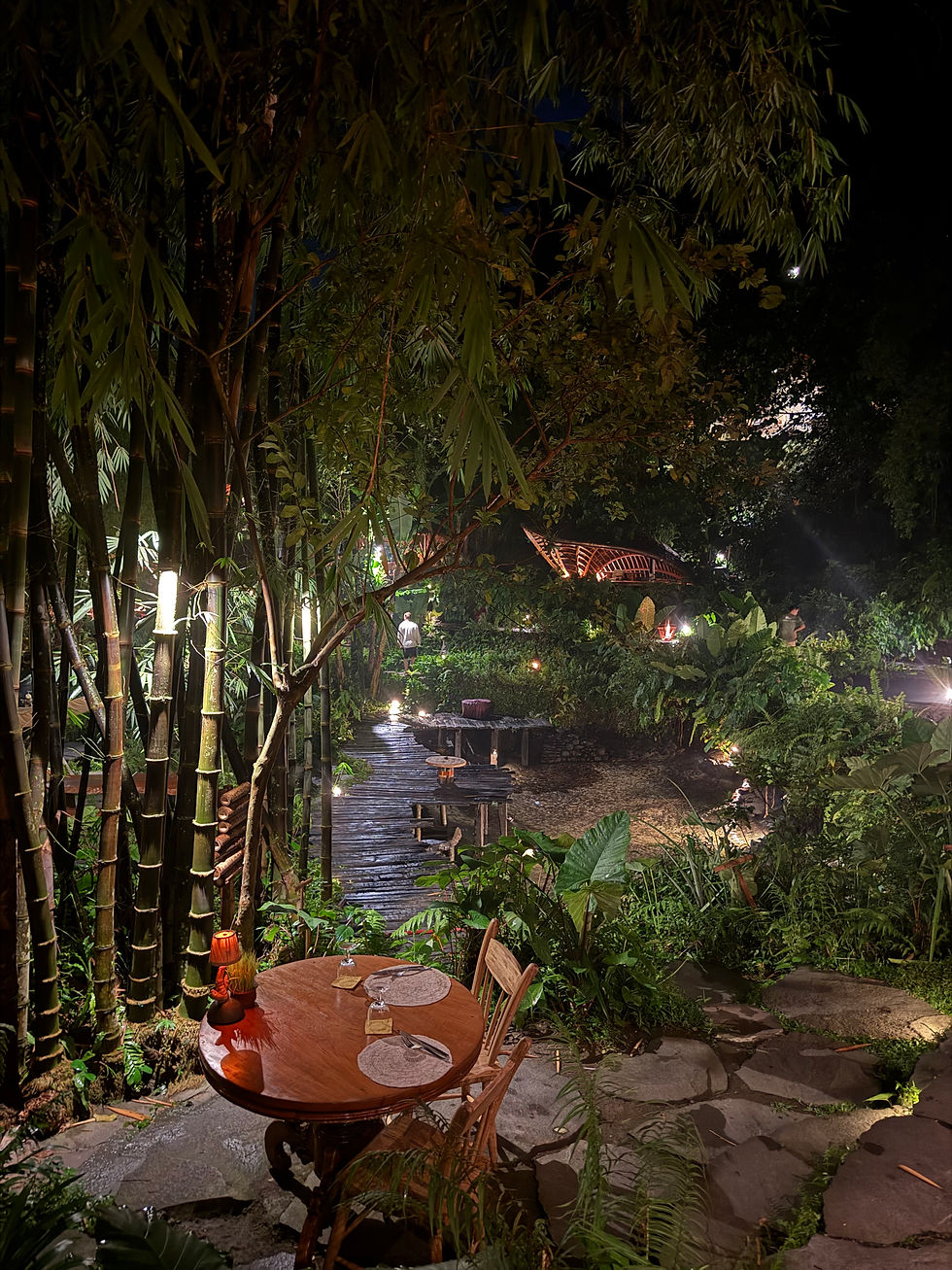
What struck me was how much the meal tasted like the place. Everything just tasted a little fresher, lighter, even healthier … if something can "taste healthy." The rice carried the memory of irrigation. The chicken had been raised on something closer to the ground. The curry paste had been made from ingredients grown in soil that received this same rain I'd arrived through. None of that is provable in a single bite. But it is not imaginary, either.
This is one of the Source & Standard framework's central contentions: taste is not accidental. Climate, land, water, farming practice, kitchen technique, food safety, hospitality norms , these all converge in what reaches the plate. At Bambu Indah, the convergence was unusually visible. Rice is, in essence, water made edible. In a place where water is treated as a relationship rather than a commodity, rice tends to carry that forward.

Balinese rice has historically been grown in hundreds of local varieties some now endangered by pressure to shift toward higher-yield hybrid strains preferred by commodity markets. The traditional varieties, grown in terraced fields fed by subak networks, develop in slower, water-cooled conditions that produce a different grain density and flavor than industrial paddy rice. What I was eating at Bambu Indah may or may not have been a heritage variety. But it tasted specific in the way that specific things do. Like somewhere, not everywhere.
The purified water mattered, too! Not as a premium detail, but as evidence of a standard. Someone had made a decision, somewhere in the property's operation, that guests would be served water they could trust. That decision shapes not just safety but flavor: when you trust the water, you taste the food differently. The two are not as separate as we pretend.
Rain in the Cup: Kintamani Coffee

Kintamani sits in the highlands of central Bali, in the volcanic terrain around Mount Batur, and the coffee grown there has the kind of flavor profile that rewards attention. I visited Curtina Coffee with Amellya and Wana, who are third-generation farmers, a detail worth dwelling on, because three generations of knowledge accumulates in the soil and the practice in ways that are difficult to replicate by shorter routes.
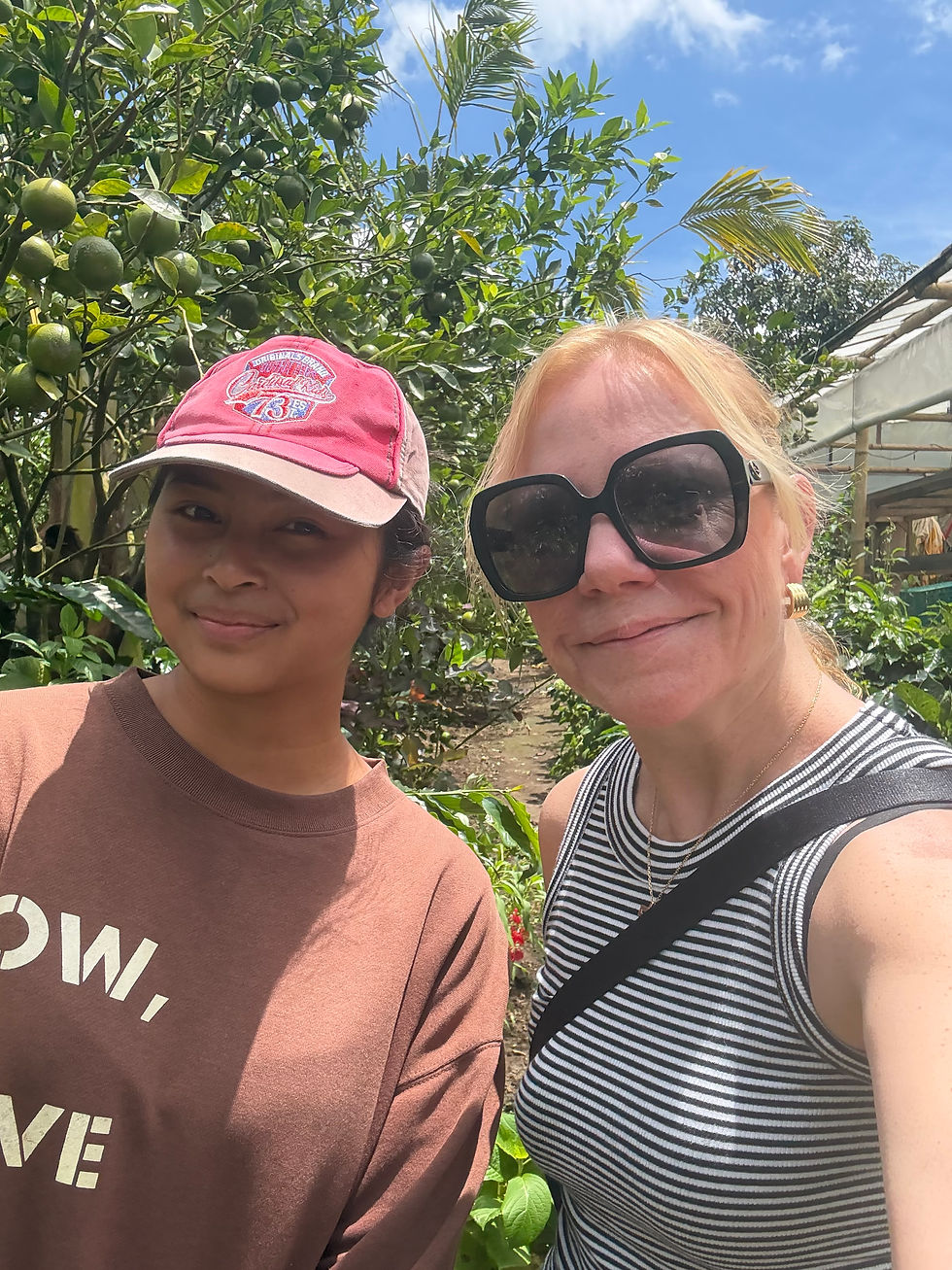
The coffee trees grow among tangerine trees, which shade them from direct sun and may contribute to the light citrus quality that runs through the cup. The elevation and the volcanic soil, which retains both moisture and minerals in ways that flatland agriculture doesn't offer, create conditions in which coffee can develop slowly and with complexity.
Kintamani coffee is recognized as a Geographical Indication product in Indonesia, meaning its specific regional character is acknowledged and protected under Indonesian intellectual property law. The coffees are predominantly Arabica, grown in a system with roots in the Subak Abian cooperative framework, a highland analog to the rice-based subak, adapted for agroforestry.2
What rain means for a coffee farm in a place like Kintamani is not simple. Rainfall is both essential and complicated: the same conditions that develop flavor in the bean can create challenges at harvest and drying. Wet processing, where cherries are pulped and fermented before drying, requires careful management of water during fermentation to avoid off-flavors. A farmer who understands how water behaves on their particular slope, at this particular time of year, has knowledge that cannot be downloaded.

Back at the farmhouse, Amellya brewed us coffee from the trees and process she just walked me through. I actually drank it black. Typically I like a little milk but the coffee honestly didn't need it. It was bright and clean, with that citrus note just underneath, and the effect was to make the addition of milk feel like interference rather than preference.
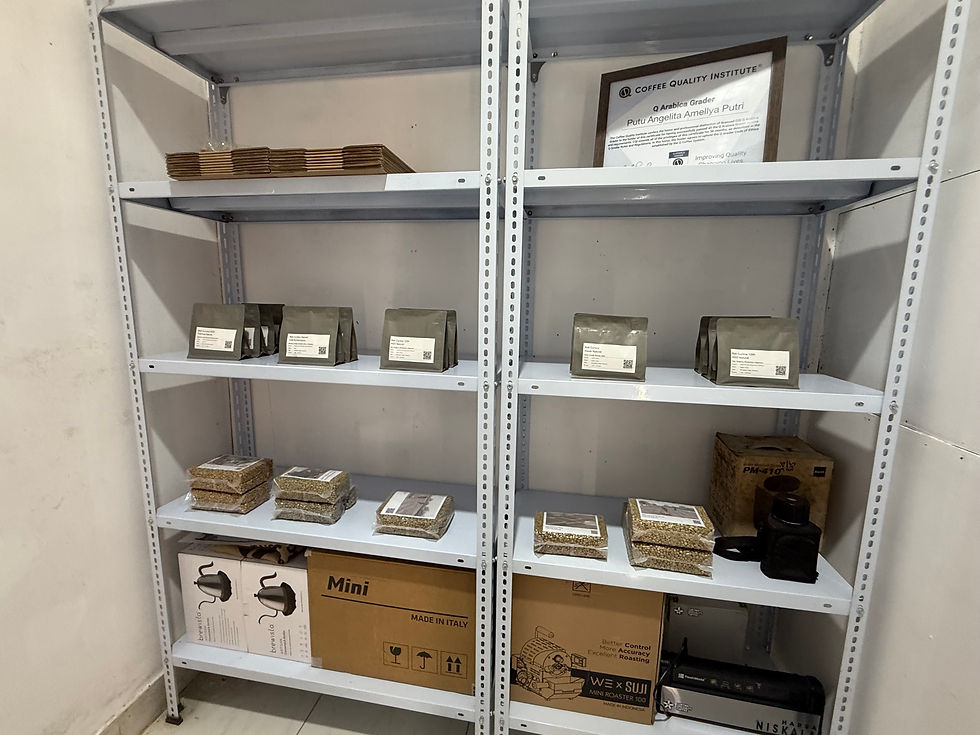
I brought a few bags home as gifts. Specifically, for my uncle who has owned a coffee roasting business for thirty-five years, and is always interested in where he can source green beans. Since Amellya didn’t have any green beans for me to take home I brought some of the roasted that I just tried. My uncle then blended the Curtina beans with a medium roast that he had roasted with beans from Rwanda. He said it made both coffees better. I believe him. Two coffees from two places shaped by two very different water regimes, and the combination was stronger than either alone. That is, in a small way, what trade is supposed to do.
Curtina doesn't sell to the U.S. — yet, but who knows. The demand for single-origin, ethically sourced, high-altitude coffee from named farms has never been higher. These beans would find a market.
One note of personal ethics, while I'm on the subject of Balinese coffee: I intentionally avoided kopi luwak, civet coffee, throughout the trip. Some local specialties are better left untasted. The animal welfare concerns associated with commercial civet coffee farms are well-documented, and the market pressure created by tourist demand does not serve the animals or, ultimately, the reputation of Balinese coffee. The standard I apply here is not complicated: if I wouldn't want to see how it's made, I shouldn't order it.
The Temple Kitchen

The cooking class was held at a century-old family temple and home, or rather, it began at the temple and moved into the kitchen. There were two of us learning: me and a woman visiting from Liechtenstein. Our teachers were two Balinese women who had been cooking this food their entire lives, with techniques absorbed from their mothers and grandmothers and the ceremonies that structure the Balinese year.

Before the cooking started, we were given sarongs to wrap around our waists and told to cover our knees. Entering a Hindu temple, even a family temple, even one that also functions as someone's kitchen yard, requires respect for the space. Signs at the entrance asked women who were menstruating not to enter, a restriction that stems from Balinese Hindu understandings of ritual purity and sacred space. I describe this carefully and without editorializing, because it is exactly the kind of standard that deserves to be understood on its own terms rather than flattened into a foreign curiosity.

We made a yellow sauce; a foundational paste of garlic, ginger, galangal, turmeric, shallots, and chilies, ground by hand in a mortar and pestle taller than me. I am not exaggerating the height. The mortar was a massive stone vessel that had clearly been used for decades, possibly generations, and the work of grinding the paste was real physical labor, the kind that makes you understand why kitchen tools exist and also why, in a context where time and ceremony are not obstacles to be optimized away, they are worth setting aside.

From that yellow paste, everything else followed: chicken satay, chicken curry, peanut sauce, tempeh, a simple salad, banana pudding. We squished minced chicken onto bamboo skewers and held them over a charcoal flame until the outside was smoky and slightly charred. The women explained that the spread was more typical of a family gathering after a ceremony or major holiday — not an everyday meal, but one that carried social meaning. Cooking this food together, in a family kitchen at a family temple, was a form of transmission.

It’s worth pausing on what went into that mortar.
Garlic, ginger, galangal, turmeric, shallots, chilies, each of them grows in the same volcanic soil and tropical rainfall that shapes everything else on this island. Bali’s spice agriculture is not incidental to its food culture; it is the food culture, the ingredient layer underneath the ingredient layer, shaped by the same water conditions that produce the coffee and the rice.
And several of these dishes involved fermentation, the probiotic curry at Bambu Indah, the wet processing of coffee cherries at Curtina, that is only possible in a climate with this particular combination of moisture and warmth. Bali’s humidity, which can feel punishing in traffic, is a culinary asset in the kitchen.

What I noticed, beyond the food itself: the women were curious about us. The woman from Liechenstein and I talked about our own food cultures, and our hosts were particularly interested to hear that coconut oil, now a staple in both the U.S. and Liechenstein, had become widely available and fashionable in our respective countries. They were delighted and a little bemused. An ingredient central to Balinese cooking for centuries had traveled the world and arrived on shelves in Boston and Liechenstein. They wanted to know what we did with it.
This is what cultural exchange in a kitchen can look like at its best: reciprocal curiosity rather than one-way performance. I will be hosting a dinner party soon, and yellow sauce will be on the menu.
Clean Food from the Sea
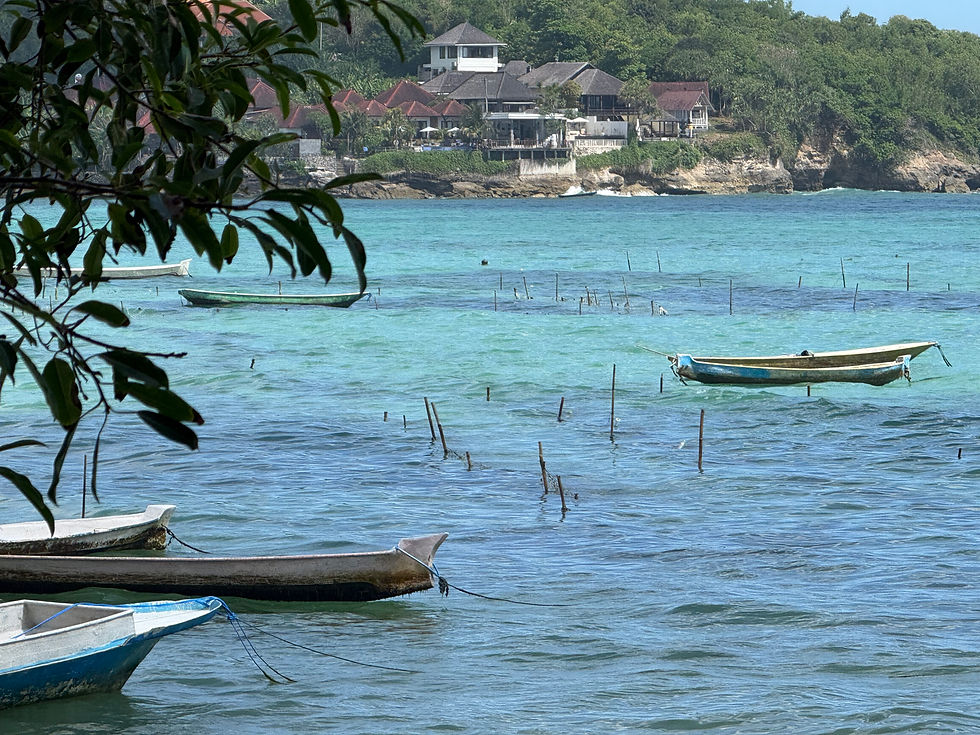
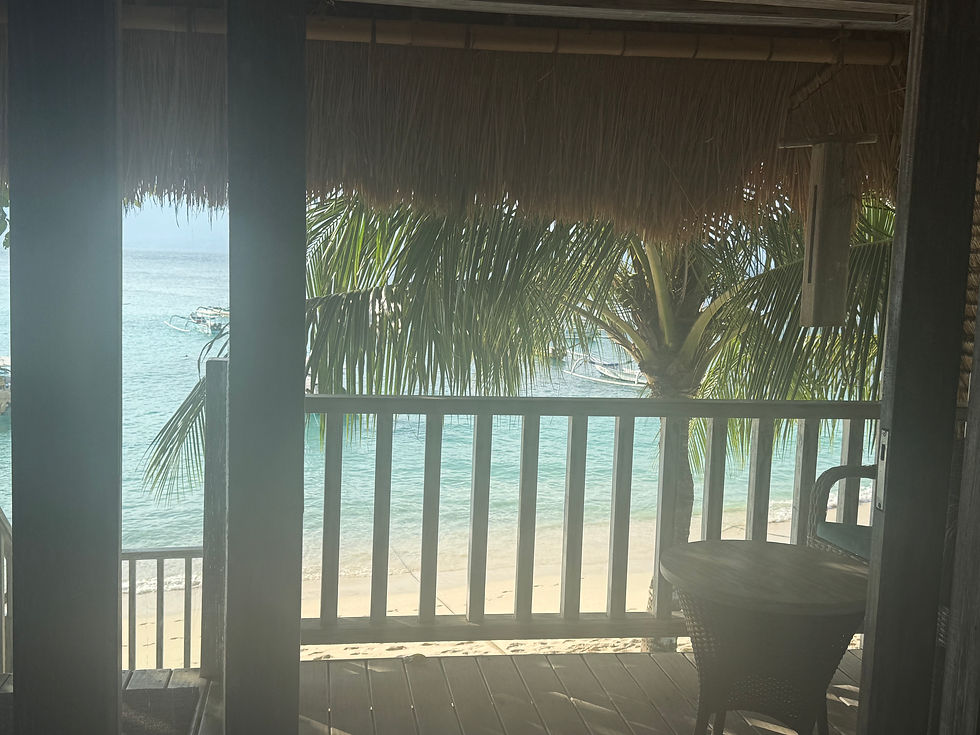
Nusa Lembongan is a small island off Bali's southeastern coast, reachable by fast boat, and significantly calmer than the main island in almost every way that matters, fewer scooters, slower pace, water you can actually see into. I visited the seaweed farms there through Hai Tide, a small resort where I had my beachfront bungalow for the ngiht, and learned something I probably should have known already.

I don't care for sushi, so I didn't make the connection right away about how big a demand there could be for quality seaweed. The farms I was looking at, long lines of cultivated seaweed stretching with the tide, tended by farmers who read the water the way coffee growers read the rain, were supplying a global market I had been consuming through products I'd never thought to trace.
Nusa Lembongan has been a center of seaweed cultivation since the 1980s. The primary species cultivated is Eucheuma cottonii, a red algae widely used as a source of carrageenan, a natural thickening and emulsifying agent that appears in processed foods, dairy products, cosmetics, and pharmaceutical applications worldwide. Indonesia is among the world's largest seaweed producers.3
Our guide explained that seaweed farming had become especially important during the pandemic, when tourism, the island's other major economic pillar, effectively collapsed. Families who had shifted toward hospitality work found themselves returning to the water, resuming farming practices that had sustained the community before the resorts arrived. The ocean had been there before the tourists. It would be there after.
It’s easy to think of Bali as a food importer. The resort menus stocked with international wine, the tourist-area cafés serving avocado toast and cold brew. But Bali sits inside one of the world’s most significant agricultural export economies. Indonesia is a top global producer of coffee, vanilla, palm oil, spices, and seaweed. Some of those supply chains run directly through the farms and ocean I was visiting. The carrageenan extracted from Eucheuma seaweed ends up in ice cream and cosmetics in markets Nusa Lembongan’s farmers will never visit. The Kintamani coffee that never quite makes it to U.S. shelves is an exception to a rule that mostly runs the other way: Bali’s agricultural output leaves the island at scale, while what tourists consume on the island is often imported back in processed form. The two flows rarely meet on the same plate.
There’s an important distinction embedded in the guide’s framing: the water here offers "clean food." That phrase carries weight. Seaweed farming is sensitive to water quality — to temperature, tides, currents, and the absence of pollution. A farm that works is evidence of ocean health. A farm that doesn't, increasingly, is evidence of something else. The conditions required to grow good seaweed are, in a rough sense, the same conditions required to maintain a coastal ecosystem that can sustain everything else.

I thought about this later, snorkeling with manta rays that looked like the animated Disney versions, enormous, graceful, utterly unbothered by our presence, and then swimming behind a sea turtle for nearly an hour as it grazed along the seafloor. And then I thought about the floating trash I'd seen in otherwise beautiful water. The ocean that makes seaweed farming possible, that hosts manta rays and turtles, also absorbs whatever finds its way in from the coast.

These observations are field notes, not data.
But the data, where it exists, tends in the same direction.
Bali's coastal waters face significant pressure from tourism-related waste, seasonal currents that carry debris from regional sources, and the inadequacy of waste infrastructure relative to the pace of development.
The Manta and the trash coexist.
The seaweed farm and the plastic bag are in the same water.
Holding both of those things at once is the honest version of this story.
Looking at the Ocean, Not Being in It
I stayed at W Bali during part of the trip, and spent an afternoon at Potato Head, the famous beach club in Seminyak. Both are beautiful. Both had one thing in common with most of the coastal venues I visited: the people around me wanted to look at the ocean more than they wanted to be in it.

This is not a criticism…well not really a criticism. The currents along much of Bali's southwestern coast are genuinely dangerous. Dangerous current signs appeared consistently along the beach frontage at venues up and down the coastline, and they were not decorative. Bali's surf beaches have claimed lives, and the warning signs are the formal acknowledgment of that risk. A resort selling ocean views is also, implicitly, selling something other than ocean swimming.
I'll take an ocean swim over a chlorinated pool any day, but many times in Bali the pool won out. The pool is predictable. The pool has no rip tides. The pool is blue in a way the ocean only is on certain days, at certain angles, in certain light. The pool is, in the end, water that has been made safe, controlled, and decorative; the resort version of what Bambu Indah's spring-fed pools are doing with rather more ecological intention.

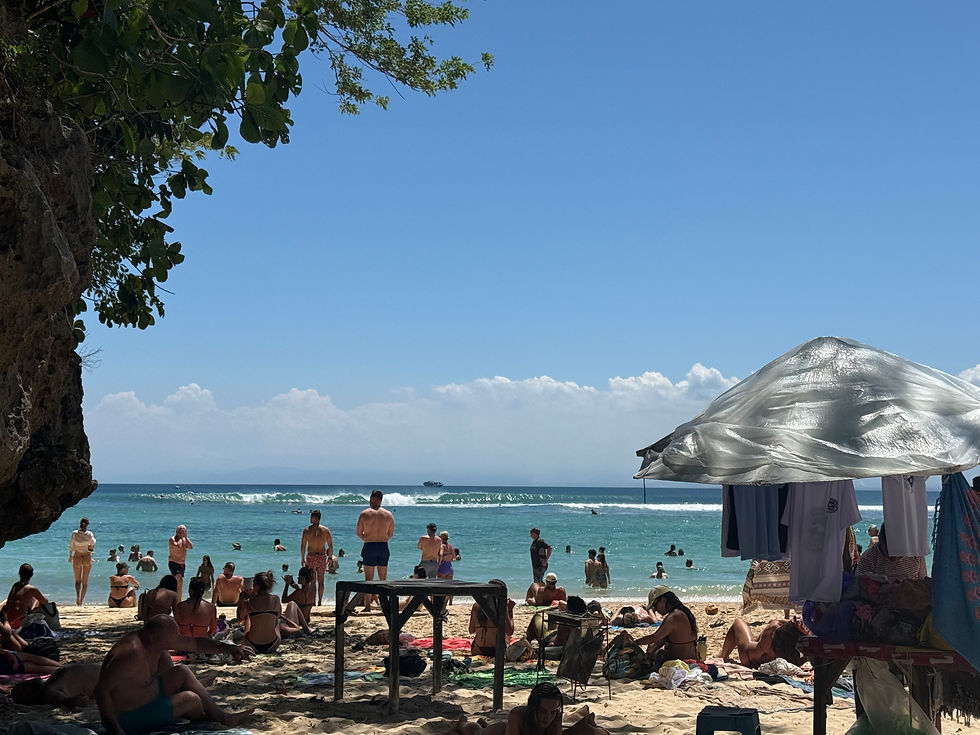
I did find swimmable ocean at Sundays Beach Club, where protected coves allow actual entry, and at Nusa Lembongan, where the calmer waters of the channel are genuinely swimmable. At Padang Beach, the sand was gorgeous and the water was the right shade of turquoise… but the beach itself was so packed with tourists, vendors, and printed sarongs laid out like product displays that it looked, from above, like a game board. Hundreds of pieces, each with a specific square.
What the beach club model offers is a particular kind of mediation: the ocean as setting rather than experience. You are near water, you can photograph water, you are served drinks within sight of water, but the interaction with the water itself is managed down to something ambient. This is not a uniquely Balinese phenomenon. It is the global tourism model applied to coastline. But it creates an odd situation: one of Bali's primary selling points is its relationship to water, and yet the water is, in practice, something many visitors engage with at a considerable remove.
Drinking the Rain
Before the trip, people told me about Bali Belly. This is the traveler shorthand for gastrointestinal illness from local tap water or improperly handled food, the kind of thing that turns a dream trip into a pharmaceutical emergency. Warnings came from friends, from the MGH travel clinic, from the general ambient wisdom of anyone who had been to Southeast Asia. The advice was consistent: don't drink the tap water. Be careful with ice. Trust only bottled or purified.
At Bambu Indah, the ice was safe and the water was purified. At the W Bali, every room had multiple bottles of water placed near the bathroom sink, not on the minibar, where you might grab one for pleasure, but by the sink, where you needed it to brush your teeth. This detail matters. The placement was not hospitality marketing. It was a message: the tap water here is not for drinking. These bottles are infrastructure.
The bottled water was not a minibar perk. It was infrastructure.”
The regulatory context matters here. Indonesia’s national drinking water standards, governed by Ministry of Health regulations, set safety benchmarks for piped water systems….but enforcement, infrastructure investment, and actual water quality vary significantly by region, and Bali’s rapid growth has outpaced the development of municipal water treatment in many areas. The government has acknowledged this gap. What fills it, for now, is a patchwork of hotel purification systems, commercial bottled water, and newer players like Bali Rain.
The standard exists on paper. The infrastructure to meet it is unevenly built.

The more interesting question is why, and what might be done about it. I met Matt, the founder of Bali Rain, over coffee in Uluwatu. He explained that groundwater in parts of Bali, particularly in the heavily developed coastal and resort areas, has come under significant pressure from commercial development and the increasing coverage of land with concrete, which reduces the island's natural recharge capacity. Rain falls, but instead of percolating into the aquifer through soil and vegetation, it runs off impervious surfaces into drainage systems and out to sea. The more concrete, the less recharge. The more extraction, from hotels, villas, golf courses, laundries, pools, the faster the depletion.
The economic logic driving this is not mysterious. A new villa generates revenue immediately. The groundwater it depletes won’t register as a cost on any developer’s balance sheet until the aquifer fails or the salt intrudes. Tourism receipts are visible; long-term water insecurity is diffuse and slow-moving. This is the market incentive problem at the center of Bali’s water story: the people making decisions about concrete and extraction are not, in most cases, the people who will live with the consequences. The farmers who depend on subak, the seaweed farmers whose yields require clean coastal water, the residents who pay for bottled water that hotel guests receive free, they absorb costs that the tourism economy externalizes.
Bali’s groundwater challenges are concentrated in the southern lowlands, particularly in the Denpasar, Kuta, and Seminyak areas. Several studies have documented increasing groundwater depletion and, in some coastal areas, saltwater intrusion, associated with rapid urban and tourism development. The limestone terrain of southern Bali is particularly sensitive to development pressure.4
Bali Rain's response to this problem is to collect rainwater. According to Google AI, Bali Rain is a premium, locally sourced drinking water brand that captures, triple-filters, and carbonates tropical rainwater into crisp sparkling beverages. Packaged in recyclable aluminum cans, the line includes zero-to-low sugar functional drinks, sparkling water, immunity shots, and mixers.
I tried the cans :) The water was clean and slightly mineral, with the faint quality that collected rainwater sometimes has: a taste of atmosphere, if that makes any sense.
More importantly however, is that not just that the water was good, but the concept, treating rainwater as a resource rather than a nuisance that makes particular sense in a place with serious groundwater pressure and abundant rain.
The broader question is one that Bali's drinking-water situation puts into sharp relief: who gets safe water, and at what cost? Hotel guests get bottles by the sink. Travelers who know to ask get purified ice. Residents and workers whose budgets don't include premium water face a different calculation. Safe water is not evenly distributed in Bali any more than it is anywhere else. Bali Rain’s school program is one response to that inequity. It is not a systemic solution. But it is asking the right question.
Sunset, Fire, Monkeys

The Kecak dance at Uluwatu Temple happens at sunset, on a stone platform at the edge of a cliff above the Indian Ocean, and it is simultaneously one of the most sacred, theatrical, and genuinely strange things I have done in a long time.

Uluwatu is a Hindu sea temple. One of Bali's Sad Kahyangan, the six sanctuaries believed to protect the island from evil spirits. It sits at the edge of a limestone peninsula, and the views from the temple grounds at dusk are the kind that make people consider life choices. The water far below is a specific shade of blue that exists, as far as I can tell, only at this latitude and this time of day.
The Kecak performance itself involves a large male chorus chanting a hypnotic rhythmic pattern — "cak-cak-cak-cak" — while actors perform scenes from the Ramayana against the backdrop of the ocean and the setting sun. It is ritual and performance and tourist spectacle in equal measure, and the combination is not diminished by any of its components. Sacred things can also be theatrical. Theatrical things can also be sacred. Uluwatu holds all of this without apparent contradiction.
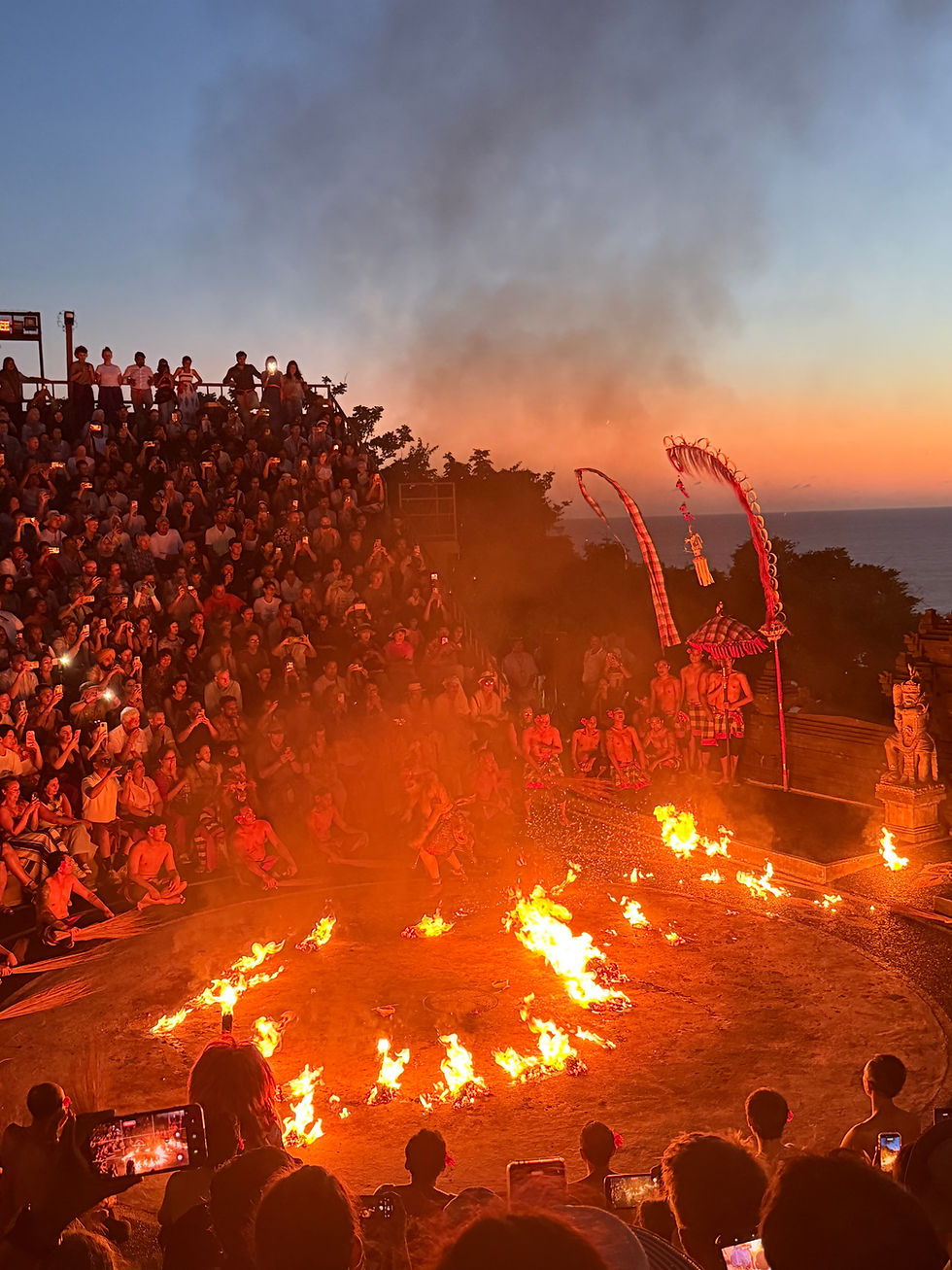
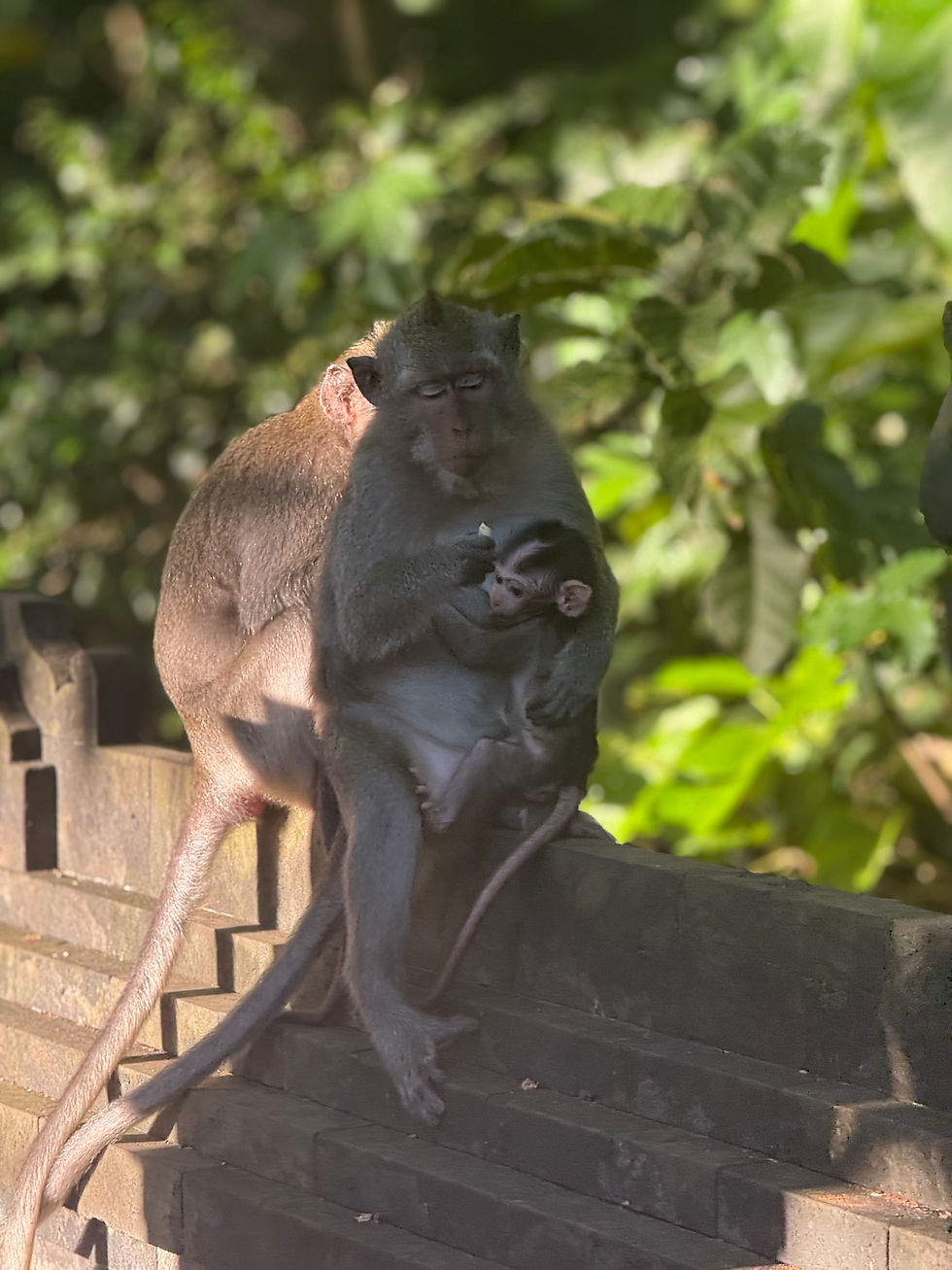
There are also monkeys. Many monkeys.

Balinese long-tailed macaques who have developed a sophisticated economy based on the theft of tourist possessions and their subsequent ransom in exchange for food. A friend attending the temple dance with me had his sunglasses stolen from his head, snatched cleanly, without ceremony, and retrieved only after negotiating with the monkey through an interlocutor wielding an Oreo. The monkey ate the cream filling and discarded the cookie. The only acceptable way to eat an Oreo, in my book. I respected the standards.
The monkey, the temple, the ocean, the sunset, the sacred chorus, and the tourists consulting their cameras…this is Bali at maximum density. It is not a contradiction. It is the thing itself: old and layered and alive, with a very clear idea of what it will and will not accept.
The Water Helped Calm the Chaos
Bali is not a peaceful island in the sense of being quiet or uncrowded or uncomplicated. The traffic is real. The scooters are everywhere. The commercial development of the coastal zones is rapid and not always thoughtful. The floating trash is in the water. The currents are dangerous. The tourists, and there are millions of them, have needs and appetites that the island's ecology absorbs imperfectly.
And yet. Following the water revealed another system underneath the chaos , older, distributed, and still functioning, though under pressure.
Rice fields fed by irrigation networks that predate the resorts by centuries. Coffee grown in volcanic highlands where rain and soil and farmer knowledge accumulate into something irreducible. Cooking rooted in ceremony and family and the specific labor of grinding paste in a stone mortar. Seaweed farming as economic resilience, the ocean as fallback when the hotels close. Spring-fed pools built around natural flow. Rainwater captured and cleaned and sent to schoolchildren who need it.
The people I met throughout the trip were curious in a particular way. They wanted to share and to learn about me as much as I was trying to learn about them. Amellya at the coffee farm, the women in the temple kitchen, the guide at the seaweed farm, Pok Budi walking me through Bambu Indah's water systems; each of them offered something more than information. They offered a perspective: that the land and the water are not simply there to be used, but are relationships to be maintained.
“The water helped calm the chaos. It felt like the reassurance of a bigger collaborative kindness.”
Bali's water story is not a model to copy wholesale. The subak system is Hindu-Balinese in its philosophy and its governance deeply embedded in a specific cultural and religious landscape that cannot be transplanted to a golf resort in Arizona or a resort island in the Caribbean. The seaweed farming of Nusa Lembongan developed in response to particular tides and temperatures and market conditions. The rainwater harvest at Uluwatu works partly because of the limestone terrain and the monsoon pattern. These are place-specific solutions.
But the questions Bali is asking are transferable.
Is water treated only as a utility, or as a relationship?
Is luxury designed on top of ecology, or inside it?
Are sustainability claims visible in operations, not just on menus?
Who gets safe water, and at what cost?
What happens when the ocean is sold as scenery but not protected as livelihood?
In Singapore, I watched a society that had engineered water into confidence. That had decided, as a matter of national survival, to control every drop with absolute precision. The system is admirable and a little terrifying, a monument to what concentrated will and competent governance can achieve.
Bali offers something different: a place where water has remained visible, shared, sacred, and stressed, shaped by temple governance and tourism pressure and volcanic soil and the sheer fact of being an island in the tropics with a complicated relationship between what the land gives and what the economy demands.
Both approaches are responses to the same underlying reality: water is not infinite, not guaranteed, and not distributed fairly by default. What a society decides to do about that, engineer it, ritually acknowledge it, harvest it from the sky, farm it from the ocean, or sell proximity to it from a safe chlorinated pool, tells you almost everything you need to know about what that society actually values.
The next part of this series moves to India, where water is even more contested, more sacred, more desperately needed, and more politically charged than anywhere I've been yet.
Bali offered a kind of preparation for that: a reminder that following the water is never just an environmental story. It is a story about governance and culture and who gets to eat, and what they get to taste, and whether the system underneath it all is one worth protecting.
I arrived through rain. I left the same way. A downpour on the drive to the airport, the island washing itself off before I could take too much of it with me. The treehouse at Bambu Indah would smell clean and fresh again within hours. The spring-fed pools would refill. The rice would be irrigated by the same coordinated system that had been running since before anyone thought to write it down.
— Jennifer, Picky Eater Boston
NOTES & SOURCES
1. UNESCO World Heritage List: 'Cultural Landscape of Bali Province: the Subak System as a Manifestation of the Tri Hita Karana Philosophy.' Inscribed 2012. https://whc.unesco.org/en/list/1194. The Tri Hita Karana philosophy connects parahyangan (spiritual), pawongan (social), and palemahan (natural) realms. Its application to water governance through the subak temple network has been the subject of extensive anthropological study, including J. Stephen Lansing's Priests and Programmers: Technologies of Power in the Engineered Landscape of Bali (1991, Princeton University Press).
2. Kintamani coffee's Geographical Indication registration was granted by the Indonesian government in 2008, making it one of the country's first protected origin products for coffee. On Subak Abian as an agroforestry analog to wet-rice subak, see: Geertz, Clifford. Agricultural Involution: The Processes of Ecological Change in Indonesia. University of California Press, 1963; and more recent studies by Lansing and colleagues on highland cooperative irrigation systems in Bali. Citrus intercropping in Kintamani coffee cultivation is a documented local practice, though the precise contribution to cup profile is a subject of ongoing discussion among specialty coffee researchers. The elevation range for Kintamani Arabica is typically cited as 900–1,700 meters above sea level.
3. On Eucheuma cottonii cultivation and Indonesia's seaweed sector: Food and Agriculture Organization of the United Nations, 'The State of World Fisheries and Aquaculture 2022,' Rome. Indonesia is consistently among the world's top two or three seaweed producers by volume. On carrageenan applications: McHugh, Dennis J., 'A Guide to the Seaweed Industry,' FAO Fisheries Technical Paper 441, Rome, 2003. The pandemic’s effect on Nusa Lembongan seaweed farming—specifically the return to ocean agriculture when tourism collapsed—is reported anecdotally from field conversation with a Hai Tide guide and is consistent with broader documentation of Balinese community livelihood shifts during 2020–2021, though independent verification of local scope and scale is noted as a fact-check item.
4. On Bali groundwater stress: Purwanto, M.R., et al., 'Groundwater Quality and Its Vulnerability to Contamination in Bali Island, Indonesia,' various publications in regional hydrology journals. Saltwater intrusion in coastal South Bali has been documented by Indonesian hydrological agencies and academic researchers. The link between rapid urbanization, increased impervious surface coverage, and reduced aquifer recharge is well-established in hydrological literature and has been applied specifically to the Kuta-Seminyak-Canggu corridor by researchers at Udayana University in Bali.
EDITORIAL NOTE
This article is Part II of the Source & Standard series 'All About the Water.' Part I examined Singapore's water infrastructure. Part III will focus on India.


Comments