
Beef. It's What's for Dinner.


Oklahoma City, from the First Americans Museum to the Cattlemen's counter: two ways of naming what feeds you
SOURCE & STANDARD
Every time I hear Copland's Hoe-Down I'm back in high school orchestra. We'd hit the final chord and pretty much the whole orchestra would mutter it under our breath: beef, it's what's for dinner. I hadn't thought about that in years. Then I found myself in Oklahoma City, at a diner counter in Stockyards City, about to ask the question the commercial never did.

I got dropped off to a line at the hostess stand outside Cattlemen's and learned the wait for a table was 40 minutes. I asked about bar seating, which is my usual move solo or duo, and she said yes. What I found was not a bar. It was a mostly empty diner counter, and I mean fully a diner: I was seated directly in front of a giant Carnation iced tea vat. I looked around and inquired whether they even sold wine. The waitress was very nice about it and also looked at me like I was slightly nuts. Yes. Here's a menu.


The filet needs no defending. Juicy, tender, cooked perfectly, flavorful enough you didn't feel you needed a sauce. Outside was Stockyards City, low buildings and boots and hats in 100-degree heat, a district that looks like an old western movie except everyone in it was working. If there's a right room in America to eat a steak in, I'd found the counter of it.
So I asked. Just curious, but by any chance do you know where the filet came from.
“I know it's from Oklahoma, but I don't know exactly which ranch.”
Then she asked me to cut into it so she could check the temperature before she'd walk away. She didn't know where my steak started. She was absolutely not leaving until she knew where it ended up.
I flew in with the Oklahoma! musical version of Oklahoma in my head. So, the beef. And the boots, the cattle, the wind, the open plains all showed up on schedule. None of it was false. A few weeks earlier, back in Boston, I'd spent a night out with two co-workers and roughly 20 Scots in kilts, over for the World Cup. One of them walked me through his itinerary: Vegas, Boston, New York, Miami. Not just for the matches. He'd figured out that American regions are as different as European countries, so he was touring them like countries. If he's right, I was now in the beef nation. And I'd just asked the beef nation where its beef came from, at the counter of its most famous steakhouse, down the street from one of the biggest cattle markets in the country.
From Oklahoma. That was the whole answer.

The Oklahoma I Expected

Night one, my colleagues and I went to the National Cowboy & Western Heritage Museum. It was beautiful. Land runs, settlement, Route 66, saddles, the whole visual language of how the West was won.

The complications were in there if you looked, but the room's dominant key was celebration.

The Blackbird Dance Troupe performed in full regalia while we were there, living Native presence inside a western heritage museum, and I filed that away without yet knowing it was a preview.

Outside, the city delivered everything the musical promised. Heat. Wind. Boots and hats in 100-degree weather. I balked briefly, then remembered my own childhood: horse shows in a collared shirt, wool blazer, tall leather boots, in summer. People who love horses dress for the animal, not the weather.
Here's what the musical never explains: why cattle, why here. The answer is grass, and the grass is the answer because of rain. Oklahoma is a climate gradient you can drive across in an afternoon. The east side gets roughly fifty inches of rain a year and could almost pass for the South. By the panhandle you're under twenty, and the trees give up.1 In between, the prairie shifts with the rainfall: tallgrass in the east, mixed grass in the middle, shortgrass heading west. That gradient once fed bison in numbers I can't actually picture, and north of Tulsa the Tallgrass Prairie Preserve still keeps a remnant of it, bison included.2 Grassland this good doesn't stay unused. The question was only ever who would use it, and for what.
For most of history the answer was bison, and the nations who built their lives around them. Then, in about two decades, it wasn't. The bison were slaughtered to the edge of extinction in the 1870s and 80s, which was not a hunting accident but a strategy, and I'll come back to that, because the First Americans Museum made sure I couldn't look away from it. What matters here is what happened to the grass. It didn't go anywhere. Texas cattle drives were already moving herds north through Indian Territory to the Kansas railheads, the Chisholm Trail cutting right through what's now this state.3 When the land runs opened the territory in 1889, cattle simply took over the ecological job bison had held for ten thousand years. Same grass. Same niche. New animal, new owners, new story.
There's a warning buried in the middle of that transition, and Oklahoma carries it harder than any state. When the plains got farmed wrong, plowed too deep and too dry through the 1920s, the land answered. The Dust Bowl put Oklahoma's name on a national catastrophe, blew its topsoil to the Atlantic, and marched its families down Route 66 into a Steinbeck novel. Every generation of Oklahoma agriculture since has farmed in that shadow. It's worth remembering, when the sustainability conversation gets treated as a coastal invention, that the most famous lesson in what happens when you ignore the land was taught here, eighty years before anyone said regenerative.
And the new story worked. It's still working. Oklahoma is the number two beef cow state in America, behind only Texas, and it's held that spot for twelve straight years. As of this January, 1.966 million beef cows, about one in fourteen nationally.4 The stockyards near my dinner weren't a museum exhibit. One Monday sale this year estimated 9,800 head of feeder cattle and calves.5 One sale. One Monday.
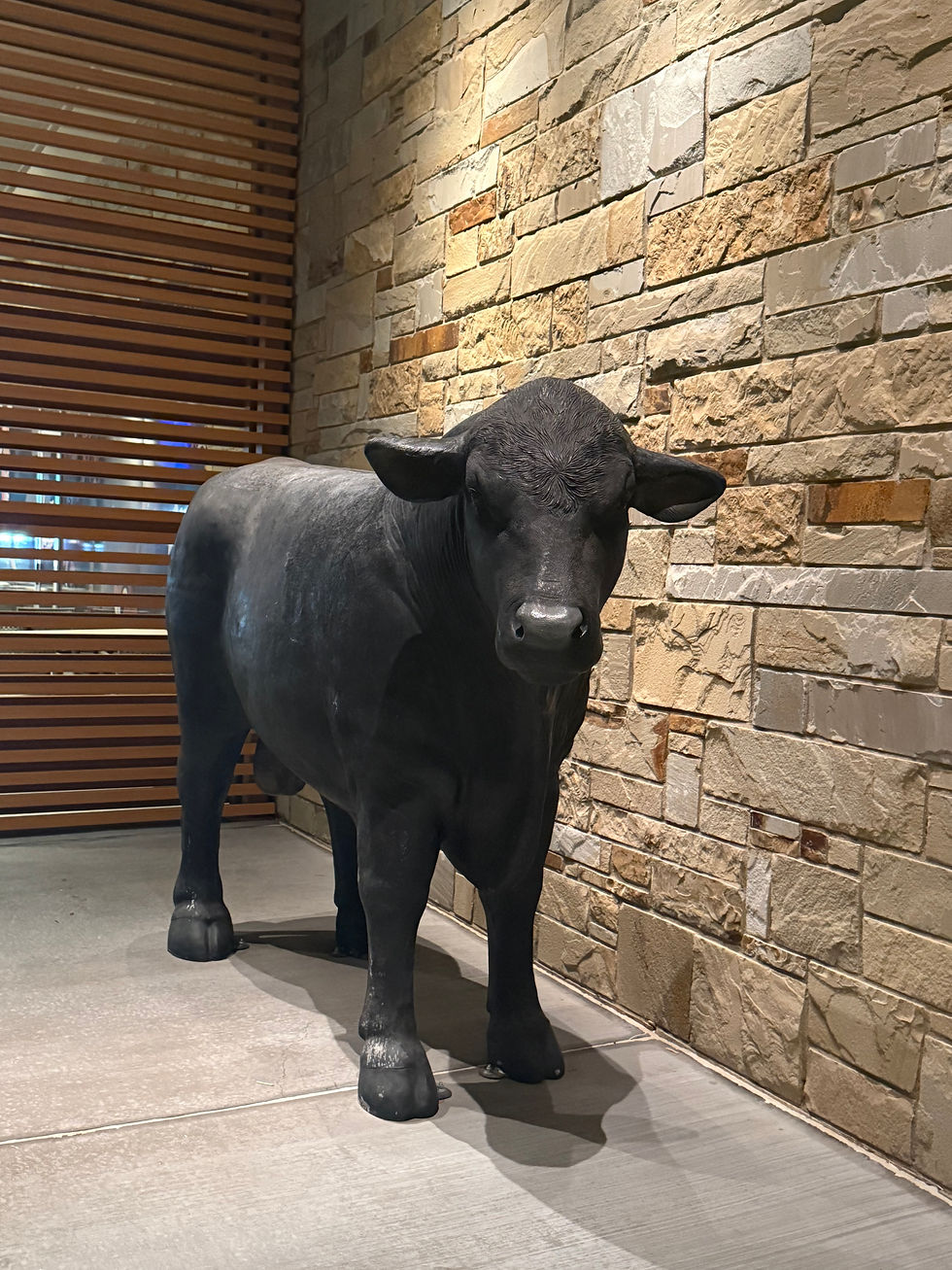
There's even a signature local practice, and it's a clever one: winter wheat pulling double duty. Calves graze the green wheat through the cold months, come off in late winter, and the same field then gets harvested for grain. Two crops, one planting.6 But that practice points at the thing I didn't understand until I pulled the thread. Oklahoma's specialty isn't finishing cattle. It's starting them. Calves begin on Oklahoma grass and wheat pasture, then a lot of them ship to feedlots in the Texas Panhandle and Kansas to be fattened and slaughtered. The state raises the beginning of the animal. The end often happens somewhere else, under someone else's name, in someone else's records. The steak on my plate could have been born down the road and still spent its last six months two states away. Or the reverse. Nothing on the menu would tell me which.
So the grass is real, the cattle are real, the pride is earned twice over, once by the land and once by the people working it. What I was starting to wonder about was the paperwork.
What Oklahoma Eats
Before I get to the museum, a word on what Oklahoma actually eats, because the plate is its own historical document. The food here is the South and the frontier holding hands: chicken-fried steak, barbecue, fried okra, black-eyed peas, cornbread. El Reno, just west of the city, claims the fried onion burger, a Depression invention that stretched expensive beef with cheap onions, which is to say the signature local dish exists because beef was once too precious to serve alone.8 And then there's my favorite legal artifact of the trip, which I didn't find in a courthouse. In 1988, the Oklahoma legislature adopted an official state meal, by concurrent resolution, the whole menu on the record: fried okra, cornbread, barbecue pork, squash, biscuits, sausage and gravy, grits, corn, strawberries, chicken-fried steak, pecan pie, and black-eyed peas.7 Sit with that as a procurement attorney for a second. The legislature put dinner in the books, item by item, and put not one word in the resolution about where any of it comes from. Oklahoma legislated what's for dinner. It never legislated whose. That's not a criticism. That's the whole American approach to food identity in a single document, and I'd bet most states would have done the same.
The Museum That Sat With Me

Day three I went to the First Americans Museum alone, which turned out to be the right way to go.
Some context the building itself insists on: there are 39 tribal nations headquartered in Oklahoma today, and most of them are not from Oklahoma.9 They were removed there. Marched there. The museum doesn't blur them into one culture, either, and neither will I. Thirty-nine nations means thirty-nine governments, languages, legal traditions, foodways. What they share is the removal, and the museum walks you through it nation by nation, and that part moved me to tears.

Standing in front of the migrations panel, I did math I didn't enjoy. This wasn't ancient history. This was grandparents' grandparents.

Here's the part that embarrassed me, in the useful way. The museum's telling goes back some 20,000 years on this continent. Twenty thousand. How did I never know that. I grew up in Plymouth County, Massachusetts. I was raised at the other bookend of this exact story, field trips and all, and this is only now occurring to me . The museum offered a different job description entirely: not a chapter in someone else's book, but a set of civilizations to be studied the way we study any great foreign culture. Admired. Learned from.

And there was one exhibit concept I haven't stopped thinking about.

The museum called it natural democracy, as I understood it: people, animals, plants, water, earth, and sky as members of one community, with standing. Obligations running in every direction, not just downhill from humans. The Cherokee material complicated things I thought I knew about property and authority, including who held it. Women, it turns out, held quite a lot of it. My procurement brain kept translating all of this into my own language: these were governance systems. Land law. Resource rules. Hearing the respect with which their laws treated the land felt analogous to what we're trying to get back to now, at conferences, with grant money, under the word “sustainability.”

Then, the horses. An exhibit presented what I understood as Horse Nation: horses respected as a fellow living community on Earth. Not tools. Not property. A nation among nations. I grew up riding, and maybe that's why this one landed where it did. Whatever instinct made a kid in a wool blazer in July feel like the horse was the point, the people in these galleries had built it into law.
Which is when the day's real question started forming. I'd just walked through an entire theory of how you relate to the animals that feed and carry you: by name, by relationship, by obligation. And it was my last night in Oklahoma City, and I already knew where I was having dinner. Cattlemen's, in the stockyards. The plan for right now was smaller: the museum has its own restaurant, and I wanted to see it before I left. One appetizer, one drink, and then cattle country.

Thirty Nine, or: the Menu with Footnotes
The restaurant is called Thirty Nine, for the 39 nations, and it sits inside the museum with a view I wasn't expecting and a board I wasn't expecting either.10

The board listed suppliers. Farms, ranches, mills, Native-linked businesses, specialty producers, by name. I stood there and read it the way I'd been reading exhibit panels all afternoon, which I think was the point. Twenty minutes earlier the galleries had been explaining relationship and reciprocity on the walls. Here was what those ideas could look like on a purchase order.

I ordered the smoked green chile and sweet corn hummus and a drink. The hummus was very unusual, honestly not my favorite, but it was good. I want to keep that reaction intact, because this is where food writing usually starts lying. The transparent restaurant's food is supposed to taste like an epiphany. Mine tasted like an interesting appetizer I'd order a different version of next time. The board didn't make the hummus taste better. What it changed was something else: I knew what questions the kitchen could answer.

And I noticed my own brain doing something worth flagging. Reading those named producers, fresh out of the Horse Nation gallery, I found myself assuming things. That the bison behind the menu were highly respected and valued for the meal and nourishment they were providing. That the land was well treated. That everyone in that supply chain shared the museum's values. Maybe all true. Probably some of it. But I hadn't verified any of it, and a name on a board is not a certification. It's an invitation. The difference between the two is basically my entire day job, and I'd just watched a beautiful room talk me out of the distinction in under an hour.

So let me be precise about what Thirty Nine actually gave me, because it's still a lot. Not proof of regenerative grazing or humane handling. Something more basic and more rare: the ability to ask. Every name on that board is a thread a curious person could pull. Call the ranch. Look up the mill. That's what transparency is, mechanically. Not a virtue. A set of working phone numbers.
Then I went to find my ride. Ubers in Oklahoma City are not Ubers in Boston, and after some app roulette earlier in the trip, a driver had offered to just drive me privately for what I understood to be a modest fee, and I'd said yes. So I had something better than an Uber. I had a local. Jessica, whose Venmo handle reads “safe rides,” which is a one-woman transportation company with a mission statement. She brought me to the museum, and now, pointing us toward the stockyards, she confirmed what I'd hoped: Cattlemen's was the real thing. She'd gone every Saturday with her family growing up.
I thought about that the whole ride. I'd spent the day learning about naming what feeds you. Here was a woman whose family had named the same restaurant, week after week, for years. That's a kind of provenance too. It just runs through people instead of paperwork.

Back to the Counter
Jessica dropped me at the hostess stand line outside Cattlemen's, and you already know the next part. The 40-minute wait. The bar seating that turned out to be a diner counter. The Carnation vat. The wine inquiry, received kindly, as the question of a person who was slightly nuts. The filet. The question. The answer.
What I haven't told you yet is what the room was like.
Cattlemen's has been feeding this district since 1910, or so the menu says,11 and the menu has personality, including a crack about how they'll occasionally even let a lawyer in. Whoops. They let one in.

Red booths, a counter, regulars who were clearly regulars, a manageable number of tourists doing a bad job of hiding that they were tourists, and me, doing possibly a worse one. I came alone. I didn't stay alone. That's not a Boston experience, eating solo at a counter and ending up sharing your sides with new friends, but that's what happened, and the sides were worth sharing.

And Jessica's Saturdays kept sitting with me. Every institution in the room was visible at once: the framed history on the walls, the regulars who'd been coming since they were kids, the waitress running her temperature check like a woman who takes exactly zero chances on doneness. Cattlemen's is not hiding anything. It is, by every measure available to a person at its counter, a proud, careful, beloved institution. It told me about its longevity. It verified my steak at the table. It could not connect my filet to a ranch.
To be clear, none of this is a knock on Cattlemen's, and I don't want it read as one. One waitress's honest answer isn't a purchasing policy. It's one truthful person's view from the best seat in the house, and that's exactly how I'm treating it. If Cattlemen's ever wants to tell me the ranch, I'll print it here and probably fly back to celebrate. And the standards this place does enforce, it enforces hard. She would not walk away until she watched me cut into that steak. Try getting that at a restaurant in Boston.

The part nobody could answer is the part that happens before the restaurant. That's not a Cattlemen's problem. That's American beef. The whole system runs on it. Doneness, guaranteed at my counter seat. Origin, “from Oklahoma,” and that's as far as the information goes, at the stockyards, in the second-biggest beef cow state in the country. If the answer stops there, here, it stops there everywhere.
That afternoon at Thirty Nine, the answer had been a board full of names. Tonight it was a state. Both restaurants told me the truth. They're just built to answer different questions.
The Label That Showed Up Three Weeks Before I Did
Here's the thing I knew sitting at that counter that the counter didn't know I knew. The words “from Oklahoma,” applied to beef, had just become a legally defined claim. Three weeks earlier.
On January 1, a USDA rule took effect that rewrote what American origin claims on meat are allowed to mean. Under it, a label can only say “Product of USA” if the animal was born, raised, slaughtered, and processed in the United States. All four.12 The old system let imported beef earn that label with minimal processing here, which meant the most patriotic words on the package were doing the least work. Ranchers spent years fighting that, and they won.
The part that made me sit up is the state provision. The same standard now applies one level down: “Product of Oklahoma” on a label requires born, raised, slaughtered, and processed in Oklahoma. Even an unqualified state outline, a little Oklahoma silhouette on a package, now carries that legal weight.13 The state pride I'd been photographing all week, the thing on the belt buckles and the museum walls, acquired a federal definition while nobody in the room was looking.
Now for the fine print, because fine print is where I live. The rule is voluntary. Nobody has to make an origin claim. A package with no claim owes the consumer nothing, and imported beef can still be sold with no origin information at all. Mandatory country-of-origin labeling for beef existed once; Congress repealed it in 2015 after a trade fight, and the bills that would restore it haven't passed.14 The new farm bill making its way through Congress this year, for all its pages, contains no consumer-facing beef traceability.15 So what America built is an opt-in honesty system. If you volunteer the claim, the government will hold you to it, hard, records on demand. If you stay silent, silence is free.
Here's the part that took me longest to believe, and I say this as someone who reads regulations recreationally. America does trace its cattle. Since late 2024, federal rules require electronic ID tags on certain cattle crossing state lines, and the government can, when it needs to, trace an animal's movements.30 The catch is the purpose. The system exists for disease: when something breaks out, USDA needs to find every animal that touched it, fast. It's built for the veterinarian and the epidemiologist, and it is walled off from you and me completely. Not one byte of it follows the animal to the menu. So the accurate sentence isn't that America doesn't trace its cattle. America traces its cattle for outbreaks and declines to trace them for dinner. Ireland built one system and let it serve both: the same passport that protects the herd tells the eater where the animal lived. America built the veterinarian's half and stopped. The information my waitress didn't have exists, somewhere, in a federal database. It's just not for her, and it's not for me.
And the rule governs labels, not conversation. Nothing my waitress said falls under it. She can tell me it's from Oklahoma with complete sincerity and zero paperwork, forever, legally. Which is exactly what happened.
That's the American answer to the question I'm actively chasing across Europe right now. Over there, origin is legal infrastructure: protected names, producer groups, inspectors, the apparatus I've been studying in Brussels, with more field work ahead. Over here, origin is a claim you're allowed to make if you can back it up, and allowed to skip if you can't. Europe built a system where the label must tell you. America built a system where the label may.
Three weeks into the may era, at the counter of the most iconic steakhouse in the second-biggest beef cow state, nobody had opted in.

How Beef Got This Big
Standing at the Cattlemen's counter, somewhere between the wine inquiry and the filet, I found myself asking a dumber and better question than the sourcing one. Why is beef this big here at all. Why does America, specifically, eat like this. The answer, once I dug, is that four things converged in this country that never converged anywhere else, and every one of them pushed in the same direction.
The grass you already know about; it's the first half of this article. A third of the continent is land too dry or rough for crops and perfect for ruminants, and when the bison were gone the engine got restaffed, not retired. Argentina and Australia have grass like this too, which is why they're the other beef nations. Neither had the second thing.
Corn. The Midwest grows more grain than anyone can eat, and by the mid-1800s farmers had worked out that the most profitable way to move surplus corn was inside a steer. They called it corn on the hoof. Grain finishing turned beef from a ranching product into a corn delivery system, and a century later, when farm policy made feed grain reliably cheap, the modern feedlot followed. American beef is enormous partly because American corn is enormous. The two industries have been carrying each other since before Oklahoma was a state.
Then the railroad made it national. Refrigerated rail cars in the 1870s and 80s let the Chicago packing houses slaughter in one city and sell to every city, and that is the exact moment beef stopped being local.35 The aggregation I keep describing, the packer's door where the ranch name dies, wasn't invented recently. It's a hundred and fifty years old. The Chisholm Trail existed to feed it.
And the last force was the story. In Europe, beef was the aristocrat's food. America's pitch to itself was that here, ordinary people eat like lords, and beef became the edible proof: the postwar steakhouse, the backyard grill, the hamburger at every exit ramp. Add the cowboy, the national self-image with a hat on, and demand stopped being appetite and became identity. The result is that the United States produces roughly a fifth of the world's beef with about four percent of its people, and eats nearly all of it at home.36 That last part matters more than it sounds. Europe built its cattle traceability partly because mad cow disease shattered consumer trust and partly because food that crosses borders has to prove itself. American beef never had to cross a border or win back a horrified public. The customer was domestic, trusting, and already sold.
Notice the shape of all four forces, though. Grass, corn, rail, story: every one is a scale force. Every one pushes toward bigger, cheaper, more uniform, and names don't survive uniformity. The industry isn't huge despite being anonymous. It got huge by the exact mechanisms that made it anonymous. Which brings me, finally, to who wrote the theme music.
Who Paid for the Song in My Head
Time to explain the title, and my high school orchestra.
“Beef. It's What's for Dinner” debuted in 1992, with Copland's Hoe-Down from Rodeo underneath it. The campaign wasn't paid for by a beef company. There is no beef company. It was paid for by the beef checkoff, a federal program that collects a fee on every head of cattle sold in America and spends it marketing beef.16 Not Oklahoma beef. Not anyone's ranch. Beef, the category. The program is generic promotion by law and by design: it exists to make you want the product without ever naming a source, because every rancher paid in and no rancher gets top billing.
Copland wrote Rodeo as a ballet about the American West. Fifty years later the checkoff borrowed it, and by the time the piece reached my music stand, the transfer was complete. We'd hit the final chord of Hoe-Down and pretty much the entire orchestra would say it, under our breath, in unison. Beef. It's what's for dinner. And then we'd crack up, every time, because we were teenagers and because we'd all heard the exact same thing in our heads. Nobody planted it there. Nobody made us say it. An entire orchestra in Massachusetts couldn't play a Copland ballet without hearing a beef commercial.
That's how well it worked.
And it gets better, or worse, depending on your tolerance for constitutional law at dinner. Ranchers who objected to funding those ads sued, arguing they were being forced to pay for speech they disagreed with. In 2005 the Supreme Court upheld the checkoff, and the reasoning is the part I can't get over: the ads survive because they are the government's own speech.32 That's the legal holding. Beef, it's what's for dinner is, as a matter of law, the federal government talking. Which means an orchestra full of Massachusetts teenagers spent years involuntarily humming government speech at the end of a Copland ballet, and cracking up about it. I'd like to report that knowing this made the song leave my head. It did not.
I'm not telling this story to be outraged about it. The checkoff is honest about what it is, and generic promotion solved a real coordination problem for a fragmented industry. I'm telling it because it answers the question my whole Oklahoma trip kept asking.
Why can't the beef nation name its beef?
Because anonymity isn't a failure of the system. It is the system. American cattle move from ranch to sale barn to stocker pasture to feedlot to a packer, and at the packer, a small handful of companies process the vast majority of the country's beef, animals from hundreds of ranches arriving as individuals and leaving as boxes.17 The commodity chain aggregates on purpose. Aggregation is what makes the beef cheap, consistent, and available everywhere, and it's also precisely the step where the ranch name dies.
You cannot mass-produce provenance.
The exception proves it better than the rule does. The most successful name in American beef, the one on steakhouse menus coast to coast, is Certified Angus Beef, and look at what it actually names. It's a certification mark, born in 1978, owned by the American Angus Association.31 It certifies a breed and a set of carcass specs. Not a ranch. Not a county. Not a state. When American beef finally built a name that could survive the packer's door, the name it built contained no geography at all. You can trace Certified Angus Beef to a type of animal. You still can't trace it to a place. Even America's best answer to the naming problem answers a different question.

The industry knew provenance wouldn't scale, so it did something smarter than fighting it: it marketed the anonymity. Made it iconic. Set it to Copland.
Here's the scale of what we're talking about, because Oklahoma's relationship to cattle isn't an industry statistic, it's a population statistic. The state holds about four million people.19 In most years the cattle outnumber them: the 2022 agricultural census counted just over 4.5 million cattle and calves in Oklahoma, and that was a brutal drought year at the bottom of the herd cycle. And the humans behind those cattle are not a handful of barons. More than 43,000 Oklahoma farms raise cattle, and the most common operation in the state runs between 20 and 99 head.18 Read that again: the typical Oklahoma cattle outfit is a family with a modest herd. This is not industrial agriculture at the ranch gate. The industry part happens after the ranch lets go.
The federal money follows the same logic, and its shape tells you everything. Cattle get no subsidy program the way wheat and corn do, no reference price, no guaranteed floor. What ranchers get is disaster relief, and Oklahoma collects a staggering share of it: in one eight-year stretch, the federal drought program for grazing losses paid out $6.82 billion nationally, and Oklahoma alone took twenty percent.33 In 2022, every one of the state's 77 counties qualified.34 Notice what that money is and isn't. It pays for the sky failing. It asks nothing back, no records, no label, no name. And meanwhile the real subsidy in beef is the one nobody itemizes: the corn. Feed grain gets the full apparatus, price supports and insurance, which quietly cushions the feedlot's biggest cost and tilts the whole industry toward grain finishing.
A rancher finishing cattle on native bluestem is competing, on price, against federally subsidized corn. Nobody subsidizes grass.
The government insures the beef nation against drought and bankrolls its feed bill, and never once, in any of it, asks anyone to write down a name.
Which brings me to who handles the marketing money. In Oklahoma, the national checkoff, that dollar collected on every head sold, flows through the Oklahoma Beef Council,23 a small nonprofit with a board drawn from the state's cattle organizations. Small is the operative word, and it's also the vulnerability. From 1995 until the summer of 2016, the Council's accounting and compliance manager, by her own guilty plea in federal court, embezzled $2,681,400.73 from it between 2009 and 2016, forging some 790 checks to herself over seven years. She was sentenced to 57 months in federal prison.20 Two and a half million dollars of ranchers' mandatory marketing money, the fee they pay whether they like it or not, walked out the door of the office that existed to spend it on their behalf, and the annual audits caught nothing.
So when Oklahoma's cattle industry asked its own producers, in November 2017, to approve a second state-level dollar on top of the national checkoff, the timing could not have been worse, and the answer is one of my favorite data points of this whole project. The referendum failed, 2,506 votes to 1,998, with independent-rancher groups leading the opposition and framing the fight as small producers refusing to hand more money to the apparatus.21 Sit at the Cattlemen's counter with that fact. The people who raise the beef, the 43,000 small outfits, looked at the machinery that markets their product namelessly, that had just misplaced two and a half million of their dollars, and said no thank you, one dollar is plenty.
The beef nation's own citizens are not entirely sold on the song.
One more twist, because Oklahoma refuses to be simple. That same Beef Council, checkoff-funded, today maintains a public directory of Oklahoma ranches selling beef directly to consumers, names and towns and delivery areas.22 The generic-promotion office quietly runs a naming service. Even the machinery of anonymity, it turns out, knows what people are starting to ask for.
At Thirty Nine, provenance survives because the supply chain is short enough to carry it.
At Cattlemen's, and nearly everywhere else, the name was gone long before the meat reached the kitchen, and the marketing filled the space where the name used to be with something warmer than information.
Boots. A sunset. A baritone. It's what's for dinner.
It never says whose.
The Questions I Didn't Get to Ask
Three nights is enough time to find a question and not enough to finish asking it. So here's what I'm carrying out of Oklahoma, and what I'd ask if you handed me another week.
To chefs, I'd skip “is this local,” which is a question that answers itself pleasantly and tells you nothing. Instead: where does today's beef come from. Can you name the ranch. Is it the same ranch every week. Grass-finished or grain-finished. Why that supplier. Could I visit.
To locals, two questions, in order. First: if someone wanted to buy the best Oklahoma beef, where would they buy it? Then, whatever they answer, a butcher or Costco or their uncle's ranch: how do you know it's Oklahoma beef? The first question is easy and everyone has an answer. The second is where the whole subject lives, and I suspect the honest answer, most of the time, is some version of what my waitress gave me. You know because you trust.
Jessica knew Cattlemen's was the real thing because her family went every Saturday. That's not paperwork. It might be better than paperwork. It's just not transferable, and it doesn't survive shipping.
You don't need to be in Oklahoma to run this experiment. Ask it tonight, wherever you are. See how far the answer gets before it turns into trust.
Saturday Morning, Producer Only
My last morning, I walked. Headphones off, which is not how I walk in Boston, past the botanical gardens toward the memorial, and straight into a farmers market at Scissortail Park, across the street from my hotel, where it had apparently been every Saturday I was asleep or elsewhere.

I did a quick stroll. It looked, honestly, like the usual stuff, plus a bison cart, a chicken truck called WH Yardbirds, a flower stand, and not many vegetables that I remember. I took a photo of the bison cart and kept walking toward the memorial, satisfied I'd seen it.
Reader, I had not seen it. What I'd walked through, I learned later, doing the homework I should have done over coffee that morning, was a producer-only market: a direct-to-consumer marketplace open exclusively to producers who raise, grow, or make their own products.24 That's not a farmers market vibe. That's a rule. An eligibility standard, a verification requirement, enforcement by market management. It is, in miniature, the exact legal architecture I'd flown to Brussels to study and had spent all week noting Oklahoma didn't have. Oklahoma has it. It runs Saturdays, nine to one, across from my hotel.

And the vegetables question answers itself once you know the rule. A producer-only market in Oklahoma in July sells what Oklahoma produces in July, which is protein and heat-tolerant stubbornness. The state's comparative advantage was never lettuce.
Then came the part where I kicked myself. Among the vendors I strolled past was a ranch called Big Grass Beef, which grazes and finishes cattle on the native grasses of the Oklahoma Flint Hills in Kay County, near Kaw Lake, regenerative, no herbicides or pesticides, grass-fed and grass-finished.25 Native bluestem. The same tallgrass that fed the bison. I had spent three days asking Oklahoma where its beef came from, and on my last morning I walked past a rancher who finishes cattle on the original grass of this whole story, with his name on the tent, and I photographed the bison cart instead. The named beef exists in Oklahoma. It was fifty feet from my hotel. I missed it because I'd already decided what a farmers market was before I walked into one.

I've since written to the ranch. A week on, no reply, which I understand completely; it's high summer, there's hay down somewhere, and I'm a stranger from Boston with seven questions. If they write back, this page will get longer. But the lesson stands without them: the answer to whether Oklahoma cares about eating locally is yes, at exactly the scale you'd expect, small, Saturday-shaped, and easy to walk past if you're not paying attention. Nobody in that park waited for a federal rule. They made naming your source a condition of the booth.
What the City Kept Adding
Oklahoma City wouldn't let the story stay that narrow, and I owe it a paragraph of what else it showed me. Walking, headphones off, which is not how I walk in Boston, I found the Myriad gardens and then a row of bronze figures seated at a lunch counter, children, mostly, with a woman standing behind them.

It took me a minute. Then it didn't. A sit-in, at a counter like the one I'd be eating at that night.26 Damn. My mom was born in 1952. This wasn't long ago. A counter is not a neutral piece of furniture in this country, and who gets to sit at one and be fed was a live legal question within living memory.

And at the bombing memorial, one panel stopped me that I didn't see coming. But I should have.

When the Murrah Building was destroyed in 1995, a food service convention happened to be in town, and the vendors turned their equipment, supplies, and skills into a round-the-clock operation feeding rescuers, thousands of meals.27 My whole framework for this series is that food is systems, laws, incentives, labor. That panel showed the floor under all of it. It showed basic kindness.

The Plains, and the Paperwork
Source & Standard started, for me, with Irish butter, and some of the best beef of my life on the Wild Atlantic Way. What I didn't fully appreciate then was the reverence underneath it. In Ireland, every single animal is tracked from birth: tagged, registered, its movements recorded until the day it's slaughtered. A passport, essentially.28 The cattle family records are better than my own. I've since stood in Brussels learning how Europe turned that kind of record-keeping into law, into protected names, into trust you can read off a label.
Oklahoma has the cattle. Oklahoma has the pride, and it's earned, twice over, by the land and by the people working it. What I got wrong flying in was the shape of the thing. I'd assumed Oklahoma was New England's opposite: big commodity ranchers here, small farmers feeding their neighbors back home. The census says otherwise. The typical Oklahoma cattle operation is a family running a modest herd, which makes Oklahoma's ranchers and New England's farmers roughly the same people. The difference isn't the size of the farmer. It's the length of the chain. A New England farm sells into a chain short enough to carry its name to the end. An Oklahoma ranch sells into one so long the name dies at the first sale barn, and everything after moves as a box, a grade, and a song. Back home I've argued that eating locally as much as we can, then filling in with what's transparent and traceable, is the honest version of the goal. Oklahoma is where I learned what that fill-in actually looks like from the supply side, and how new, voluntary, and unclaimed the traceability is. The beef nation still runs on trust: Jessica's Saturdays, a waitress who won't leave until she's seen the center of your steak.
Real trust, thick and local and decades deep. It just can't travel.
The First Americans Museum holds the oldest answer in the room, and it was there the whole time. Nations that named what fed them, that kept the relationship in the record because the relationship was the record, for twenty thousand years, on this exact grass. Thirty Nine writes its version on a board by the kitchen. A new federal rule, three weeks old when I visited, just made the naming legally possible again, ranch by ranch, state by state, for anyone willing to keep the records.29
Voluntary. Opt-in. Waiting.

I left the way I arrived, with the musical in my head, except now it's the Copland, and I know who paid for it. On my last morning I walked the river one more time, headphones off. The city gave me the cowboy story in the first hour and made me walk into a museum for the older one, and past the city the plains just keep going, out toward tribal nations and ranches and small towns holding pieces of this story I didn't get to.
I don't know what I'd find out there.
But I know what I'd ask.

Endnotes
1. Oklahoma Climatological Survey: average annual precipitation ranges from more than 50 inches in far southeastern Oklahoma to under 20 inches in the panhandle. https://climate.ok.gov (accessed August 2026).
2. The Nature Conservancy, Joseph H. Williams Tallgrass Prairie Preserve, Osage County, Oklahoma: protected remnant of the tallgrass prairie ecosystem with a managed bison herd. https://www.nature.org/en-us/get-involved/how-to-help/places-we-protect/tallgrass-prairie-preserve/ (accessed August 2026).
3. Oklahoma Historical Society, The Encyclopedia of Oklahoma History and Culture, Chisholm Trail: post-Civil War Texas cattle drives north through Indian Territory to Kansas railheads. https://www.okhistory.org/publications/enc/entry?entry=CH033 (accessed August 2026).
4. U.S. Department of Agriculture, National Agricultural Statistics Service, Cattle (January 1, 2026 inventory): Oklahoma beef cow inventory 1.966 million head, second among states behind Texas for twelve consecutive years; analysis by Oklahoma State University extension economists, reported in Beef Magazine, February 2026. https://www.beefmagazine.com/farm-business-management/the-development-of-oklahomas-beef-cow-herd (accessed August 2026).
5. USDA Agricultural Marketing Service, Market News, Oklahoma National Stockyards, Oklahoma City, OK (KO_LS800), January 19, 2026: estimated receipts 9,800 head of feeder cattle and calves. https://www.ams.usda.gov/mnreports/ko_ls800.txt (accessed August 2026).
6. Oklahoma State University Extension, fact sheets on dual-purpose winter wheat systems: fall-winter grazing of stocker cattle on green wheat followed by grain harvest from the same acreage. https://extension.okstate.edu (accessed August 2026).
7. Oklahoma Historical Society, The Encyclopedia of Oklahoma History and Culture, State Meal: adopted by House Concurrent Resolution 1083, Forty-first Legislature (1988); menu comprising barbecued pork, chicken-fried steak, sausage with biscuits and gravy, fried okra, squash, grits, corn, black-eyed peas, cornbread, strawberries, and pecan pie. https://www.okhistory.org/publications/enc/entry?entry=ST023 (accessed August 2026).
8. The fried onion burger tradition of El Reno, Oklahoma, a Depression-era practice of extending beef with grilled onions, celebrated annually at El Reno's Fried Onion Burger Day festival; documented in Oklahoma Historical Society and local materials.
9. First Americans Museum, Oklahoma City: 39 tribal nations in Oklahoma today, most removed from homelands elsewhere. https://famok.org (accessed August 2026).
10. Thirty Nine Restaurant, First Americans Museum, Oklahoma City. https://39restaurant.com (accessed August 2026).
11. Cattlemen's Steakhouse, Stockyards City, Oklahoma City; establishment date of 1910 per the restaurant's own menu and materials.
12. USDA Food Safety and Inspection Service, Voluntary Labeling of FSIS-Regulated Products with U.S.-Origin Claims, Final Rule, 89 Fed. Reg. 19470 (March 18, 2024), effective January 1, 2026. https://www.fsis.usda.gov (accessed August 2026).
13. USDA FSIS Directive 7221.1, Prior Labeling Approval (Revision 4, December 2025): verification instructions for voluntary U.S.-origin and state-origin claims, with substantiation records available to FSIS on request; unqualified state imagery held to the same born-raised-slaughtered-processed standard. https://www.fsis.usda.gov/policy/fsis-directives/7221.1 (accessed August 2026).
14. Consolidated Appropriations Act, 2016, Pub. L. No. 114-113 (December 18, 2015), repealing mandatory country-of-origin labeling for beef and pork following World Trade Organization dispute rulings.
15. H.R. 7567, Farm, Food, and National Security Act of 2026, passed the House April 30, 2026; Senate action pending as of publication. https://www.congress.gov/bill/119th-congress/house-bill/7567 (accessed August 2026).
16. Beef Promotion and Research Act of 1985, 7 U.S.C. sections 2901-2911, establishing the national beef checkoff, a mandatory assessment of one dollar per head administered by the Cattlemen's Beef Board; the Beef. It's What's for Dinner campaign debuted in 1992 set to Aaron Copland's Hoe-Down from Rodeo (1942). Campaign history at https://www.beefitswhatsfordinner.com (accessed August 2026).
17. On concentration in fed-cattle slaughter among the four largest packing companies, see USDA Packers and Stockyards Division annual reports and related Government Accountability Office analyses.
18. USDA NASS, 2022 Census of Agriculture, Oklahoma: cattle and calves inventory 4,512,794; 43,223 farms with cattle and calves; herds of 20 to 99 head the most common size class (11,878 farms). State summaries via Oklahoma Farm Bureau, Agriculture in Numbers, https://www.okfarmbureau.org/agriculture-in-numbers/ (accessed August 2026).
19. U.S. Census Bureau, Oklahoma resident population estimate, approximately 4.1 million. https://www.census.gov/quickfacts/OK (accessed August 2026).
20. U.S. Attorney's Office, Western District of Oklahoma, press releases of May 24, 2017 (guilty plea) and January 2018 (sentencing to 57 months): the Oklahoma Beef Council's former accounting and compliance manager embezzled a stipulated $2,681,400.73 through approximately 790 forged checks between 2009 and 2016; employed October 1995 to July 2016. https://www.justice.gov/usao-wdok/pr/former-oklahoma-beef-council-employee-sentenced-57-months-268-million-embezzlement-and (accessed August 2026).
21. Oklahoma beef checkoff referendum, November 1, 2017: failed 2,506 no votes to 1,998 yes; opposition led by R-CALF USA and the Organization for Competitive Markets. Feedstuffs, November 9, 2017. https://www.feedstuffs.com/news/oklahoma-beef-producers-vote-down-checkoff-increase (accessed August 2026).
22. Oklahoma Beef Council, Local Beef Directory. https://www.oklabeef.org/cooking/local-beef-directory (accessed August 2026).
23. Oklahoma Beef Council, the qualified state beef council administering national checkoff collections in Oklahoma. https://www.oklabeef.org (accessed August 2026).
24. Scissortail Park, The Farmers Market at Scissortail Park: a producer-only market exclusively for producers who raise, grow, or make their own products; Saturdays 9 a.m. to 1 p.m., April through October. https://www.scissortailpark.org/farmersmarket/ (accessed August 2026).
25. Big Grass Beef, Kay County, Oklahoma, near Kaw Lake: grass-fed, grass-finished beef raised on native Flint Hills bluestem with rotational grazing. Vendor listings at https://www.tulsafarmersmarket.org/vendors/big-grass-beef and https://www.biggrassbeef.com (accessed August 2026). The ranch had not responded to an interview request as of publication.
26. The bronze sculpture group in downtown Oklahoma City commemorates the August 1958 Katz Drug Store lunch-counter sit-in led by Clara Luper and the NAACP Youth Council. See Oklahoma Historical Society, The Encyclopedia of Oklahoma History and Culture, entries on Clara Luper and the Katz Drug Store Sit-In. https://www.okhistory.org (accessed August 2026).
27. Oklahoma City National Memorial & Museum, permanent exhibit; the account of food service convention vendors feeding rescue workers after the April 19, 1995 bombing is as recorded by the author on site.
28. Council Regulation (EC) No 1760/2000, establishing a system for identification and registration of bovine animals (ear tags, cattle passports, and movement recording from birth to slaughter), as carried forward under the EU Animal Health Law and implemented in Ireland by the Department of Agriculture, Food and the Marine. See also Source & Standard, A Tasting Impact, Starting in Ireland.
29. See notes 12 and 13.
30. USDA Animal and Plant Health Inspection Service, Use of Electronic Identification Eartags as Official Identification in Cattle and Bison, Final Rule (May 2024), effective November 5, 2024; Animal Disease Traceability regulations, 9 C.F.R. part 86.
31. Certified Angus Beef, established 1978, a certification program and mark owned by the American Angus Association. https://www.certifiedangusbeef.com (accessed August 2026).
32. Johanns v. Livestock Marketing Association, 544 U.S. 550 (2005): checkoff-funded generic beef advertising is the government's own speech and does not violate objecting producers' First Amendment rights.
33. Oklahoma State University Extension, The Livestock Forage Program Disaster Assistance (2019): LFP distributed $6.82 billion nationally from January 2011 to December 2018, with Oklahoma receiving 20 percent of payments. https://extension.okstate.edu/fact-sheets/the-livestock-forage-program-disaster-assistance (accessed August 2026).
34. USDA Farm Service Agency, Oklahoma State Office, news release, September 21, 2022: all 77 Oklahoma counties met drought severity levels triggering Livestock Forage Disaster Program eligibility for the 2022 program year. https://fsa.usda.gov/state-offices/Oklahoma/news-releases/2022/stnr_ok_20220921_rel_001 (accessed August 2026).
35. On refrigerated rail transport and the rise of the Chicago meatpackers in the 1870s and 1880s, see Oklahoma Historical Society and standard histories of the American meatpacking industry, including William Cronon, Nature's Metropolis: Chicago and the Great West (W. W. Norton, 1991), chapter 5.
36. USDA Foreign Agricultural Service, Livestock and Poultry: World Markets and Trade: the United States is the world's largest beef producer, at roughly one-fifth of global production, with the large majority consumed domestically. https://www.fas.usda.gov (accessed August 2026). On the BSE origins of the EU traceability system, see note 28: Regulation (EC) No 1760/2000 was adopted in direct response to the bovine spongiform encephalopathy crisis.


Comments