
Chaos and Kindness


India, and the Water You Cannot Take for Granted
Delhi, Agra, a river beside a monument, a can of Himalayan spring water promising it “Can Make a Difference,” and the people who made an overwhelming country navigable.
SOURCE & STANDARD
All About the Water · Part III of III
The System I Could Hear Before I Could Understand
The first thing Delhi gave me was not water. It was sound.
I arrived at the end of a long Asia field study. Singapore first, then Bali, and within minutes of leaving the airport, the city announced itself as a wall of horns. Not the punctuated, accusatory honking of Boston, where a horn is a sentence directed at a specific driver who has committed a specific offense (I've been known to instinctively raise a middle finger too often when I was younger...). This was honking from every direction, continuous and multidirectional, a kind of ambient weather. It was impossible to tell who was honking at whom. Possibly no one knew. Possibly that was the point.
When I said this to my guide, that it was impossible to tell who was actually being honked at, he laughed and said, “Actually, that’s a really good point.”
My internal response, which I mostly kept to myself was: sooo, can everyone just stop honking then?
He could not explain the system, exactly, but he could navigate it, and that distinction turned out to be the key to the entire trip. The honking was not the absence of a system. It was a system I could not read. The signals meant something to the people inside it.. a warning, a greeting, an announcement of presence, a negotiation of space conducted at sixty decibels? All of this meant nothing to me except noise.
Delhi traffic was the first system in India that I could hear but not understand. It would not be the last.

Over four days in Delhi and Agra, I kept encountering systems like this: functioning, dense, layered, and illegible to an outsider. Markets where the posted price was only an opening position. Trains that were fast and also late. A business-class ticket that turned out, after an aircraft swap, to be business class in name only! Barely any recline, no screen, very little comfort, on exactly the Air India flight my Indian friends and my father had warned me about. I arrived, in my own words at the time, “a bit of a disheveled mess.”
And then, every single time, someone stepped in and translated. A guide laughed with me. A driver waited with a sign. A hotel bent a rule. A stranger bargained on my behalf. A family fed me at their own table. The systems overwhelmed me; the people kept making them navigable.
That became the thesis of Northern India before I had consciously formed one: chaos carried by kindness.
The traffic was the first system I could hear but not understand. Water became the first system I could feel in my body.
The Second System
This series began in Singapore, where I spent days inside a country that had engineered water so thoroughly that the engineering disappeared. The tap water there; blended from rainwater, recycled wastewater, desalinated seawater, and a treaty with Malaysia, could be trusted without a single conscious thought, and the most striking discovery was a fifteen-year resident who had no idea her drinking water was partly recycled. The system had succeeded its way into invisibility.1
In Bali, water never disappeared. It announced itself. In rain on bamboo, in spring-fed pools, in thousand-year-old subak irrigation cooperatives coordinated through water temples, in rice that is essentially water made edible. Water in Bali was a relationship, visibly and continuously maintained, and the warnings about “Bali Belly” were the first hint in this series that safe drinking water is not a given but a standard someone, somewhere, has to uphold.2
India was the third movement, and within hours it had inverted the question. In Singapore I had to be told the water story, because the success of the infrastructure hid it. In Bali I could follow the water, because the culture kept it visible. In India, the water found me!
Immediately, bodily, and without ceremony.
It found me as a sealed bottle in the car from the airport. As filtered water in the hotel. As the silent calculation performed over every glass of ice: where has this been? As the question hovering over every gorgeous plate of food: who washed this, in what, and can my body handle the answer? In Singapore I never thought about water. In Bali I thought about it with admiration. In India I thought about it constantly, the way you think about a language you don’t speak in a country where everyone else does.
Here is the thing I want to be precise about, because it is the analytical spine of this article: my caution was a traveler’s caution, temporary and well-buffered. I had a luxury hotel, sealed bottles, private guides, and a flight home. But the conditions producing my caution are structural, and for hundreds of millions of people they are not temporary at all. India holds roughly eighteen percent of the world’s population and about four percent of its freshwater.3 It is the largest extractor of groundwater on earth, pumping more than the United States and China combined!4
Government think-tank assessments have described hundreds of millions of Indians as living under high to extreme water stress.3 The southwest monsoon delivers roughly three-quarters of the country’s annual rainfall in a single concentrated season, which means India’s water arrives the way its traffic moves: intensely, unevenly, and on a schedule that rewards those who know how to read it.5
In Singapore, water infrastructure becomes invisible when it succeeds. In Bali, water remains sacred and visible because the relationship must be maintained. In India, water became visible to me because safe, clean, reliable water could not be assumed and because everywhere I went, I could see the systems, formal and human, that existed precisely to manage that fact.
The driving question I carried through Delhi and Agra, and the question I want you to carry through this article, is this: when access to safe water is uneven, who gets to feel free enough to taste the place?
The Hotel as Shelter: The Leela Palace and the Parallel Infrastructure
After the flight and the horns, The Leela Palace New Delhi arrived like a held breath finally released. It is probably one of the most stunning hotels I have stayed at anywhere in the world. Domed, gilded, flower-heavy, cool, and quiet in a way that felt almost physically impossible given what was happening just beyond its gates.

But you do not simply walk into a luxury hotel in Delhi. You pass through it the way you pass through an airport. Every hotel I entered in Delhi and Agra, including my own, where I was a registered, vetted, already-screened guest, required X-ray machines and metal detectors at the door. Bags on the belt. Body through the arch. Every time.
I understood the history behind it; hotel security in India hardened dramatically after attacks on luxury hotels, and the screening is a formal standard now woven into the architecture of hospitality. But understanding it did not change how it felt. The machines protected me, and they also fenced me off. The same apparatus that made the hotel a refuge made it a bubble. Out there: twenty-four million people, in my own unscientific field estimate “literally 24 million people everywhere.” In here: orchids, marble, and a security perimeter.
This is the first unresolved tension of the trip, and I am going to leave it unresolved, because resolving it would be dishonest: luxury made the trip possible, and luxury separated me from the place I had come to experience. Both things are true. The tiny Old Delhi food stalls I would visit later had no X-ray machines, just families eating nearby and bread you pop open with your hand. The stall trusted the street. The palace screened it.

What does this have to do with water? Almost everything, it turns out.
A luxury hotel in a water-stressed megacity is not just serving water; it is operating a parallel infrastructure. Delhi’s official water utility, the Delhi Jal Board, produces and distributes potable water after treating raw water drawn from the Yamuna River, from Bhakra storage in the Ravi-Beas system, from the Upper Ganga Canal, and from groundwater.6 Roughly ninety-three percent of Delhi households are connected to piped supply, but demand outruns production: the Delhi government’s own Economic Survey put the city’s requirement around 1,380 million gallons a day against planned peak supply closer to 1,000.7 Supply is intermittent in much of the city, quality varies by neighborhood and season, and a substantial tanker economy fills the gaps.3 Households that can afford it layer on their own treatment: rooftop tanks, RO filters, bottled water, boiled water.
A five-star hotel is the most complete private version of that layering. Filtered water in the bathroom. Sealed bottles by the bed. Ice you don’t have to interrogate. Vegetables washed in water that has been treated to a standard the municipal pipe cannot promise. Laundry, pools, cooling towers, kitchens, a roof deck pool... all of it running on water the hotel has secured, treated, or purchased so that the guest never has to think about any of it. I could not verify The Leela’s specific filtration or procurement systems, and I am not going to guess at them.† What I can say from direct experience is what the system felt like from inside: it converted an entire city’s hydrological complexity into calm. Inside the hotel, water arrived as peace of mind. Outside, it was much harder to tell where calm ended and infrastructure began.

In Singapore, the state performs that conversion for everyone, which is why nobody there thinks about water at all. In Delhi, the conversion is performed unevenly, by the state where the state reaches, and by money, labor, and improvisation where it does not. Safe water, I started to understand, was part of what I was paying for, even though it appeared on no bill. It was hospitality’s most invisible labor.
The Library Bar, the Tandoori Chicken, and the Naan from Another Menu

My first meal in Delhi was in the Leela’s library bar, and the room deserves its own paragraph: dim lighting, mahogany, books floor to ceiling, the kind of space that seems designed for people who want company without conversation. People sat alone at the bar and were left in peace. For someone who loves reading and old libraries... and who, in Bali, kept being asked whether I was waiting for my husband, traveling with a group, or in town on business (eye roll) the library bar was a small miracle of solo-traveler dignity. Nobody asked who I was waiting for.
I wasn’t waiting for anyone.
I ordered wine and tandoori chicken, which was delicious! Smoky, charred at the edges, terrific accompanying sauce, hot from a clay oven that cooks at temperatures no home kitchen can match. And I wanted naan with it, which produced a small crisis, because the naan technically belonged to the menu of one of the hotel’s other restaurants. The kitchen brought it anyway.

I have thought about that naan more than is reasonable, because it is the perfect miniature of how standards actually work in India...and the cleanest Source & Standard moment of the entire trip. There was a rule: this menu here, that menu there. The rule existed for real reasons of kitchen logistics and restaurant identity. And then there was a guest who wanted bread, and the staff decided, without drama, that hospitality outranked the menu boundary.
The standard did not disappear. It bent.

Over the following days I watched this pattern repeat at every scale. Formal systems and lived systems ran side by side: fixed prices that were starting points, fast trains that left late, a business class that was not business class, security standards that were absolute, and menu standards that were negotiable. Knowing which rules were load-bearing and which were flexible was itself a form of literacy, one more system I could not read and the people around me could.
And the meal itself carried the water thesis quietly: a tandoor manages risk as much as it creates flavor. Searing heat, cooked-through meat, bread slapped against the oven wall and eaten minutes later. When you cannot fully trust the water, the kitchen’s techniques, boiling, frying, simmering, roasting at ferocious temperatures, become the bridge between risk and comfort. A meal tastes different when the body trusts the environment.
In the library bar, surrounded by books and filtered calm, I trusted it completely.
If the hotel made water feel like shelter, the Taj made water feel like power.
The Taj and the Yamuna: Water as Prestige
Nobody told me the Taj Mahal sparkles.

I had seen it in a thousand photographs, all of which flatten it into a white silhouette, and none of which prepare you for the fact that the marble is inlaid with semi-precious stones that catch the light and glitter as you move. The Taj does not just glow. It sparkles, and discovering that in person felt like being let in on a secret the photographs had been keeping for centuries.

My guide told the story the way guides have told it for generations: the emperor Shah Jahan built it over roughly twenty-two years as a tomb for his beloved wife Mumtaz Mahal...his third wife, the guide emphasized, a love match rather than an arrangement. My American reaction arrived before my diplomatic filter did: ”Ahh, What about the first two?” The guide laughed. History, presumably, did not. But the question is more than a joke. The Taj is a monument to a hierarchy of affection, built by an empire with the resources to make one woman’s memory permanent, and the question of who gets memorialized and who gets forgotten is not a bad lens for a trip that kept circling questions of who gets protected and who does not.
The water at the Taj is not incidental. The Archaeological Survey of India, which administers the monument, describes it standing on the right bank of the Yamuna at a point where the river takes a turn, a placement chosen, not inherited, with its great charbagh garden divided by broad, shallow canals of water, the channels and fountains fed from overhead tanks.8 In the Mughal architectural imagination, water was the medium of paradise: the four-part garden with its crossing water channels is a built representation of the gardens of heaven, and the long reflecting channel that doubles the Taj in every tourist photograph is doing precisely what its designers intended four centuries ago - using water as mirror, as cooling, as geometry, as proof of command. In seventeenth-century Agra, the ability to lift river water into overhead tanks and send it dancing through fountains was a technology of empire. Water, arranged this beautifully and this uselessly, announced that you had more of it than you needed.
I wrote in my notes that day: ”In India, water was a sign of prestige.” I meant it as an observation about the Mughals. It turned out to be an observation about the present, too.
Because here is the other half of the river. The Yamuna that the Taj was built to overlook is, today, one of the most degraded major rivers in the world. The 22-kilometer stretch through Delhi, about two percent of the river’s length, contributes roughly three-quarters to four-fifths of its entire pollution load, and for much of the year there is little fresh water in the Delhi stretch at all: what flows is substantially treated and untreated sewage from the city’s drains.9 Delhi has spent thousands of crores on cleanup across decades of action plans, and the river still froths with foam at Okhla. Downstream at Agra, the river that was once the Taj’s mirror and moat runs thin and fouled, and conservationists have long worried about what a dying river means for the monument itself, for its foundations, for the insects whose secretions stain the marble, for the air above a riverbed that no longer behaves like a river.
So the Taj gave me water as paradox in a single view: water as the most prestigious material in the Mughal palette, and water as the most neglected commons in the modern city.
The sparkle in the walls and the sewage in the river are part of the same story, which is that water reflects whatever a society pours into it, devotion, ambition, wealth, or waste.
The standards at the Taj, meanwhile, were not abstract. They were on my body. Shoe covers, included with the foreigner’s entry ticket, along with a half-liter bottle of water and a map of Agra, so that millions of feet do not grind the marble away.10 No photography inside the main mausoleum.10 Signs asking visitors not to touch or scratch the walls and surfaces, because these are heritage surfaces requiring special care.10 The tombs you see inside are cenotaphs; the actual graves lie in a chamber below. At the Taj, preservation standards were on my feet, in my pocket where the phone had to stay, and in the slow, shuffling choreography of a crowd moving through a space it is forbidden to touch. I found the rules oddly moving. Somebody had decided this thing would outlast all of us, and the shoe covers were the decision made wearable.
It is worth noting, with the foreigner’s ticket in hand, that even here the water thesis surfaced: the ticket that costs foreign visitors many times the domestic price includes a bottle of water. Hydration as an amenity of admission. Safe water, bundled with heritage, priced into the privilege of visiting.10
Two more things happened at the Taj that I want on the record, because they reversed the tourist gaze in ways I am still thinking about. A little girl asked to take a photo with me.. my blonde hair, apparently, was the attraction, and she was so sweet that my only regret is not asking for a photo of my own. On three separate occasions during the trip, people asked whether I was royalty! I am a public procurement attorney from Boston. I have never felt less like royalty than I did standing in front of an actual imperial monument. But the question taught me something about how I was being read: foreign, blonde, alone, evidently resourced enough to be there. The market sections of this article should be read with that in mind. I was never just a browser in India. I was a legible category.
My guide also told me, repeatedly and with evident pride, that two families have maintained the Taj’s gemstones and marble for seventeen generations, with some manner of government sponsorship. I want to be careful here: I could not independently verify this claim, and the Archaeological Survey’s public materials describe the original artisans coming from across the Mughal empire, Central Asia, and Iran, without confirming any continuous seventeen-generation maintenance lineage.8 The claim belongs in this story as a tourism narrative, a beautiful one, and exactly the kind of heritage storytelling that powers Agra’s craft economy, not as established fact. You will see in the next section why the distinction matters commercially.

Butter Chicken and a Bordered North
After the Taj, back at the hotel, I ordered butter chicken from room service, because eating butter chicken in Agra after seeing the Taj Mahal felt like the kind of cliché you earn. It was wonderful! Creamy, with a bit of spice.. and, as I noted at the time with full sincerity, “not as good as my friend from work’s homemade, but still amazing.” (Thank you Yogita!)

I want to dwell on that sentence, because it contains an entire theory of food standards. The five-star kitchen was excellent. The benchmark it could not beat was a home cook.
Throughout this series, the framework has insisted that rules shape what ends up on the plate, grading systems, hygiene codes, menu boundaries, but the deepest standard of all turns out to be domestic: the version someone makes for people they love, with no inspector and no menu, judged only by the people at the table. Restaurant standards aim at consistency. Home standards aim at care. My palate, it turns out, can tell the difference even when the restaurant wins on technique.
Butter chicken also carries more history than its silkiness suggests, and the history is the history of the border I was about to feel personally. The dish is widely associated with post-Partition Delhi, specifically with Moti Mahal, the restaurant founded by Hindu Punjabi refugees from Peshawar who fled to Delhi during the catastrophic division of British India in 1947 and brought the tandoor tradition with them. The story most often told is one of thrift: tandoori chicken dries out, refrigeration was scarce, and a sauce of butter and tomatoes revived the leftovers into something new. Remarkably, the question of which founder invented it, two partners, both named Kundan Lal, one Gujral and one Jaggi — became the subject of an actual lawsuit in the Delhi High Court in 2024, with descendants litigating a dish’s origin story like a disputed estate.11
I love everything about this: a recipe born of displacement and leftovers becoming intellectual property worth fighting over!
Authenticity, here as in the markets, is not a fact waiting to be discovered. It is a claim, asserted, performed, and sometimes filed in court.
The larger point is that Northern India’s food is Partition’s food, Mughal food, Punjabi food, refugee food, dairy-rich, tandoor-fired, wheat-based, and it tasted to me like a different country from the South I had visited fifteen to twenty years earlier. On that long-ago trip through Southern India, I had been told, memorably, that I was in “the land of Gandhi now” ...no alcohol, no meat, and my memories were of Hindu temples and vegetarian abundance.
Northern India complicated the memory immediately.
In Delhi I drank wine in a hotel bar. I ate tandoori chicken and butter chicken. I also ate chickpeas, breads, lassi, vegetarian stews, and sweets. I saw mosques and Mughal domes shaping the skyline in a way the South never showed me. The guide offered theology over lunch.. GOD, he said, could be understood as Generator, Operator, Destroyer ..and also testified, with complete conviction, that milk from a sacred cow had cured an ear infection modern medicine could not touch. I pass that along as his belief, not as medicine, and I note that I was charmed rather than persuaded.

India did not give me one food standard. It gave me overlapping standards, religious, regional, household, hotel, market, tourist, and personal, coexisting without merging, the way the honking coexists without resolving.
The useful question in India is never “what is the rule?”
It is “whose rule, where, and for whom?”
Sparkle as a Market System: Rubies, a Tapestry, and a Reading I Cannot Explain
I went to India under parental instruction. My parents had been to India and returned with one piece of investment advice they repeated until it became a mandate: ”This is the place to buy rubies!!” So I arrived with a mission I described to my guide as buying “a ruby something.”

In Old Delhi, my guide took me to a jeweler I would never have found alone, would never have entered alone, honestly, because nothing about the doorway announced what was inside. I joked that he was probably getting a commission for bringing me. He laughed. I want to be precise about what I know here: I observed a guide-shop relationship that is a well-documented feature of tourism economies everywhere, I made a joke, he laughed, and I bought a ruby bracelet I love. Whether a commission changed hands, I cannot say, and I am not going to assert it.† What I can say is that the visit came with paperwork: a letter of authenticity, formally typed, accompanying the bracelet like a passport. The shop’s walls carried framed photographs said to show the jeweler’s ancestors designing for the great European houses, a lineage claim I likewise could not verify (other than the photo I took of the photo) and therefore present as décor and narrative rather than genealogy.†

Here is what struck the procurement attorney in me: in a market where I could not evaluate the goods myself...I cannot grade a ruby, every layer of the transaction was a substitute for my missing expertise. The guide’s reputation vouched for the shop. The letter vouched for the stone. The ancestor photographs vouched for the lineage. The certificate, the story, and the relationship were all doing the same job: converting my ignorance into confidence.
That is what authenticity infrastructure is.
Sometimes it is a government grading standard. Sometimes it is a typed letter and a guide who laughs at your commission joke. The formal and informal versions are answering the identical question: why should the buyer trust?
In Agra, the same machinery ran again, this time powered directly by the Taj.
After the guide’s stories about hereditary craft families maintaining the monument’s gems and marble, I was offered the chance to visit a workshop connected, by narrative, at least, to that tradition. I chose to go, fully aware of how the funnel worked, and I bought a handwoven tapestry with a center sapphire that, in the only description that matters, ”sparkles like the Taj.” That is precisely the product: the Taj’s sparkle, miniaturized, certified by story, and made portable. Heritage you can pack. The seventeen-generations claim I could not verify as history was working perfectly as marketing, and I say that without contempt! Every luxury economy on earth, from Bordeaux to Swiss watchmaking, sells lineage alongside material. Agra’s craft market is simply honest enough to do it within sight of the monument that anchors the brand.

And then the jeweler read me.
He asked my birthday and birthplace, did some figuring, and proceeded to deliver what I can only call the creepiest on-point reading of my life: that I was probably a lawyer or a doctor; that I likely held more than one job, at least one of them in government; and that I had suffered a serious trauma... and here he gestured not at the facial scars he could see, but at my stomach, which he could not have known about. Years ago, a car accident left me with thirteen hours of abdominal surgery. There is no public version of that information an Agra jeweler could plausibly have retrieved.
I am not going to explain this, because I cannot, and I am suspicious of both available explanations, the mystical one and the debunking one. Cold reading is real; so is the fact that he said “stomach.” I record it here as what it was: a moment when commerce, performance, intuition, and something I have no name for blurred together in a back room full of gemstones, and I walked out bringing home a beautiful tapestry and feeling seen in a way no transaction is supposed to produce. The markets of India kept doing this..refusing to stay merely commercial. Every purchase came wrapped in relationship.
An Honored Guest at Dilli Haat
A work friend (Yogita, chef of the amazing Butter chicken) originally from Bombay had insisted, with the urgency of someone assigning homework, that I visit Dilli Haat. I saved it for my last day. And serendipity, which had been working overtime all trip, arranged the final piece the night before: in the library bar, over a conversation that began, fittingly, with water, I met Gautam, an Indian fashion designer. He offered to come shopping with me.
What he actually did was conduct a masterclass.
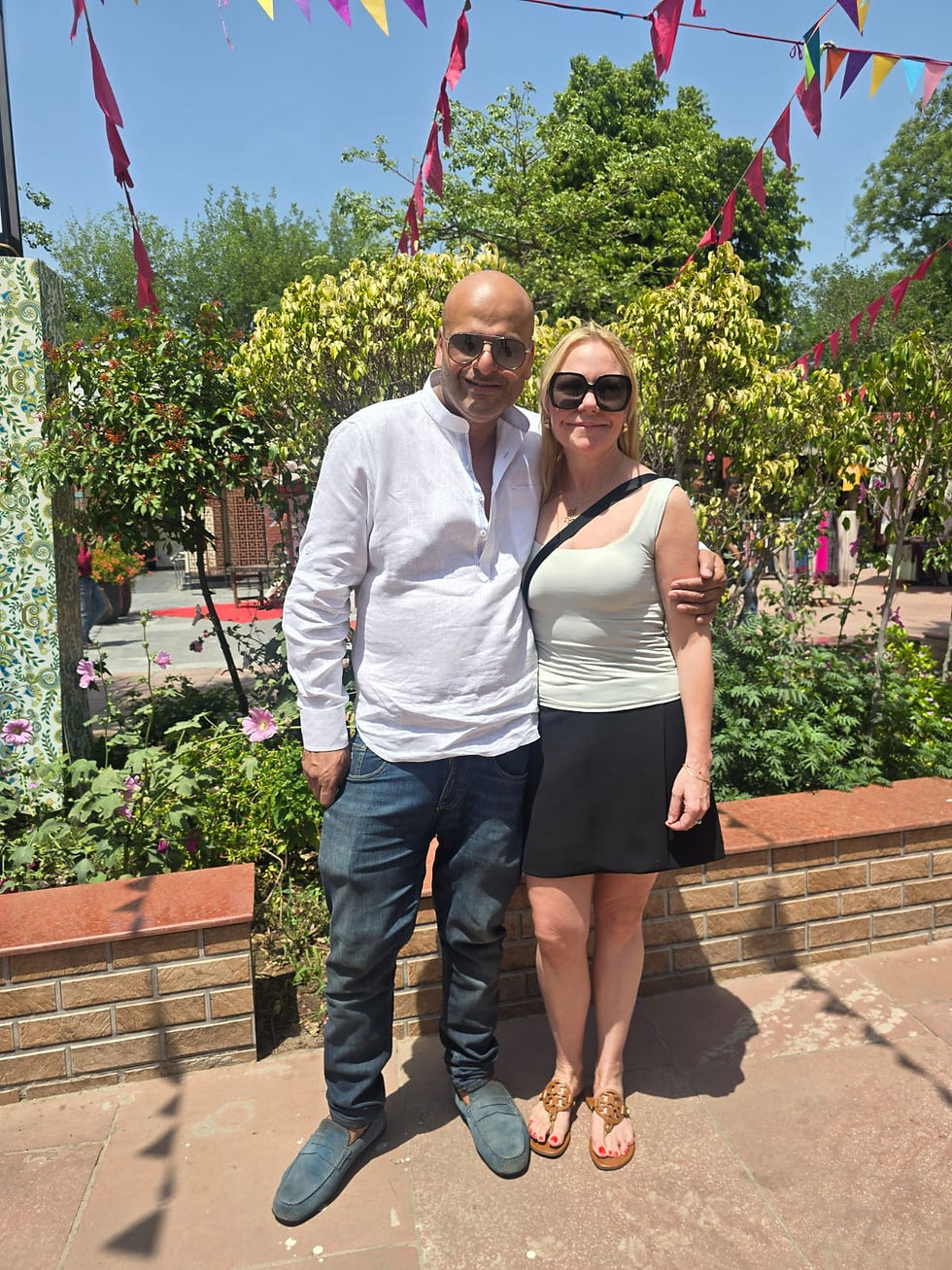
Dilli Haat is not an informal bazaar, though it performs like one.
The INA market is a formal piece of craft-market infrastructure run under Delhi Tourism: 166 built-up stalls allotted to artisans in roughly fifteen-day rotations through the offices of the Development Commissioners for Handicrafts and Handlooms.12 Read that again, because it is quietly remarkable: the rotation is the policy. The state deliberately cycles craftspeople from across India through the capital’s premier craft venue so that no vendor permanently captures the location and a buyer in Delhi can, over a year, meet artisans from nearly everywhere. It is a market designed as a sampler, a standing exhibition of the country’s handmade economy, with bargaining built in as the price-discovery mechanism.
Gautam’s method was choreography. He let me browse alone. When vendors called after me ....and they called, persistently, professionally... he pulled me away. He returned with me only when I was certain I actually wanted something, and then he bargained on my behalf in a language and register I could not follow, telling the vendors, he reported, that I was ”an honored guest” and that India’s hosts should treat me accordingly.
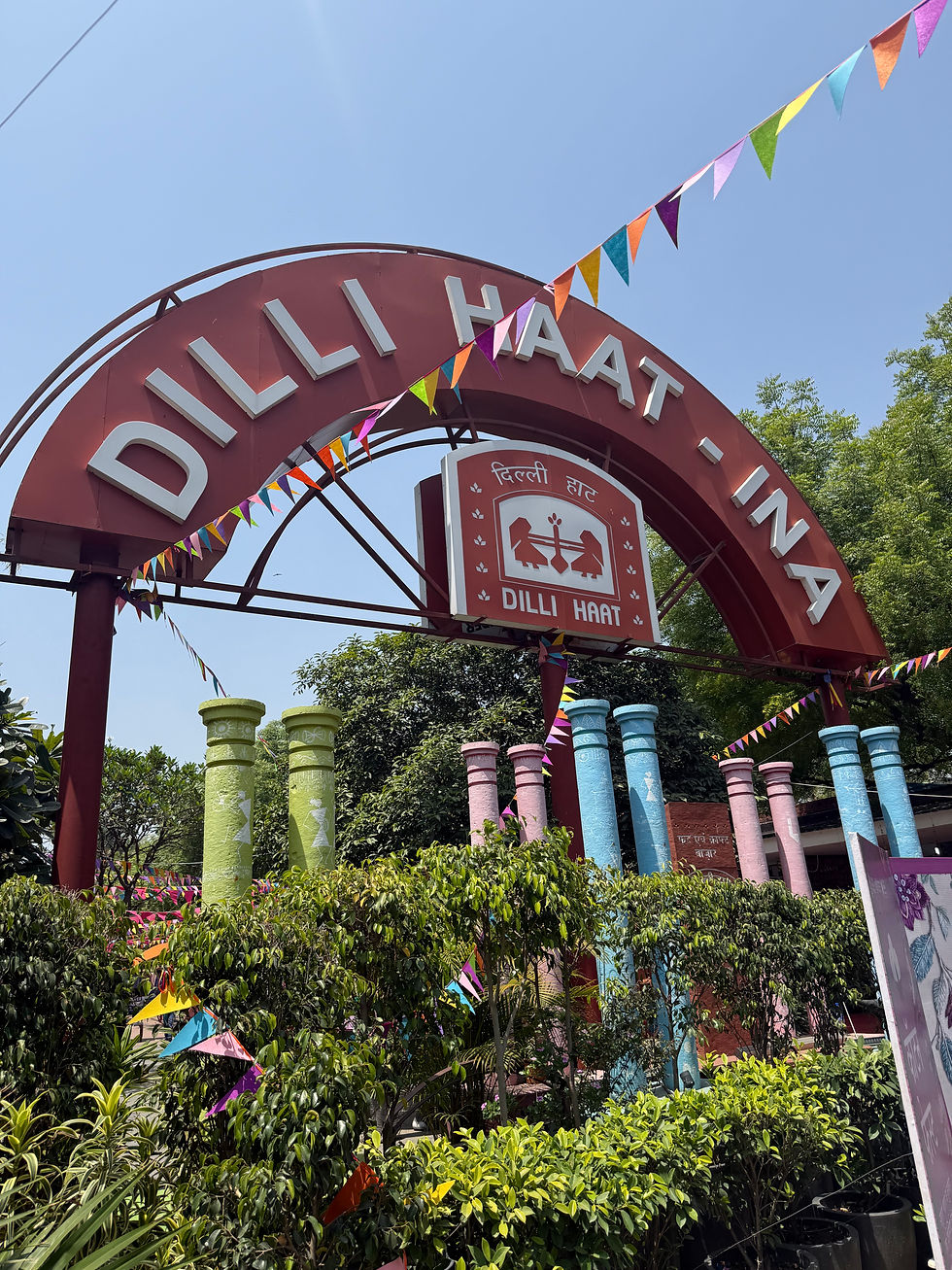
I bought anklets, earrings, handwoven pashminas, three table runners, and two small elephant figurines, and I had a wonderful time doing it. I also felt a specific discomfort that I noted at the time and want to preserve here precisely because it resists resolution: ”I’m always afraid that by saying I don’t want to pay that price, I’m telling them I don’t think their goods are worth it.”
Gautam carried none of that anxiety, because he understood what I did not: the opening price was not a verdict on the goods, and my counteroffer was not an insult to them. Bargaining was not a fight about worth. It was a conversation about position, mine as a foreigner, his as my sponsor, the vendor’s as a professional reading both of us. The price that emerged at the end measured the relationship as much as the object.
This is the section of the Source & Standard framework that economics textbooks describe most bloodlessly, market and social incentives, and Dilli Haat is the best field demonstration of it I have ever walked through. Price was only one rule in operation. The others were language, timing, persistence, reputation, performance, and the precise social meaning of the phrase “honored guest,” which converted me from a mark into a ward.
Markets in India were governed by knowing what things should cost, and that knowledge was social. Without Gautam, I would have paid more, enjoyed it less, and understood nothing. With him, every purchase was a small lesson in how the system actually ran.
One more market note, from the Old Delhi food tour I will come to shortly, because it belongs in the incentives ledger: at the end of that tour, after a genuinely moving home meal, the guide invited me to write a note in the family journal, which I did with real gratitude. Then he asked me to repost it as a Google review, and something in me balked.. not at the request exactly, which was modest and rational, but at the sudden visibility of the machinery. I had felt hosted; now I felt, briefly, like a conversion metric. Both things were true at once. The hospitality was genuine and it lived inside a reputation economy where a foreigner’s five stars have measurable value. I left the journal note. I understood the ask. The discomfort, like the bargaining discomfort, I am keeping...it is data.
The Pashmina's Hidden Water
It was Gautam, fashion designer, market translator, library-bar acquaintance, who handed me the thread that stitched the shopping to the series.
Somewhere between stalls, talking about his industry, he told me that water scarcity was becoming a bigger and bigger problem in India, and that clothing production, fabric, especially, was part of it. I was holding a pashmina at the time. It is a strange thing to stand in a market with soft goods draped over your arm and be told, by someone who designs them, that you are effectively holding water.
He is right, and the numbers are sobering. Cotton is one of the thirstiest commercial crops on the planet: producing a single kilogram of cotton fiber is commonly estimated to require on the order of eight to ten thousand liters of water, with estimates running double that in water-scarce growing regions where irrigation does the work rain does not.13 India is one of the world’s largest cotton producers, and much of that cotton grows on irrigation drawn from the same stressed aquifers that grow the country’s rice and wheat. Then comes wet processing, bleaching, dyeing, finishing, which consumes roughly fifty to one hundred fifty liters of water per kilogram of fabric and returns much of it as chemically loaded wastewater.13 Textile dyeing and treatment is regularly cited as one of the largest industrial sources of water pollution globally, and India’s dyeing clusters have documented histories of exhausted local supplies and contaminated rivers; Indian research institutions like TERI have been developing and recommending advanced oxidation treatment specifically so that dyeing wastewater can be cleaned to reuse standards and discharged at zero liquid levels.14 Industry water-stewardship handbooks now exist for the Indian textile sector for exactly this reason, because the brands buying Indian fabric have begun auditing the water behind it.15
Stand in Dilli Haat with that knowledge and the stalls reorganize themselves. The handwoven pashmina, the block-printed table runner, the dyed cottons hanging like flags — every textile in the market is partly congealed water: irrigation water in the fiber, process water in the color, groundwater in the washing. The handloom sector, it should be said, is generally far gentler on water than industrial mills, and a market like Dilli Haat, artisan-rotated, handcraft-certified, sits at the lighter end of the footprint. But the principle holds across the spectrum, and it is the same principle this series found in Singapore’s semiconductors and Bali’s rice: the things that travel carry water.
The pashmina in my hand was soft, beautiful, and easy to buy. The water behind it was harder to see, and a working fashion designer, standing in a craft market in his own capital, wanted a foreign food writer to see it.
I bought the pashmina. I think about the conversation every time I wear it, which may be the most useful thing a souvenir has ever done.
Responsible Whatr and the Problem of the Bottle

At the hotel, I was handed water in a slim aluminum can. The brand name was rendered in a stylized trademark that left me genuinely unsure, at first glance, whether I was reading an “o” or an “a” — it turned out to be Responsible Whatr, water minus a vowel — and the tagline underneath completed the pun: ”Can Make a Difference.”
For once in this series, the packaging is traceable, so let me tell you exactly what was in my hand. Responsible Whatr is a homegrown Indian brand launched in 2020 by Fabonest Food and Beverages, founded by Ankur Chawla, a veteran of India’s luxury-hotel industry, which may explain how the can found its way to a hotel like mine, and Bhrigu Seth. The water is spring water from a natural source in Solan, Himachal Pradesh, in the Himalayan foothills, marketed on its naturally balanced minerals and a pH of around 7.4. The can is the argument: aluminum, supplied by Ball Corporation, the world’s largest maker of beverage cans, and positioned explicitly as the answer to India’s single-use plastic problem (a problem we take seriously in Massachusetts) the founders cite a national plastic-waste burden on the order of 9.46 million tonnes a year, roughly forty percent of it never collected. Aluminum, the brand’s materials note, is infinitely recyclable, and recycling it uses about ninety-five percent less energy than producing primary metal. The company has sold more than a million cans, supplied water to G20 delegates in Delhi in 2023, and charges a premium for all of it, at launch, about sixty rupees for a half-liter, several times the price of the plastic bottle it wants to retire.16 The environmental and lifecycle claims are the company’s and its packaging partner’s; I am reporting them, not auditing them.†
So the can answers one anxiety, plastic, sincerely and possibly substantively, while silently confirming a much larger one: that the water in the municipal pipe could not be handed to a guest at all. The pun on the label is better than its writers may have intended. A can can make a difference to the waste stream. It cannot make a difference to the reason the can exists. The deeper text of any packaged water in India is not the label. It is the existence of the package.
India has a formal national drinking-water standard — IS 10500, maintained by the Bureau of Indian Standards, specifying acceptable and permissible limits for everything from coliform bacteria to fluoride to arsenic — and it is the benchmark the government’s own rural water mission adopts for the supply it builds.17 The standard exists. The gap is between the standard and the tap: intermittent supply, aging distribution, contamination in transit, groundwater laced in some regions with naturally occurring fluoride and arsenic that affect millions.18 Into that gap flows the bottled-water industry, the household RO filter, the twenty-liter delivery jug, the water tanker, and the boiling pot, an enormous, layered, privately purchased correction to a public shortfall. When Chennai’s four main reservoirs ran nearly dry in the summer of 2019, the city survived on tankers and, eventually, a dedicated water train.19
So here is the moral complexity I refuse to flatten, because flattening it is the standard failure of travel writing about bottled water. The environmental critique of the bottle is correct: it is packaging, transport emissions, and waste, multiplied by a billion-person market. And the bottle is also, for the traveler and for many residents, protection.. the cheapest available unit of certainty in a system where certainty is unevenly distributed. The problem with bottled water in India is not that people drink it. The problem is what its necessity reveals: that safety arrives through packaging, purchasing power, and parallel systems rather than through the pipe. A can of Responsible Whatr is a small, sincere object trying to shrink the footprint of a workaround. The genuinely responsible water is the kind that needs no can at all, which is, as we will see, exactly what the largest infrastructure program in the country is trying to build.
And there is one more layer, because the trip kept insisting on it: the can’s premium is partly provenance, Himalayan spring water, a named source, a mineral profile, which means that four centuries after the Mughals lifted a river into overhead tanks to make fountains announce their command of water, the prestige of water is still for sale in Delhi, now in an infinitely recyclable can. ”In India, water was a sign of prestige.” I wrote that at the Taj. It was on the label all along.
For me, water caution was a four-day inconvenience and a line item. For the people who served me, it is infrastructure, labor, cost, and health, every day, forever. That asymmetry is the real subject of this article, and the can is just where it becomes visible enough to photograph.
Old Delhi: Controlled Risk, Real Hospitality
The best food I ate in India, and some of the best food I ate on the entire three-country field study, came on a four-hour food and culture tour of Old Delhi, and I want to be honest about the structure of the experience before I rhapsodize about the flavors: it was guided immersion, not a reckless plunge. A trusted guide chose the stops. The vendors were known to him. The route was curated. The risk was controlled. I felt wonderfully, vividly immersed in Old Delhi, and the immersion was mediated at every step, which is not a confession that diminishes the experience but a fact that explains it. Someone had decided where it was safe for me to eat. That decision was the invisible standard underneath everything I tasted.

What I tasted: a lassi thick enough to slow time. Homemade breads. Vegetarian stews and curries built on legumes and vegetables and dairy. Small sweets, including a coconut one I am still thinking about. And the breakfast that quietly rearranged my preferences: at a tiny seated stall...a few families eating nearby, everyone busy, nothing performed for tourists — I was served a bread you pop open from the top with your hand, with a chickpea stew ladled alongside. I am not a huge American breakfast person, and I sat there thinking, with total clarity: ”I would take this over bacon and eggs any day.” And then, the realization that became a thesis: ”I forgot how much I enjoy chickpeas.”

Economical but SO flavorful. I wrote it in capital letters at the time and I am keeping the capitals, because the sentence is the food-systems insight of the whole trip. The Old Delhi breakfast cost almost nothing in ingredient terms, chickpeas, flour, water, spice, heat, and delivered more satisfaction than meals costing fifty times as much. The flavor was not in the inputs. It was in the accumulated technique applied to the inputs: soaking, simmering, frying, fermenting, churning, kneading, spicing, and serving immediately, at temperature, by hands that have made the same dish ten thousand times. Affordability and flavor were not opposites in Old Delhi. Affordability was the constraint that produced the flavor -generations of cooks extracting maximum depth from minimum cost, because that was the assignment. Singapore’s hawker excellence comes from regulated competition in built infrastructure. Bali’s flavor comes from ecological flow. Old Delhi’s comes from adaptation under constraint, and it can stand next to either of them.

The tour ended at the owner’s home, with a meal that contained the best sentence anyone said to me in India. The family served, in the guide’s framing, ”what they would eat, not what they think you would want to eat.”
That sentence deserves a moment of silence from everyone who has ever worked in hospitality. The entire global tourism food economy is built on the second clause, cooking at the visitor, anticipating the visitor, softening and translating and garnishing for the visitor. This family did the opposite, and the opposite turned out to be the highest form of hosting: they let me eat their actual life. No menu, no adjustment, no performance. It was the only meal of the trip with no standard between me and the food except the household’s own, and the household’s own standard, as the butter chicken had already taught me, is the deepest one there is.

There is a formal regulatory layer under all of this, and it matters even though I never saw it: India’s food-safety regulator, FSSAI, requires food businesses, down to and including street vendors, to be registered or licensed, and runs a Clean Street Food initiative aimed at lifting hygiene and safety standards in exactly the kind of vending ecosystem I was eating my way through, including certifying entire “Clean Street Food Hubs.”20 The formal standard exists on paper and in inspection regimes. But what I navigated Old Delhi on was the informal standard: the guide’s knowledge, the vendor’s reputation, the visible turnover of the stall, the heat of the food, the relationships.
In Singapore, the hygiene grade is posted on the stall and the infrastructure guarantees the baseline. In Old Delhi, the guarantee was social. Food safety, where I ate, was trust, accumulated, personal, and locally administered.
The more delicious the food became, the more obvious the hidden standard became: someone had decided where it was safe for me to eat. I am permanently grateful to that someone.

Cooked, Boiled, Fried, Fermented: The Water Between Safety and Comfort
Look back across everything I ate in India and a pattern emerges that I did not design: almost nothing raw, almost nothing room-temperature, almost nothing still.
Lassi, fermented dairy, churned. Chai, boiled, twice over, milk and water together.
Tandoori chicken, cooked at clay-oven temperatures.
Butter chicken, simmered in cream and tomato.
Chickpea stew, soaked and simmered for hours.
Breads, fried or slapped against the inferno wall of a tandoor.
Sweets, sugar cooked to preservation. Even the dairy that anchors North Indian cooking arrives transformed: yogurt, paneer, ghee, cream...milk made stable through culture, heat, and fat.
Water does not only appear in a glass. It appears as tea, as lassi, as the liquid in every stew, as the ice you decline, as the rinse on the cilantro, as the film on the just-washed plate.
A cuisine is, among many other things, a protocol for managing water, and North India’s kitchen grammar of boiling, frying, simmering, and fermenting is flavor technique and risk management fused so completely that they cannot be separated. The same hours of simmering that make a chickpea stew profound also make it safe. The same ferocious tandoor that creates char creates sterility. The fermentation that gives lassi its tang gives it its keeping qualities. I will not claim, because the culinary-history sourcing would need to be stronger than what I carry, that these techniques originated as water-safety measures; cuisines are never that single-minded. What I can say from direct experience is how they functioned for me: cooked, boiled, fried, and fermented foods were the bridge between risk and comfort, the means by which I could taste a place whose water I could not drink.
Heat was the treaty my body signed with Delhi.
And it worked. Four days, total immersion in dairy and street breads and market sweets, zero regrets, digestive or otherwise. The system, the layered, human, partly invisible system of guides and hosts and kitchens and bottles, held.
The Stakes Beneath a Traveler's Caution
It would be easy, and it would be a failure, to write about my four days of water vigilance as if the vigilance were the story. It is not.
The story is what my temporary, well-funded caution reveals about the permanent condition it briefly let me sample.
Globally, the WHO/UNICEF Joint Monitoring Programme, the authoritative scorekeeper of water, sanitation, and hygiene, has spent the last reporting cycle focused on exactly the theme this trip kept forcing on me: inequality, the gap between households that have safely managed water and sanitation and households that do not, within the same countries and the same cities.21 Unsafe water and inadequate sanitation remain leading drivers of diarrheal disease, which remains one of the major killers of children under five worldwide.22 That is the floor beneath every charming sentence ever written about being “careful with the ice.” A traveler’s stomach trouble is an anecdote. A child’s repeated waterborne infections are a developmental and mortality event. Same pathogen, different worlds.
India’s recent record here contains genuinely historic achievement, and I want to state it without irony before I complicate it. The Swachh Bharat Mission, launched in 2014, built individual household toilets at a scale with few precedents anywhere, more than a hundred million by 2019, when the country declared itself open-defecation free, with construction since pushing past 120 million and the program now pursuing “ODF Plus” villages with solid and liquid waste management.23 Whatever one’s view of the campaign’s politics or of the gap between declared and actual behavior change, researchers have documented both, the physical fact of the infrastructure is enormous, and the public-health logic connecting sanitation to water quality to child survival is not in dispute.
The complication is the one that runs through this entire article: a toilet still needs water. Hygiene needs water. Handwashing, the cheapest medical intervention in human history, needs water. Food safety needs water. Building the latrine is the step you can photograph; supplying the water that makes the latrine function, every day, in a drought year, at the end of a failing pipe, is the step that decides whether the photograph meant anything. Sanitation coverage and water security are not the same achievement, and the second is harder. Meanwhile, the quality problem runs underneath the access problem: in large swaths of rural India, the groundwater that households drink carries naturally occurring fluoride or arsenic at levels affecting millions, a contamination no behavior campaign can fix and only treatment or alternative sourcing can.18

I kept returning, in this section of my thinking, to the tone instruction I had set for myself before the trip: do not turn India into a poverty tableau. I saw sanitation conditions in Delhi that no honest account omits, and I saw begging children, and I am declining to render either cinematically, because the voyeuristic version of this paragraph helps no one.
The analytically honest version is this: everything that protected me, the sealed bottle, the screened hotel, the curated food stops, the filtered ice, was a privatized, portable answer to questions that public infrastructure is supposed to answer for everyone. My protections worked because they were exceptions. The policy challenge, which the next sections take up, is making them unnecessary.
The Plate Is a Water Map
Now widen the lens from the glass to the field, because drinking water, for all its visibility in a traveler’s day, is a rounding error in India’s water budget. Agriculture takes the overwhelming share: by most official accounts, on the order of eighty to ninety percent of the country’s freshwater use, with domestic consumption in the single digits.24 If you want to understand Indian water, you do not start at the tap. You start at the plate.
Here is the map. India is the world’s largest user of groundwater, extracting more than the United States and China combined, and roughly eighty-nine percent of what it extracts goes to irrigation.4,25 Two crops dominate the drinking: paddy rice and sugarcane together consume more than sixty percent of the country’s irrigation water while occupying only about a quarter of its cropped area.25 The national Economic Survey has warned in nearly annual language that cropping patterns skewed toward paddy, sugarcane, and wheat have driven “alarming” groundwater depletion, most severely in the northwest, Punjab and Haryana, the Green Revolution heartland, where assessment units now extract groundwater far faster than rain can recharge it.26
Why do farmers in semi-arid states grow the thirstiest crops? Because the incentive architecture tells them to. Free or heavily subsidized electricity for agricultural pumping makes the marginal cost of groundwater effectively zero — the deeper the water table falls, the more power it takes to chase it, and the subsidy absorbs the difference.4 Assured government procurement of rice and wheat at support prices makes those crops the safest bet a farmer can plant. The result is one of the great unintended infrastructures of the modern world: millions of private tubewells, drilled under a colonial-era legal doctrine that lets every landowner pump freely beneath his own land, collectively mining an invisible commons. The Green Revolution made India food-secure, a staggering achievement that ended an era of famine vulnerability, and it did so by converting groundwater into grain at a rate the aquifers cannot sustain.
And then India exports the grain. This is the concept the trade literature calls virtual water, and it is the single most clarifying idea in this entire series: every traded crop carries, embedded in it, the water that grew it. India is among the world’s largest rice exporters, which means India, a country holding four percent of the world’s freshwater, is one of the world’s great net exporters of water, shipped abroad in the form of basmati and parboiled grain drawn substantially from depleting aquifers.27 The national Economic Survey itself has made the point: India exports water-intensive rice and wheat while importing comparatively water-light pulses and oilseeds, an exchange that runs precisely backwards from its hydrology.27
Now set the plate from my trip on this map. The breads and the naan: wheat, irrigated, procurement-backed. The rice alongside the butter chicken: the thirstiest grain in the portfolio. The sugar in the sweets and the chai: sugarcane, the other champion drinker. The dairy in everything, the lassi, the butter chicken’s cream, the paneer, the ghee: behind every liter of milk stands the water that grew the fodder and watered the animal, in the world’s largest dairy-producing country. And the chickpeas, my beloved, revelatory chickpeas, turn out to be the quiet heroes of the water map as well as the breakfast: pulses are among the most water-efficient protein sources Indian agriculture grows, nitrogen-fixing, largely rain-fed, the crop category every water economist wishes occupied more Indian acreage.28 The dish I would take over bacon and eggs any day is also, hydrologically, close to the dish India’s aquifers would vote for. “Economical but SO flavorful” was, it turns out, a water-policy statement. I just didn’t know it when I said it.

The monsoon is the clock running above all of it. Three-quarters of India’s rain arrives in one season; the kharif planting rides the monsoon’s onset, the rabi crop depends on what the monsoon banked in soil and aquifer; a weak monsoon means drought, an erratic one means floods and ruined timing, and climate change is making erratic the new normal, longer dry spells punctured by more violent bursts.5,29 Stability shapes a cuisine; instability multiplies it. India’s regional food diversity, the very thing that makes it impossible to flatten into one standard, is partly the deep history of ten thousand microclimates and water regimes, each producing its own answer to the question of what can reliably grow here. The plate is a water map in both directions: water determines what India eats, and what India eats determines where its water goes.
If the plate is a water map, then agriculture is where the map becomes political. Which brings us to what India is actually doing about all of this.
Solutions Without False Comfort
It would be as dishonest to end the analysis at crisis as it would be to end it at the Leela’s filtered calm. India is not merely enduring its water situation. It is running what may be the largest and most plural set of water interventions ever attempted by a single country, and the honest assessment is that the effort is genuinely impressive and every solution is partial, both facts at full strength, no resolution offered.
Start with the flagship. The Jal Jeevan Mission, launched in August 2019, set out to deliver a functional tap connection to every rural household in India, a goal that sounds administrative until you absorb the baseline: when the mission began, only 3.23 crore rural households, about seventeen percent, had tap water at home.30 As of this spring, government reporting puts coverage at roughly 15.8 crore households, about eighty-two percent of rural India, one of the fastest expansions of basic infrastructure in the country’s history, with the mission extended through December 2028 to chase full saturation.30 The benchmark for what comes out of those taps is the BIS IS 10500 drinking-water standard, the formal spec meeting the physical pipe.17
The detail of the mission I find most quietly radical is who tests the water. Under the program’s water-quality framework, roughly twenty-five lakh, two and a half million, rural women have been trained to test their own village supplies using field test kits, feeding results into a national water-quality information system backed by a network of more than two thousand laboratories.31 Think about what that design encodes: the people historically tasked with fetching water, overwhelmingly women, at a cost the WHO estimates in crores of hours daily, are being made the monitors of its safety. Water-quality surveillance as women’s civic infrastructure. It is the kind of institutional choice Singapore never had to make and Bali makes through temple networks; India is making it through field kits and self-help groups, at village scale, two and a half million times over.
The honest asterisk, supplied by the government’s own commissioned surveying: coverage is not the same as functionality. Assessments of certified “Har Ghar Jal” villages have found that while nearly all households have the connection, only about three-quarters reliably receive adequate, safe water through it, the “dry tap” problem, where the infrastructure outran the source.30 A tap without water behind it is a promise, not a supply. Which is why the mission’s source-sustainability mandate, recharge, reuse, greywater management, rainwater harvesting, is not a green flourish but the load-bearing wall.30
Underground, where the real crisis lives, sits Atal Bhujal Yojana: a community-led groundwater management program targeting the most water-stressed blocks, built on the recognition that millions of private pumps cannot be regulated from Delhi but might be governed by the villages that share the aquifer, community water budgets, local rules, data made visible to the people doing the pumping.32
Alongside it, a national push to revive what India arguably invented: rainwater harvesting and recharge, check dams, restored ponds and tanks and stepwell-era logic, under campaigns like Jal Shakti Abhiyan, because India does not lack rain so much as it lacks storage, and capturing the monsoon where it falls is the cheapest new water source the country has.33 On the demand side: micro-irrigation and drip systems, crop diversification campaigns nudging farmers from paddy toward millets and pulses, and the slow, politically radioactive work of rationalizing power subsidies.34 In the cities: wastewater recycling and decentralized treatment, the obvious frontier given how little of India’s sewage is treated before it reaches rivers like the Yamuna.9,35 And threaded through everything, a distinctly contemporary layer: satellite aquifer mapping, IoT sensors, digital dashboards tracking the missions in real time.30
The pattern across all of it is the takeaway: India’s most promising shift is not any single program but a change of model, from centralized, supply-side, build-and-forget projects toward decentralized, community-led, data-monitored, sustainability-framed systems.
The reality check is permanent: dry taps where sources failed, funding gaps, uneven state-level implementation, aquifers still falling in the northwest. At Indian scale, every solution is partial. That is not an indictment. It is what water governance looks like for 1.4 billion people across a continent’s worth of hydrology, many imperfect answers, running simultaneously, forever.
Why India Cannot Be Solved by a Single Model
The lazy ending to a three-country water series would be a ranking, so let me preempt it: Singapore is not the answer key, Bali is not the moral, and India is not the cautionary tale. The three are different problems wearing the same molecule.
Singapore’s model, total centralization, closed-loop engineering, water priced at value, one government, 720 square kilometers, six million people, no farmers, is a masterpiece that does not scale to India and was never meant to. India’s water runs through twenty-eight states with constitutional authority over it, hundreds of millions of agricultural livelihoods, a monsoon lottery, interstate river disputes that topple governments, and a groundwater economy of tens of millions of private wells. You cannot NEWater your way out of that; the relevant unit is not the national tap but the village source, the district aquifer, the state procurement policy.
Bali’s subak model, water as sacred relationship, coordinated through temple networks, depends on a specific Hindu-Balinese fusion of religion, agriculture, and micro-governance that a thousand years built and that cannot be exported by memo, though India’s own water-temple traditions, stepwells, and tank systems are cousins to it in spirit.1,2
What the world can learn from India runs the other direction, and it is substantial: that water governance must work at household scale or it does not work; that infrastructure coverage and actual safe access are different metrics and the gap between them is where programs die; that women’s participation in monitoring is not a gender garnish but a design principle with two and a half million data points behind it; that groundwater is almost always the hidden crisis beneath the visible river; that agriculture, not the city, is the lever that moves the water budget; and that at sufficient scale, the only honest strategy is portfolio...many partial solutions, locally governed, centrally funded, perpetually maintained.
Singapore teaches what total control can achieve.
Bali teaches what cultural coordination can sustain.
India teaches what plurality requires, and since most of the world’s water-stressed population lives in conditions far closer to India’s than to Singapore’s, India’s lessons may travel furthest of the three.
The City That Drinks from Four Directions
Before the borders, one more system worth making visible, because Delhi itself is a daily miracle of hydraulic logistics that almost no one who lives inside it ever diagrams.
The capital sits on the Yamuna but cannot live on it. The Delhi Jal Board assembles the city’s drinking water from four directions at once: the Yamuna itself, lifted at the Wazirabad barrage; Ganga water, carried in from the east by the Upper Ganga Canal; Ravi-Beas water from Bhakra storage, delivered from Punjab and Haryana through the Munak canal system; and groundwater, pumped from Ranney wells and tubewells beneath the city.6 In rough terms, the river the city is named alongside supplies only the largest single share, on the order of forty percent, with imported canal water from two other river systems making up most of the rest.7 All of it depends on upstream releases governed by interstate allocations and, in dry years, by litigation: when Haryana’s releases fall and the Wazirabad pond level drops, Delhi’s treatment plants throttle down and the city’s taps feel a drought happening a state away.7
Hold that picture next to the Yamuna I described at the Taj, the river that is two percent of its own basin’s length through Delhi and three-quarters of its pollution, the river with little fresh flow for much of the year, and the full strangeness lands.9
Delhi drinks from the Yamuna above the city and uses the Yamuna below the city as a drain; the barrage at Wazirabad is effectively the membrane between the river as resource and the river as sewer. A megacity of more than twenty million people, the capital of the country, runs on water imported from the Ganga and the Indus tributary systems because its own river cannot carry the load and the engineering that makes this work every single day is, like Singapore’s, almost perfectly invisible to the people it serves.
The difference is the margin. Singapore engineered redundancy into confidence. Delhi engineers sufficiency into each summer, one interstate release at a time.
I drank that water, filtered, treated, bottled, layered through the hotel’s parallel system, for four days without once picturing the four-directional machine behind it. That is the thing about water infrastructure everywhere: you only see it when you go looking, or when it fails.
Borders and Rivers
Somewhere in the middle of the trip, looking at a map, I had a thought that I can only describe as geographically innocent: Pakistan is right there.
I have a website developer I work with who lives in Pakistan, talented, reliable, someone I genuinely like, and in the spirit of the thought, I asked her: would she want to come meet me in Delhi for a day? My treat, completely. It is, after all, so close.
She explained, kindly, that she logistically could not.
I knew about Partition the way Americans know about Partition, as a chapter heading.
What I had not felt until that exchange was the administrative reality of it: that two professional women, one already in Delhi and one a short flight away, could not have lunch, because the border between their countries is among the hardest in the world for exactly the people it divided. In the south, fifteen years ago, India had felt vast to me endless, interior, oceanic. In the north, it suddenly felt bordered. The mosques, the Mughal domes, the Peshawar-refugee butter chicken, the proximity of Lahore to Amritsar , Northern India is a region whose food, architecture, and population were all shaped by a line drawn in 1947, and my failed lunch invitation was the smallest possible demonstration that the line is still fully load-bearing.

Water, of course, crosses the line that people cannot. The rivers of the northwest, the Indus and its tributaries, rise in the Himalaya, flow through India, and continue into Pakistan, indifferent to 1947. For sixty-five years, the Indus Waters Treaty of 1960 governed that fact: a World Bank-brokered division of the basin, allocating the eastern rivers to India and the western rivers to Pakistan, with data-sharing and a permanent commission, a treaty so durable it survived multiple wars between its signatories and was cited for decades as the world’s great proof that water cooperation can outlast hostility.36
I have to report that the proof is currently suspended. In April 2025, following a terrorist attack on civilians in Kashmir, India placed the treaty in abeyance, the first rupture in its sixty-five-year history, and as I write this in 2026, it remains there: India has rejected arbitration rulings holding that the treaty permits no unilateral abeyance, senior Indian officials have said it will never be restored in its old form, and Pakistan, downstream and dependent, calls the suspension a weaponization of water.37 I am not going to adjudicate a live geopolitical crisis in a food and travel publication, and the editorial caution I set for myself, do not overburden this section with treaty mechanics, applies double when the mechanics are in flux. But the development sharpens, painfully, the exact point my lunch invitation taught me: geography does not equal access. The rivers still cross the border. The water-sharing framework that managed them for six decades, and the people, currently do not.
On India’s other flank, the Ganga continues into Bangladesh, governed by a 1996 treaty on sharing flows at the Farakka barrage, an agreement written with a thirty-year term that comes due this very year, putting a second great South Asian water compact on the negotiating table.38
However those negotiations resolve, the structural lesson stands and belongs in this series’ conclusion: water is never only climate and infrastructure. It is law, diplomacy, and borders. A country’s water security is partly written in treaties, documents that can be signed in goodwill, honored through wars, and suspended in an afternoon.
In the south, India had felt vast. In the north, it felt bordered, and so, I learned, does its water.
The Monsoon Arrives Sideways
On my final night in Delhi, I dressed up. After weeks of field-study practicality across three countries, I put on heels, actual (well platform, heels) because I was, in my own words, “going out in style for a final night of my trip.” The plan was the Piano Man Jazz Club, which everyone agreed was wonderful.
Delhi consulted the plan and sent a monsoon.
Not vertical rain. Horizontal rain, wind-driven sheets moving sideways through the streets while my driver circled, unable to find the club, and I recalculated the physics of heels on flooded streets. We never found the jazz. I retreated, soaked and laughing, to the library bar, where the books and the mahogany and the dim light received me like a returning regular, and where, let the record show, the bar redeemed anther part of the the different failed evening, after I walked into the famous Bukhara and walked right back out of what I can only describe as fluorescent lighting and loud men in bibs. Some rooms are sanctuaries. You return to them.

It is the perfect ending precisely because the city overruled me, so let me give the monsoon its analytical due rather than just its comic timing. Delhi’s rain is radically concentrated: the southwest monsoon months of June through September deliver, in an average year, about 640 millimeters at the city’s benchmark Safdarjung station, the overwhelming bulk of Delhi’s annual total, with the rest of the year contributing comparatively little.39 Nationally, the same season carries roughly seventy-five percent of India’s rainfall, filling rivers and reservoirs, recharging the groundwater that the rest of the year will spend, and setting the terms for the agricultural calendar.5 And the delivery is increasingly erratic: the recent pattern, in Delhi as across India, is longer dry spells broken by more violent bursts — months of deficit erased in twenty-four hours of flooding, the kind of rain that arrives sideways and shuts down a city’s storm drains and a tourist’s last-night plans simultaneously.29,39
This is the climate fact under everything in this article. India does not lack rain. It lacks rain distributed... across the calendar, across the map, across the aquifers that need slow soaking rather than violent runoff.
Water in India arrives the way it arrived on my last night: too much, too fast, too sideways, and gone by morning. The entire national water project, the reservoirs, the recharge structures, the check dams, the rooftop harvesting, the tanks and stepwells of the deep past, is, at bottom, one long argument with the monsoon’s delivery schedule: an attempt to make four months of sky last twelve months of country.
I experienced it as weather and a re-routed evening. Half a billion farmers experience it as the year’s income, arriving or not. The monsoon was the only system in India that overwhelmed me and could not be made navigable by kindness, although the library bar, it must be said, came close.
What India Reveals
I left India feeling exactly as overwhelmed as I had arrived, only more grateful.
The honking never became legible.
The bargaining never became entirely comfortable.
The luxury never stopped being both shelter and separation.
The water story never resolved; it only got more complicated the more I learned, which I have come to believe is what understanding actually feels like.
And again and again, at every point where the systems exceeded me, a person made them navigable: a guide laughing beside me at the horns, a hotel bending a menu for naan, a designer telling vendors I was an honored guest, a jeweler seeing more than he should have been able to see, a family feeding me what they would actually eat.
When people asked me afterward how the trip was, my honest answer was the one in my notes: ”all of the above lol.”
Exhausted, grateful, overstimulated, humbled, inspired, conflicted, eager to return, relieved to leave.
India does not issue single verdicts, and I have tried, in this article, not to impose one.
It is not a crisis, a temple, a market, a palace, or a kitchen. It is all of them, simultaneously, refusing to resolve, chaos and kindness, luxury and separation, immersion and protection, sparkle and sewage, abundance and scarcity, generosity and inequality, a country with two and a half million women testing village water and a capital whose sacred river runs as foam. The honest tribute is to hold all of it at once.
What India revealed, the thing the third country of this series was uniquely positioned to reveal, is dependence.
In Singapore, the system carried me so completely I never felt it.
In Bali, the relationship between people and water was visible enough to admire from a respectful distance.
In India, I could feel, hourly, how many people and systems were working so that I could safely drink, eat, and move through a day: the Jal Board pulling water from four directions, the hotel running its parallel infrastructure, the bottler sealing the bottle, the guide vetting the stall, the cook simmering the chickpeas, the host serving her own dinner, the women in villages I never saw testing the supply with field kits. Water made the dependence visible, but the dependence was always there, in every country, for every traveler, for every resident ...on systems, strangers, labor, luck, and care.
India just declined to hide it. That is not India’s deficiency. It may be India’s honesty.
All About the Water
So: three countries, one molecule, and the end of the series.
Singapore engineered water — into Four National Taps, into recycled certainty, into an infrastructure so successful it vanished from its own citizens’ awareness. Water there is a solved sovereignty problem, and the lesson is what patient, total, generational engineering can buy: the luxury of never thinking about water at all.1
Bali revered water — as relationship, as ritual, as the subak’s thousand-year choreography of rice and temple and flow. Water there remains visible because the relationship must be continuously maintained, and the lesson is what culture can coordinate that no ministry could mandate.2
India exposed water — as luxury and risk, prestige and crisis, protection and inequality, labor and weather, the condition beneath every plate and every border. Water there is visible because it cannot be assumed, and the lesson is what dependence actually looks like when nothing hides it: plural, human, partial, generous, unequal, and shared.
Every society reveals itself through water; what it engineers, what it reveres, what it protects, what it sells, what it wastes, what it cannot guarantee, and who must carry the risk when the system fails.
That sentence was this series’ founding premise, and three countries later I would only sharpen it: water is not an environmental theme that food writing occasionally visits. Water is the precondition of the entire subject. It decides what can be grown, washed, cooked, trusted, transported, sold, ritualized, and tasted. It is in the wheat of the naan and the steam of the chai, in the marble-reflecting canals of an emperor’s grief and the field test kit in a village woman’s hand, in the treaty in abeyance and the can called Responsible Whatr, in the hawker’s broth in Singapore and the spring-fed pool in Bali and the lassi in Old Delhi that I would take over bacon and eggs any day.
Every place leaves a mark on flavor, and rules shape what ends up on the plate... but underneath the place and the rules, always, is the water.
Which leaves only the advice, and it is the same advice my notes ended with, the truest sentence I brought home:
Do not be overwhelmed — but take time to meet the people.
You probably will be overwhelmed; Delhi and Agra are not interested in your composure, and the honking starts immediately.
Let it.
The systems will exceed you, and that is the authentic experience of the place, not a failure of preparation.
But the systems are not the country.
The people are, and in Northern India, the people are the interface: the translators, the bargainers, the hosts, the rule-benders, the ones who decide you are an honored guest before you have done anything to earn it.
The chaos is real.
The kindness is the infrastructure.
Drink the water they hand you. It will have been chosen with care.
-Jennifer C. Lyons, Picky Eater Boston
ENDNOTES
1. Jennifer [byline], “The Country That Engineered Survival: Singapore, Water, and the Infrastructure You Never See,” Source & Standard, All About the Water, Part I. Singapore water-system facts therein (Four National Taps, NEWater, catchment, desalination, Malaysia water agreements) per PUB, Singapore’s National Water Agency, https://www.pub.gov.sg.
2. Jennifer [byline], “Following the Water in Bali,” Source & Standard, All About the Water, Part II. Subak irrigation system and Tri Hita Karana per UNESCO World Heritage Centre, “Cultural Landscape of Bali Province: the Subak System as a Manifestation of the Tri Hita Karana Philosophy” (inscribed 2012), https://whc.unesco.org/en/list/1194.
3. NITI Aayog, “Composite Water Management Index,” June 2018: approximately 600 million Indians facing high to extreme water stress; India sustaining roughly 18 percent of the world’s population on about 4 percent of its freshwater resources; documentation of urban supply gaps and reliance on informal tanker markets. https://www.niti.gov.in.
4. World Bank, “India Groundwater: A Valuable but Diminishing Resource” (2012, and subsequent World Bank India water reporting): India as the largest user of groundwater in the world, extracting more than the United States and China combined; the role of free or heavily subsidized rural electricity in driving over-extraction. https://www.worldbank.org/en/news/feature/2012/03/06/india-groundwater-critical-diminishing.
5. Press Information Bureau, Government of India, “The Indian Monsoon,” explainer note, July 15, 2025: the southwest monsoon as India’s main rainy season, providing about 75 percent of total annual rainfall and supporting agriculture, rivers, lakes, groundwater recharge, and hydropower. https://www.pib.gov.in/PressNoteDetails.aspx?ModuleId=3&NoteId=154892.
6. Delhi Jal Board, Government of NCT of Delhi, “About Us”: DJB responsibility for production and distribution of potable water after treating raw water from the Yamuna, Bhakra storage, Upper Ganga Canal, and groundwater, and for wastewater treatment and disposal. https://delhijalboard.delhi.gov.in/jalboard/about-us.
7. On Delhi’s source mix and supply-demand balance: Economic Survey of Delhi (2021-22 and subsequent), “Water Supply and Sewerage” chapter (city requirement of roughly 1,380 MGD against peak planned supply near 1,000 MGD), https://delhiplanning.delhi.gov.in/sites/default/files/Planning/e13_water.pdf; R. Sharma et al., “Urban Water System of the National Capital Territory (NCT) of Delhi: A Comprehensive Study,” Water Supply (IWA Publishing) 24:11 (2024), reporting raw-water inflows of roughly 389 MGD from the Yamuna, 253 MGD from the Ganga, 221 MGD from Bhakra storage (Ravi-Beas), and about 90 MGD of groundwater, with roughly 93 percent household piped coverage, https://iwaponline.com/ws/article/24/11/3639/. On Wazirabad pond levels and dependence on Haryana releases, see Delhi Jal Board public statements and contemporaneous press reporting.
8. Archaeological Survey of India, “Agra — Taj Mahal” (World Heritage listing materials): the Taj’s siting on the right bank of the Yamuna where the river turns; the charbagh garden divided by broad shallow canals with water channels and fountains fed by overhead tanks; construction over approximately twenty-two years; marble from Makrana and semi-precious stones from multiple regions; artisans drawn from across the Mughal empire, Central Asia, and Iran. https://asi.nic.in/pages/WorldHeritageAgra. The Taj Mahal was inscribed as a UNESCO World Heritage Site in 1983.
9. Centre for Science and Environment, Yamuna analyses (2023-2025): the 22-km Delhi stretch of the Yamuna (Wazirabad to Okhla), about 2 percent of the river basin’s length, contributing roughly 76-80+ percent of the river’s total pollution load; little fresh water flow in the Delhi stretch for roughly nine months of the year, with flows dominated by drain discharges; Delhi’s 37 STPs and treatment shortfalls. https://www.cseindia.org/yamuna-can-be-cleaned-just-needs-a-plan-and-action-with-a-difference-cse-12909; see also Primus Partners, “Beyond the Froth: 22 Kilometres of Crisis” (2023/2025).
10. Taj Mahal Official Website (Archaeological Survey of India / UP Tourism), “Do’s and Don’ts”: shoe covers, half-liter water bottle, and Agra tourist map provided free with the SAARC/BIMSTEC/foreigner entry ticket; photography prohibited inside the main mausoleum; visitors instructed not to touch or scratch walls and surfaces of the heritage monument. https://www.tajmahal.gov.in/dos-and-donts.aspx (accessed June 2026).
11. On butter chicken’s post-Partition Delhi association and the origin dispute: NPR, “Butter chicken’s origin is being debated in a court case in India,” March 1, 2024, https://www.npr.org/sections/goatsandsoda/2024/03/01/1234793757/; NBC News, “Who invented butter chicken? A court in India will decide,” 2024. Both Moti Mahal founders — Kundan Lal Gujral and Kundan Lal Jaggi — were refugees from Peshawar who established the Delhi restaurant after Partition in 1947.
12. Delhi Tourism and Transportation Development Corporation, “Allotment Policy for Dilli Haat, INA”: 166 built-up craft stalls allotted through the Development Commissioner (Handicrafts) and Development Commissioner (Handlooms) in approximately 15-day rotational cycles. https://delhitourism.gov.in/pdf/revised_rate_for_allotment_policy.pdf.
13. On textile and cotton water footprints (reputable secondary syntheses of Water Footprint Network, UNEP, and World Resources Institute figures): cotton fiber commonly estimated at roughly 8,000-10,000 liters of water per kilogram (up to about 20,000 in water-scarce irrigated regions); wet processing (bleaching, dyeing, finishing) at roughly 50-150 liters per kilogram of fabric; textile dyeing and treatment cited as the source of approximately 20 percent of global industrial water pollution (UNEP/World Bank-derived figure). See, e.g., World Resources Institute, “The Apparel Industry’s Environmental Impact in 6 Graphics” (2017), https://www.wri.org/insights/apparel-industrys-environmental-impact-6-graphics, and sources at notes 14-15.
14. Nupur Bahadur, The Energy and Resources Institute (TERI), “TADOX® to Treat Textile and Dyeing Wastewater, Achieve Zero Liquid Discharge, and Enhance Water Reuse: R&D-Based Policy Recommendations,” 2021. https://www.teriin.org/sites/default/files/2021-03/textile-dyeing-wastewater.pdf.
15. India Water Stewardship Network / Gap Inc. / CEO Water Mandate, “Water Stewardship in the Indian Textile Industry: A Handbook of Recommended Good Practices,” 2020. https://ceowatermandate.org/wp-content/uploads/2020/09/WaterStewardshipHandbook_07-09_FINAL.pdf.
16. On the Responsible Whatr brand (Fabonest Food and Beverages Pvt. Ltd.): ANI/NewsVoir press release via Business Standard, “Responsible Whatr offers Indian consumers spring water in infinitely recyclable aluminium cans,” February 10, 2021 (co-founders Ankur Chawla and Bhrigu Seth; Himalayan spring source; pH ~7.4; aluminum cans supplied by Ball Corporation; aluminum recycling reducing primary-production energy by ~95 percent), https://www.business-standard.com/content/press-releases-ani/responsible-whatr-offers-indian-consumers-spring-water-in-infinitely-recyclable-aluminium-cans-121021000822_1.html; India Retailing and AlCircle, June 2020 launch coverage (source in Solan, Himachal Pradesh; founders’ plastic-waste figures of ~9.46 million tonnes annually with ~40 percent uncollected), https://www.indiaretailing.com/2020/06/10/responsible-whatr-launches-natural-mineral-water-beverage-in-aluminium-cans/; Business Insider India (premium pricing of roughly Rs 60 per 500 ml at launch, several times a standard plastic bottle), https://www.businessinsider.in/india/news/water-sold-in-aluminum-cans-to-avoid-plastic-use-is-the-latest-trend-in-india/articleshow/76490551.cms; AlCircle, September 2023 (water supplied to G20 delegates in Delhi; more than one million cans sold), https://www.alcircle.com/news/responsible-whatr-provided-spring-water-in-aluminium-cans-to-g20-delegates-delhi-99201. Environmental and lifecycle claims are those of the company and its packaging partner.
17. Bureau of Indian Standards, IS 10500:2012, “Drinking Water — Specification” (with amendments), the national drinking-water standard adopted as the quality benchmark under the Jal Jeevan Mission. https://bis.gov.in.
18. Central Ground Water Board / Ministry of Jal Shakti, groundwater quality reporting: naturally occurring fluoride and arsenic contamination affecting habitations across multiple states; see CGWB groundwater quality and year-book reports, https://cgwb.gov.in, and Press Information Bureau releases on water-quality-affected habitations addressed under the Jal Jeevan Mission.
19. Contemporaneous reporting on Chennai’s 2019 “Day Zero” water crisis (BBC News, Reuters, and Indian press, June-July 2019): the city’s four main reservoirs at or near empty; reliance on tanker fleets and a dedicated water train from Jolarpettai.
20. Food Safety and Standards Authority of India: licensing and registration requirements for Food Business Operators, including petty vendors, https://www.fssai.gov.in/cms/registration.php; and FSSAI “Clean Street Food” initiative and Clean Street Food Hub certification, https://fssai.gov.in/cms/clean-street-food.php.
21. WHO/UNICEF Joint Monitoring Programme for Water Supply, Sanitation and Hygiene, “Progress on Household Drinking Water, Sanitation and Hygiene 2000-2024: Special Focus on Inequalities,” 2025. https://data.unicef.org/resources/jmp-report-2025/.
22. World Health Organization, “Diarrhoeal disease” fact sheet: diarrhoea among the leading causes of death in children under five globally, with a large share attributable to unsafe drinking water, inadequate sanitation, and poor hygiene. https://www.who.int/news-room/fact-sheets/detail/diarrhoeal-disease.
23. Swachh Bharat Mission — Grameen, Department of Drinking Water and Sanitation, Government of India: more than 100 million individual household toilets constructed by 2019 and rural India declared open-defecation free in October 2019; cumulative construction since exceeding 12 crore (120 million) toilets; ODF Plus village certification ongoing. https://swachhbharatmission.ddws.gov.in/; Government of India progress documentation, June 2026.
24. Central Water Commission / Ministry of Jal Shakti, “Water and Related Statistics” (periodic compendium): irrigation and agriculture accounting for roughly 80+ percent of India’s water use, with domestic use in the single digits; consistent with Economic Survey discussions placing agriculture’s share at roughly 78-89 percent across measures.
25. Government of India, Economic Survey 2018-19, Vol. 1, chapter on water and agriculture (presented July 2019), and Press Information Bureau release, “National priority should be to shift from land productivity to irrigation water productivity,” July 4, 2019: approximately 89 percent of extracted groundwater used for irrigation (citing Asian Water Development Outlook 2016); paddy and sugarcane together consuming more than 60 percent of irrigation water; support-price and subsidy structures skewing cropping patterns toward water-intensive crops. https://www.pib.gov.in/newsite/PrintRelease.aspx?relid=191196.
26. Government of India, Economic Survey 2021-22 (and subsequent surveys), discussion of crop diversification and groundwater: cropping patterns skewed toward sugarcane, paddy, and wheat contributing to alarming depletion of fresh groundwater resources, especially in northwestern India. https://static.pib.gov.in/WriteReadData/specificdocs/documents/2022/jan/doc202213111201.pdf. On extraction exceeding recharge in Punjab and Haryana, see Central Ground Water Board, “National Compilation on Dynamic Ground Water Resources of India” (recent assessments), https://cgwb.gov.in.
27. Government of India, Economic Survey 2015-16, on virtual water trade: India as a net exporter of water embedded in water-intensive crops (rice, wheat) while importing water-light pulses and oilseeds; India among the world’s largest rice exporters. https://www.indiabudget.gov.in.
28. NABARD-ICRIER, “Water Productivity Mapping of Major Indian Crops,” 2018: paddy and sugarcane occupying roughly one-quarter of gross cropped area while consuming over 60 percent of irrigation water; pulses among the lower water-use, largely rain-fed crop categories. https://www.nabard.org.
29. R. Krishnan et al. (eds.), “Assessment of Climate Change over the Indian Region,” Ministry of Earth Sciences, Government of India (Springer, 2020): observed and projected increases in rainfall variability over India, with more frequent localized heavy-rainfall extremes and lengthening dry spells within the monsoon season.
30. Jal Jeevan Mission, Ministry of Jal Shakti, Government of India, official program materials, https://jaljeevanmission.gov.in/; Press Information Bureau releases on mission progress (baseline of 3.23 crore rural households / ~17% with tap connections at launch in August 2019; coverage of approximately 15.8 crore households / ~81-82% of rural households reported as of March-May 2026; mission extended to December 2028; BIS 10500 adopted as quality benchmark; digital monitoring and dashboards), including PIB, “Jal Jeevan Mission: Ensuring Tap Water for 15 Crore Rural Families,” February 2025, https://www.pib.gov.in/PressReleasePage.aspx?PRID=2098651. On the coverage-versus-functionality gap, see reporting on the Ministry’s 2024 commissioned functionality assessment (approximately three-quarters of connected households receiving regular, adequate, safe supply).
31. Press Information Bureau, Government of India, Jal Jeevan Mission water-quality monitoring releases: approximately 24.6-25 lakh (~2.5 million) rural women trained to test water quality using Field Test Kits; network of 2,100+ drinking-water testing laboratories; JJM Water Quality Management Information System (WQMIS). See PIB PRID 2098651 (February 2025) and PIB JJM update, October 2025, https://www.pib.gov.in/PressReleasePage.aspx?PRID=2182568.
32. Central Ground Water Board, Ministry of Jal Shakti, “Participatory Ground Water Management — Atal Bhujal Yojana”: community-led groundwater management in identified water-stressed areas, combining data, community water-security planning, and demand-side measures. https://cgwb.gov.in/en/participatory-ground-water-management-atal-bhujal-yojana.
33. Ministry of Jal Shakti / National Water Mission, Jal Shakti Abhiyan and “Catch the Rain” campaigns: rainwater harvesting, recharge structures, check dams, and water-body rejuvenation, under the motto “catch the rain, where it falls, when it falls.” https://nwm.gov.in; Press Information Bureau campaign releases.
34. Pradhan Mantri Krishi Sinchayee Yojana, “Per Drop More Crop” micro-irrigation component, Ministry of Agriculture and Farmers Welfare / Press Information Bureau: drip and sprinkler irrigation promotion; allied crop-diversification programs toward millets and pulses. https://pmksy.gov.in.
35. Central Pollution Control Board, “National Inventory of Sewage Treatment Plants,” March 2021: urban India generating roughly 72,368 MLD of sewage against installed treatment capacity of about 31,841 MLD and operational treatment of about 20,236 MLD — roughly 28 percent of generation. https://cpcb.nic.in.
36. “The Indus Waters Treaty 1960,” India-Pakistan, brokered by the World Bank; United Nations Treaty Series, vol. 419. https://treaties.un.org/doc/Publication/UNTS/Volume%20419/volume-419-I-6032-English.pdf.
37. On the treaty’s current status: Government of India announcements placing the Indus Waters Treaty “in abeyance” following the April 2025 Pahalgam attack, and reiterations through 2026 that it remains in abeyance (Ministry of External Affairs statements; India’s Permanent Mission to the UN, World Water Day 2026 remarks); Court of Arbitration supplemental awards of June 2025 and May 2026 holding that the treaty does not provide for unilateral abeyance, rejected by India. See Encyclopaedia Britannica, “Indus Waters Treaty” (updated 2026), https://www.britannica.com/event/Indus-Waters-Treaty; DD News, “India reiterates Indus Waters Treaty to remain in abeyance,” March 2026, https://ddnews.gov.in/en/india-reiterates-indus-waters-treaty-to-remain-in-abeyance-until-pakistan-ends-support-for-terrorism/.
38. “Treaty between the Government of the Republic of India and the Government of the People’s Republic of Bangladesh on Sharing of the Ganga/Ganges Waters at Farakka,” signed December 12, 1996, for a term of thirty years. Ministry of Jal Shakti, Government of India, https://mowr.nic.in/core/WebsiteUpload/2023/2023011877.pdf.
39. India Meteorological Department, Regional Meteorological Centre New Delhi, “Southwest Monsoon Report” and climatological normals for Delhi (Safdarjung), 1971-2020 base period: seasonal (June-September) normal rainfall of 640.4 mm for Delhi. https://mausam.imd.gov.in/newdelhi/mcdata/seasonal_report.pdf (accessed June 2026).


Comments