
The Country That Engineered Survival

Singapore, Water, and the Infrastructure You Never See

SOURCE & STANDARD
All About the Water · Part I of III
“I don’t know what happened to all the water. Apparently we drank it.”
— Fran Lebowitz
WATER FALLING FROM THE CEILING
The first thing you notice, if you notice it at all, is that you have to make a choice.
Changi Airport deposits you into the terminal in the usual way...customs, baggage, the particular fluorescent calm of an international arrivals hall. You can proceed directly to the taxi queue, MRT (Mass Rapid Transit) Subway, to a connecting flight, to wherever the itinerary takes you next. Most people do. The system is designed to move you through efficiently, and Singapore is very good at efficiency.
But if you leave the secured zone, if you cross back through into the public space of Jewel, the airport’s extraordinary glass-and-steel atrium that opened in 2019, you will find yourself standing at the base of one of the most theatrical things any government has ever commissioned: a waterfall that falls seven stories from a circular oculus in the roof, surrounded by terraced gardens, misting air, and the particular hush that comes when something is genuinely stunning.1
They call it the Rain Vortex. It is the world’s tallest indoor waterfall, and it exists inside an airport in a country that, for most of its modern history, did not have enough water to take for granted.2

I didn’t see it when I originally arrived in Singapore. I was tired from the flight, oriented toward the city, carrying the usual traveler’s momentum toward the next thing. It was only later, on my layover from Bali to India, that I purposely went to find one of the more quietly remarkable metaphors I would encounter on this trip: a nation so water-anxious it once negotiated water treaties the way other countries negotiate defense pacts, welcoming visitors with a seven-story waterfall, harvesting the rain from its own roof, circulating it through a closed system, wasting almost none of it.
Even the spectacle is engineered. The rain doesn’t fall — it is returned.
The most important systems often become invisible precisely when they are working. Singapore may be the world’s clearest proof of that.
This is what I kept thinking about during my days in Singapore, arriving here as the first stop of a longer field study through Asia: that the most important things were consistently the least visible.
The water in the tap, ultra-clean, blended from rainwater and recycled wastewater and desalinated seawater and a treaty with Malaysia that expires on a fixed date. The river outside The Fullerton Hotel, calm and jade-green in the early morning, looking as though it had always been that way, which it very much had not. The city itself, dense and warm and improbably functional, exuding a confidence that I gradually realized was not the confidence of natural abundance, it was the confidence of problems that had been solved, deliberately and at great cost, before most visitors thought to ask about them.
Fran Lebowitz was joking. But the joke lands differently in different places.
In Singapore, the answer to where the water went is specific, technical, and somewhat extraordinary: they found it, recycled it, desalinated it, captured it from the sky, and built a governance system rigorous enough to make sure it never disappeared again. That is not a punchline. That is a national survival strategy.
THE COUNTRY THAT HAD NO CHOICE
Singapore became an independent nation in 1965 under circumstances that were, by almost any measure, unpromising. Separated from Malaysia after a brief and contentious union, the island city-state found itself with a land area of roughly 720 square kilometers, no natural resources, no agricultural hinterland, no strategic depth, and critically, no reliable freshwater supply of its own. The country depended on Malaysia for the bulk of its water imports, a dependency that its first prime minister, Lee Kuan Yew, regarded as an existential vulnerability.3
That word existential, is not rhetorical. Lee Kuan Yew reportedly treated water independence as one of the central tests of whether Singapore could actually function as a sovereign nation. Water was discussed with the seriousness other governments reserve for military capacity. The question was not “how do we manage our water utility?” It was: “can we survive if the supply is cut off?”
This is the distinction this article demanded I hold, and I think it is worth holding carefully.
Many countries view water as a utility problem. A technical and administrative challenge, subject to the usual pressures of budget, politics, and infrastructure aging. Singapore, from the moment of independence, viewed it as a sovereignty problem. That difference in framing changes everything that follows: the investment horizon, the political will, the institutional structures, the willingness to ask the population to trust systems they cannot see.
The river you can see from The Fullerton today, the beautiful heritage hotel and former Post Office where I stayed, the Singapore River, winding past the former colonial trading houses and the Cavenagh Bridge was, in the 1960s and 1970s, heavily polluted. Squatters lined the banks. Sewage entered the water directly. Pig and duck farms upstream contributed biological waste at industrial scale. Street hawkers cleaned their equipment at the water’s edge. The smell, by contemporary accounts, was penetrating.4
In 1977, the government launched a cleanup campaign that would take roughly a decade to complete and require the relocation of thousands of households and businesses, the construction of sewer infrastructure on a massive scale, the enforcement of anti-pollution regulations that had no precedent in the country, and the kind of long-horizon planning that short electoral cycles rarely reward. It was expensive. It was politically complicated. It required a governing philosophy willing to think in generational terms rather than legislative terms.5
By 1987, the river was clean enough to support fish again.
Standing outside The Fullerton on my second morning in the city, coffee in hand, watching a heron fish from the far bank with the particular patience of a creature that has no concept of a deadline, I tried to hold both versions of the river simultaneously — the one that was, and the one that is. It was almost impossible. The present version is so complete, so apparently inevitable, that the contaminated version felt like reading about a different place entirely.
That, I think, is the point.

Successful infrastructure doesn’t announce itself. It disappears into the background of ordinary life, becoming the invisible floor beneath everything else.
When infrastructure fails, when the pipes burst, when the river floods, when the lights go out, it becomes visible with a sudden, shocking clarity. When it succeeds, it fades. The Singapore River, today, is scenery. It is the backdrop for a hotel terrace and a tourist photograph and a heron’s breakfast. The forty years of engineering and enforcement and political commitment that made it that way are not visible in the water. They are the water.
THE FOUR NATIONAL TAPS
Singapore’s contemporary water strategy is organized around what the country’s public utility, PUB, calls the Four National Taps: local catchment water, imported water from Malaysia, NEWater (highly purified recycled wastewater), and desalinated water. The architecture of the system is not accidental redundancy, it is a portfolio strategy, deliberately constructed so that no single source can create a crisis.6
Local catchment has expanded considerably since independence. Singapore now captures rainwater across roughly two-thirds of its land area, directing it into a network of seventeen reservoirs. The Marina Reservoir, created in 2008 by damming the mouth of the Singapore River and gradually freshening what was once a tidal estuary, is perhaps the most striking example: the river itself became a reservoir. The catchment network is integrated with the urban landscape through a system of canals and drains that have been progressively upgraded and, in many cases, transformed into public amenities: landscaped waterways where people walk, children play, and herons fish.7
Imported water from Malaysia remains part of the mix, though its relative share has decreased as the other taps have expanded. Two water agreements govern the arrangement, with the last scheduled to expire in 2061. Singapore’s long-term strategy has been to reduce dependence on imports below the level at which a disruption would constitute a crisis. The goal is not to end the relationship, it remains economically rational, but to ensure it is a choice rather than a necessity.8
Desalination rounds out the portfolio. It is energy-intensive and comparatively expensive, but it is essentially unlimited in scale: Singapore is an island, surrounded on all sides by seawater. Two desalination plants currently operate, with more planned. Desalination is the most expensive tap to turn on, but it is the tap that can never run dry.9
And then there is NEWater.
NEWATER AND THE PSYCHOLOGY OF TRUST
The word ‘recycled’ does a lot of work in discussions of wastewater reuse, and not always helpful work. It summons, for many people, something that is being made acceptable again after being made unacceptable.... a salvage operation, a workaround, a compromise. Singapore understood this problem very early, and the NEWater brand was, among other things, an act of linguistic strategy.
What NEWater actually is: treated wastewater that has been processed through microfiltration, reverse osmosis, and ultraviolet disinfection, producing water that meets or exceeds World Health Organization standards for drinking water. The process removes pharmaceuticals, hormones, heavy metals, pathogens, and essentially everything else. What comes out is purer, by most measures, than what comes in from most conventional sources.10
A significant portion of NEWater goes directly to industrial users, semiconductor fabrication plants, in particular, require water of extraordinary purity , which means it never enters the drinking water system directly. Instead, it is blended into reservoirs, where it mixes with other sources and is treated again before distribution. This indirect potable use is, from a public health standpoint, impeccably safe. It is also, from a public communication standpoint, carefully managed.11
The NEWater Visitor Centre which opened in 2003 and has been updated several times since (and unfortunately recently closed before I was there) was not an afterthought. It was part of the strategy. Singapore invested in public trust the same way it invested in pipes. There were school field trips. There were tastings. There were national events at which politicians and dignitaries drank NEWater prominently and publicly. The Prime Minister served it at National Day celebrations. The message was not defensive. It was celebratory! Singapore had done something technically remarkable, and it wanted its citizens to understand and take pride in what had been achieved.12
The outcome is perhaps the most interesting part of the story. Speak with Singaporeans today about NEWater and you will often find — nothing much. Not disgust, not enthusiasm, not even particular awareness. It has become ordinary. The recycled wastewater that once seemed to require delicate public management is now, for most residents, simply water. It comes from the tap. It is clean. It is fine.
That ordinariness is the achievement.
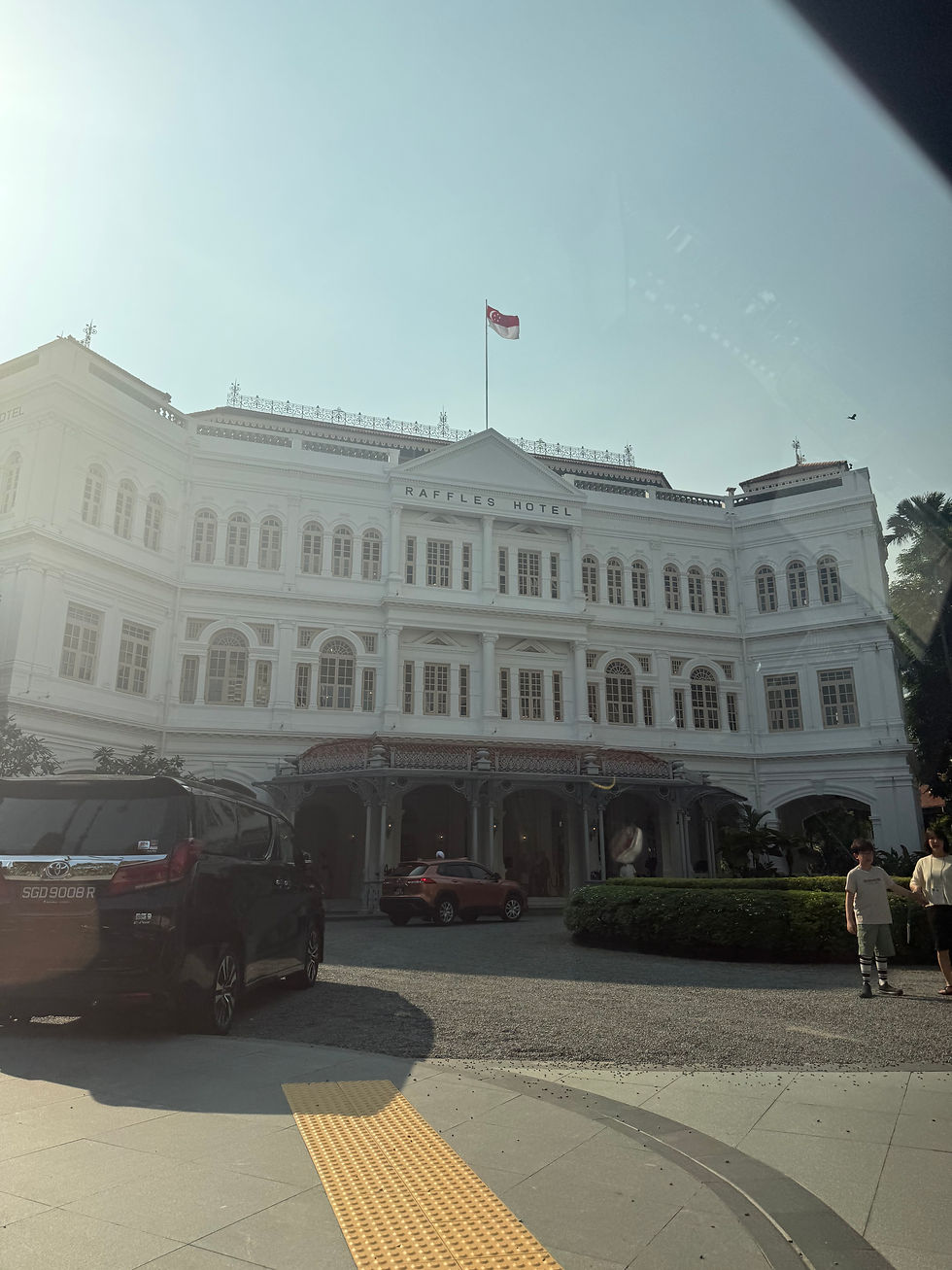
Which made one conversation on my first night in the city all the more striking. I’d arranged to meet a friend at Raffles, the Long Bar, specifically, because some rituals are worth observing even if you are not particularly interested in a Singapore Sling (we had the gin and sake versions which in my opinion where much better than the overly sweet original). She had been living in Singapore for fifteen years. She was sharp, curious, professionally accomplished, the kind of person you would expect to know the operational details of the city she’d made her home.

I mentioned NEWater; that Singapore produces its own ultra-clean recycled water, that it meets WHO drinking standards, that it supplies roughly forty percent of national demand.
She looked at me with genuine surprise.13
“Really?” she said. “I had no idea.”
Not skepticism. Not resistance. Just honest, complete unawareness. She had been drinking the water, presumably remarking that it was fine, and never once registered that its origins were remarkable. I found this more illuminating than any official communication campaign could have been. The NEWater Visitor Centre efforts over 20 years, the school field trips, the Prime Minister’s National Day toast, all of that public trust-building had worked so thoroughly, in the most unexpected possible way: it had produced not informed enthusiasm but comfortable ignorance. The system had become so normal that even a highly educated fifteen-year resident didn’t know it existed.
That is a different kind of achievement than the engineering. It is the achievement of infrastructure so successful it has dissolved entirely into the background of daily life. Singapore didn’t just solve its water problem. It made solving the water problem unremarkable.
The global implication is significant.
The technical barriers to expanding water reuse are, in most places, not the limiting factor. The engineering is understood. The costs, while real, are manageable for affluent societies. What stops countries from pursuing aggressive wastewater recycling seems... almost always psychology. A visceral resistance to the idea, regardless of what the science says. Singapore’s contribution to global water thinking is not only the specific technology of NEWater but the demonstration that the psychological barrier can be overcome, given time, transparency, and a government willing to do the patient, unglamorous work of building public trust.
You can engineer water more easily than you can engineer eating habits. But you can engineer trust — if you start early enough and tell the truth.
THE INVISIBLE ECONOMY BENEATH THE DIGITAL ONE
There is a story Singapore tells about itself, and that is frequently told about Singapore, in which it is primarily a financial hub, a tech corridor, a logistics center, a city-state that leveraged its geographic position and its governance competence into one of the highest per-capita incomes in the world. This is accurate as far as it goes. What it tends to obscure is how thoroughly that economy depends on water.
Semiconductor fabrication requires ultra-pure water in extraordinary volumes. The chips that run our phones, our data centers, our cars, and increasingly our AI infrastructure cannot be manufactured without water that has been processed to near-absolute purity. Singapore is home to a significant portion of the world’s wafer fabrication capacity. That capacity depends, in a way that is rarely discussed outside of engineering circles, on NEWater. The same system that processes the city’s wastewater into drinking-water-quality water also provides the industrial purity that semiconductor plants require.14
The connection goes further. Data centers, the physical infrastructure of the digital economy, require massive cooling systems that consume enormous quantities of water. Pharmaceutical manufacturing is similarly water-intensive. Port logistics, food processing, hospital systems, hotels: all of it runs on water that, in Singapore, is reliable, clean, and priced to reflect its real value rather than the subsidized fiction common in countries with more apparent abundance.15
This is the point that tends to get lost when water is discussed primarily as an environmental or public health issue: the digital economy is a water economy. The apparent weightlessness of software and services is underwritten by physical infrastructure that is extremely wet. AI’s expanding computational demands are, among other things, a growing demand for cooling water. Every major data center siting decision now includes a water-risk analysis. Drought conditions affecting the Panama Canal in recent years disrupted global shipping and raised logistics costs in ways that rippled through supply chains far from any visible waterway.16
Singapore, having internalized this connection early, built its economic infrastructure on water security rather than assuming water security would take care of itself. It is worth asking, in 2026, which regions of the world are still operating on the second assumption.
THE FOOD QUESTION
Singapore imports over ninety percent of its food. This is not a rounding error or a policy failure, it is a structural reality of a city-state with limited agricultural land and a population of nearly six million people. It is also, in the context of everything this article has covered so far, a striking contrast: the country that engineered water independence never achieved, or really attempted, food independence.17
The “30 by 30” initiative, a Singapore Food Agency goal to produce thirty percent of the country’s nutritional needs locally by 2030....was, in retrospect, an ambitious expression of the same impulse that drove NEWater: the desire to reduce critical dependencies before crisis makes reduction necessary. Vertical farms growing leafy greens under LED arrays. Coastal aquaculture producing fish and prawns. High-tech egg farms designed for urban density. All of it gesturing toward a future in which Singapore’s food supply is somewhat less exposed to the disruptions of export bans, shipping bottlenecks, climate-driven harvest failures, everything that a globalized food system periodically delivers.18
The initiative has faced headwinds that NEWater did not. Water purification is a matter of engineering and public trust. Food production is a matter of economics, taste, culture, and the accumulated habits of a population that has largely stopped cooking at home.
Singapore’s hawker culture , the extraordinary network of open-air food courts serving rich, cheap, varied food, is among the genuine wonders of urban life anywhere in the world. It is also a food system predicated on imported ingredients, prepared with skill and tradition, and priced at levels that would be impossible if the inputs were locally grown.

The deeper tension, is that you can engineer water more easily than you can engineer eating behavior. Water doesn’t have a cuisine. It doesn’t have habits or preferences or the emotional associations that accumulate around particular foods over generations. You can change what comes out of the tap, communicate transparently about how it got there, and watch the public eventually accept it as ordinary.
Getting a population accustomed to cheap, diverse, imported food to reorient toward expensive, limited, locally grown produce is a different order of challenge: behavioral, cultural, economic... for which there is no engineering solution.
Singapore’s food system is, in this sense, the limit case of what centralized planning can achieve. It demonstrates, almost by contrast, how much of the NEWater success story was about the particular nature of water as a resource: invisible, fungible, centrally controlled, and ultimately indifferent to taste.
TASTING IMPACT: WHAT WATER DOES TO WHAT YOU EAT
The Source & Standard framework asks a consistent set of questions wherever it lands: What does the climate and land produce? What practices and traditions have grown up around those ingredients? How do standards, laws, and institutional choices shape what reaches the plate? And ultimately — what does all of it taste like, and why?
In Singapore, applying that framework leads somewhere unexpected. A tropical city-state with no agricultural hinterland and virtually no domestic food production should not have a distinctive food culture. And yet it does. One of the most vibrant and seriously regarded in Asia. The hawker center, Singapore’s most iconic food institution and a UNESCO Intangible Cultural Heritage since 2020, serves as the organizing lens.19
The food at a Singapore hawker center is an education in what happens when a small, wealthy, multicultural city-state at the crossroads of major trade routes decides to feed itself efficiently and well. Hainanese chicken rice — poached chicken served over rice cooked in chicken stock and fat, with ginger paste and chili sauce — is perhaps the national dish, a Chinese immigrant preparation that became something distinctly Singaporean: restrained, precise, the quality of the water used in poaching and cooking the rice discernible to anyone paying attention.20

One morning, I went on a hawker center food and culture tour. What the tour provided was not curation so much as context: a guide who had grown up eating at these tables, who could explain not just what I was eating but where the dish came from and why it landed here, in this particular form, in this particular city.
We moved through stalls in what I can only describe as organized abundance. There was chicken rice from a stall whose queue had been forming since morning. There was laksa with a broth so layered it seemed to have been building across several decades. There was char kway teow from a wok that had been in continuous service since the stall owner’s father ran it. There was rojak and carrot cake and tau huay and things I ate enthusiastically before I knew their names. The prices were, by any reasonable global standard, startling — a full meal for a few dollars, served on trays, eaten at shared tables, with no pretension whatsoever and no apology for the absence of it.
And then the other thing, which took me a moment to register properly: the Michelin Guide has awarded stars to hawker stalls. Not to restaurants that imitate hawker food with tablecloths and wine lists. To the actual stalls, the actual queues and plastic stools and overhead fans. Chan Hon Meng, who has been cooking soy sauce chicken at his stall for decades, was for a time the world’s most affordable Michelin-starred meal at roughly two dollars a plate. The Michelin inspectors did not lower their standards. Singapore raised its stalls to meet them, or, more precisely, a few of its stall operators had been running at that level all along, without anyone outside the city stopping to notice.

What stays with me is not any single dish but the texture of the experience. The communal tables where strangers ate alongside each other without ceremony, the particular sensory mix of dialects and languages and cuisines existing in a shared space that felt, above all, completely ordinary. Malay families and Chinese uncles and Indian office workers and tourists and construction crews, all finding their respective stalls, all occupying the same infrastructure of tables and trays and overhead fluorescent light, all participating in something that functioned simultaneously as lunch and as a kind of low-key civic fact. This is what Singapore looks like from the inside, I kept thinking. This is what the city is actually for.
Laksa, a spiced coconut milk noodle soup that varies by region and stall, carries the layered influence of Malay, Chinese, and Peranakan cooking traditions. Char kway teow — flat rice noodles stir-fried over intense heat with prawns, cockles, eggs, and bean sprouts — is a dish whose excellence depends almost entirely on wok hei, the breath of the wok, the high-temperature smoky caramelization that only open-flame cooking produces and that cannot be replicated in a home kitchen. These dishes arrived from China, Malaysia, Indonesia, and India, carried by the waves of immigration that made Singapore what it is, and were then refined by competition: in a city where eating out is the default and every hawker stall competes with dozens of others, the standards are kept honest by the market.21
What water contributes to this tasting story is not, in Singapore’s case, the mineral complexity that characterizes water’s influence on bread in Paris or espresso in Naples. Singapore’s water is highly treated, blended, consistent to the point of near-uniformity. What it contributes is reliability. The same neutral, ultra-clean baseline, every day, in every stall, regardless of season or rainfall. This matters more than it might seem.
In countries where water quality is variable, where mineral content shifts with the aquifer, where seasonal flooding introduces contamination, where aging pipes leach metals, food safety and flavor are both subject to an uncertainty that chefs and home cooks manage rather than solve. In Singapore, that variable has been engineered out of the equation. The uncertainty that remains is craft, heat, timing, the quality of the prawn, the freshness of the cockle.22
Put differently: Singapore’s water infrastructure doesn’t make the food taste like anything in particular. It removes obstacles to the food tasting exactly as intended. The consistency that makes a bowl of Hainanese chicken rice at a hawker center in Tiong Bahru taste, reliably, like what it is supposed to taste like, that consistency has water in its foundation, invisible and unacknowledged, the way a good stage has a floor you don’t notice until it’s uneven.
The food safety dimension reinforces this. Singapore’s regulatory framework for food handling is rigorous. The Singapore Food Agency licenses hawkers, inspects premises, grades stalls, and maintains standards that are, by regional comparison, exceptionally high. A hawker stall’s hygiene rating is publicly posted. The system works partly because the water infrastructure beneath it, reliable supply, high purity, functioning sanitation, makes compliance achievable. You cannot maintain high food safety standards without water you can count on.23
There is something worth sitting with here for anyone who thinks about food sourcing and food systems. We tend to think of flavor as primarily a function of ingredients: the variety of the tomato, the breed of the pig, the mineral content of the soil. And it is, largely. But beneath the ingredients is the water that grew them, washed them, cooked them, and constitutes a significant portion of everything we eat. In Singapore, that water is as engineered as the irrigation terraces of a French AOC wine region — just less visible, less celebrated, and far more recent.
The “30 by 30” vertical farming initiative, for all its economic challenges, points toward a future in which Singapore could theoretically close the loop: water produced domestically, used to grow food domestically, within a controlled and monitored system. What it can’t close is the cultural loop, the hawker center, the laksa, the char kway teow , because those dishes are products not of Singapore’s soil and water but of its history, its migrations, its polyglot urban density. The flavor is the city. And the city, in this case, is itself an infrastructure project.
It is worth pausing on a fact that tends to get obscured in the romance of the hawker center experience: Singapore did not create this system because it wanted charming food halls. It created the system because street food was a public health problem. In the 1950s and 1960s, as Singapore urbanized rapidly after independence, unlicensed vendors operated on sidewalks throughout the city. Food safety was inconsistent, sanitation infrastructure was weak, and disease was a genuine concern. Sewage management was inadequate. Congestion was worsening. The government faced a choice that governments confronting informal economies frequently face: ban the vendors, ignore the problem, or do something harder, which is to formalize the informal without destroying what made it valuable.

Singapore chose the third option. Vendors were licensed and relocated into centralized facilities. Sanitation infrastructure was built in. Shared utilities and drainage were integrated. Rent was controlled initially to keep the stalls accessible. Hygiene inspections became rigorous and the grades were posted publicly. The state essentially declared: street food is culturally necessary and economically rational.... but it must function inside an engineered system. The result, across several decades, is what a visitor now experiences as the hawker center: a form of urban infrastructure that is simultaneously a public health achievement, an economic policy, a cultural institution, and, by any honest accounting, one of the great pleasures of being in Singapore.
The integration with public housing matters here. Singapore’s Housing & Development Board concentrated the population into high-density apartment blocks with deliberate intentionality, and hawker centers were built as neighborhood infrastructure, not tourist amenities. People did not travel to eat at hawker centers. They walked there. For families in public housing, which is to say, most families in Singapore (although not the way Americans think of public housing- think Nice!) the hawker center was not a dining option but a default: affordable, nearby, varied, and safe enough to eat at daily without anxiety about what might be in the water or on the surfaces. That reliability, as this article has been arguing throughout, does not happen by accident. It was built, at cost, and it is maintained through ongoing enforcement and inspection that most visitors never think to notice.
Food, in other words, became part of national identity formation in a deliberate way. Singapore needed to be a country, and it needed its three million or more residents, Chinese, Malay, Indian, Peranakan, and numerous others, to experience themselves as sharing something. The hawker center provided a daily occasion for that shared experience: Michelin-quality soy sauce chicken next to nasi lemak next to roti prata next to mutton soup, all under one roof, all priced for the same population, all eaten at the same tables.
Food as civic infrastructure. Diversity as daily fact rather than annual festival.
THE QUESTION AN AMERICAN LAWYER KEEPS ASKING
I should be transparent about what I was doing as I moved through Singapore: I was practicing law in one part of my mind while traveling in another. I can't help but view things from a certain lens. I work in public procurement, in a system designed around checks, balances, transparency requirements, and the diffusion of authority specifically to prevent the kind of concentrated decision-making that Singapore has, to a remarkable degree, embraced. I believe in that system. I believe in the First Amendment, in the press as a check on power, in the importance of being able to criticize a government without legal consequence, in the fundamental legitimacy of mess and disorder as the cost of genuine freedom. These are not abstract commitments. They are, in some sense, professional ones.
Singapore tests those commitments. Not by threatening them, Singapore poses no threat to American jurisprudence, but by complicating the easy assumption that freedom and functionality must travel together and that the alternative to one is always a failure of the other. The trains in Singapore run. The hawker centers are safe. The streets are clean (and also safe to walk alone at night as a solo female). The water is extraordinary. The transit system works with a reliability that a regular commuter on the MBTA ( the "T" as we say in Boston) might receive as a kind of science fiction. The corruption index is among the lowest in the world. The public infrastructure is, by the metrics I could observe directly, operating at a level that would be considered aspirational in most American cities.
This did not make me wish Singapore’s system on my own country. But it did make me sit with a discomfort I think is worth naming. Singapore imposes strict regulations, significant fines, and strong state oversight. There are meaningful limitations on certain forms of speech and political assembly. Surveillance infrastructure is visible in public spaces. The legal system can and does reach conduct that would be constitutionally protected in the United States. The freedom to be disruptive, to protest without permission, to write critically about the government without legal risk, these are circumscribed in ways that an American takes for granted as inviolable and that Singapore has made explicit tradeoffs to constrain.
And yet. The hawker center at which I sat, eating two-dollar food that the Michelin Guide had found worthy of recognition, at a table shared with strangers (some of whom became good friends!) and some of whom whose languages I could not identify (they seemed genuinely surprised to see us sitting with them!), in a city that had once been a malarial trading post with a polluted river and no reliable water , was not a testament to oppression. It was a testament to something else, something harder to name, something I keep circling around: the possibility that a certain kind of freedom from fear, freedom from contamination, from infrastructure failure, from the particular anxiety of not knowing whether the system will hold, is also a form of freedom, even if it is not the form that American political culture has learned to name and defend.
I am not resolving this tension. I am not sure it can be resolved, and I am suspicious of arguments, from either direction, that reach resolution too easily.
What I can say is that Singapore forced me to hold both things at once: admiration for what the systems had produced, and discomfort at some of what they required. Both of those responses seem honest. The city earns the admiration. The discomfort is also real. A legal mind trained to prize individual liberty does not automatically convert that training into comfort with surveillance cameras and speech restrictions, however clean the streets are. But that same legal mind, standing in a functioning transit station eating a flawless bowl of food for three dollars at nine in the morning, cannot entirely pretend that the tradeoff has produced nothing of value.
Comfort versus liberty. Efficiency versus openness. Infrastructure versus spontaneity. Singapore does not resolve these tensions. It simply weights them differently than we do.
WHAT RESILIENCE FEELS LIKE
I have been in cities where water is visibly fragile. Where the infrastructure that should be invisible keeps surfacing, insistently, into view. Where tankers fill gaps in the pipe network. Where the timing of the monsoon is not background information but an active concern. Where the river carries things it shouldn’t, and everyone knows it.
Singapore is not one of those places. And the difference is not merely technical — it is atmospheric.
There is a quality to the city that I found difficult to name precisely until I stopped trying to name it and just sat with it. It is not quite luxury, though there is plenty of that. It is not quite efficiency, though the trains run and the streets are clean and the paperwork gets done. It is something closer to what psychologists might call ambient security. The background absence of certain kinds of worry. The water is fine. The systems are working. Something that might otherwise occupy your attention, some low-level vigilance about basic infrastructure, is simply not required.
This is what successful resilience actually feels like from the inside. It doesn’t feel like triumph. It feels like nothing. The absence of a problem that, in other places, is very much present.
I am aware of the complexities embedded in that observation, and I have tried not to look away from them. Singapore’s governance model is not transferable whole-cloth to more pluralistic societies, and the ambient security it produces is inseparable from centralized authority, managed speech, and a governing philosophy that most Americans, and certainly most American lawyers, would find uncomfortable to endorse. The willingness to relocate communities, enforce strict anti-pollution rules, invest billions over decades, and trust the technocratic apparatus over the messy wisdom of unmanaged markets: all of this produced the clean river and the functional transit and the safe food. And all of it came at a cost that shows up in different ledgers than the ones that measure water quality and transit reliability. I have tried to hold both sets of numbers honestly.
What I am noting, as a traveler with a particular interest in how systems shape lived experience, is that the tradeoff , whatever its full accounting, produced something real: a city in which basic infrastructure serves as a floor of confidence rather than a source of anxiety. That floor is not nothing. It is, for the people who stand on it every day, a great deal.
That floor, I came to understand, is not natural. It was built.
The deeper lesson of Singapore is not that infrastructure can eliminate vulnerability. It is that societies reveal their values through what they choose to secure before scarcity forces them to.
WHAT COMES NEXT — A BRIDGE TO BALI
Singapore is a place that has, with extraordinary discipline and at significant cost, put water behind it. The river is clean. The taps are reliable. The population does not think much about where their water comes from, because the answer is so thoroughly managed that the question barely arises. The country remains vulnerable, to the global food system, to energy prices that underpin desalination and vertical farming, to the climate instability that will eventually reshape the hydrology of the entire region....but the specific vulnerability that defined the first decades of independence has been reduced to something manageable. In a crisis, Singapore’s system is designed so that failure looks like inconvenience rather than collapse. That is not a guarantee. But it is a meaningful engineering achievement.24
I left Singapore thinking about what I had not seen. The pipes. The treatment plants. The NEWater facility and its ultraviolet chambers. The reservoir that used to be a tidal estuary. The decades of enforcement and relocation and political will that produced the calm green river I watched from the terrace of a hotel built, with considerable historical irony, in the old colonial post office.
What you do not see in a place as well-managed as Singapore is a lot of the actual story. My next stop was Bali.
Bali was different. In Bali, water moves in the open, through terraced rice fields, along ancient channels, past temple offerings left at the point where a river changes direction. The Balinese irrigation system called the Subak, a UNESCO World Heritage system, is as sophisticated in its own way as anything Singapore has built, but it is communal rather than centralized, spiritual rather than technical, visible rather than hidden. Water is not infrastructure you don’t notice. Water is the organizing principle of the landscape, the measure of social obligation, the medium through which agricultural communities coordinate their relationship with the land.25
The contrast is not simply between modern and traditional, or between a city-state and a tropical island. It is between two different answers to the question of what water is for, and who it belongs to, and what it means to manage it well.
In Singapore, water disappears into systems. It becomes invisible because the systems work.
In Bali, water is present. It is seen, shared, thanked, directed, argued over, and ceremonially honored, because the systems require it to be.
Every society reveals itself through water: what it fears, what it controls, what it shares, what it wastes, and what it worships.
Singapore is an extraordinary answer to the fear of scarcity.
It is not, perhaps, the only kind of answer worth thinking about.
That is what Part II is for.
- Jennifer, Picky Eater Boston
Jennifer Lyons writes the Source & Standard series for Picky Eater Boston. This is Part I of a three-part series, All About the Water. Part II explores Bali’s Subak irrigation system and the communal politics of shared water. Part III examines the Yamuna River and water under pressure in Delhi and Agra.
ENDNOTES
1. Jewel Changi Airport. “About Jewel.” Jewel Changi Airport Devt Pte Ltd, 2019. https://www.jewelchangiairport.com/en/attraction/rain-vortex.html
2. Jewel Changi Airport / DesignSingapore Council. “Rain Vortex: The World’s Tallest Indoor Waterfall.” See also: Frearson, Amy. “Jewel Changi Airport opens with world’s tallest indoor waterfall.” Dezeen, April 2019.
3. Tan, Tai Yong. “Singapore’s Water Story.” In Tortajada, Cecilia, Asit K. Biswas, and Benedito P. F. Braga, eds. Water Security for Better Lives. Springer, 2013. See also: PUB Singapore. Our Water, Our Future. Singapore: PUB, 2021.
4. Tan, Imelda. “The Clean-Up of Singapore River and Kallang Basin.” Ministry of the Environment, Singapore, 1987. Reprinted in various PUB historical accounts. See also: Dobbs, Stephen. The Singapore River: A Social History, 1819–2002. Singapore: Singapore University Press, 2003.
5. Lee Kuan Yew. From Third World to First: The Singapore Story, 1965–2000. New York: HarperCollins, 2000. See Chapter references to the Singapore River cleanup and the centrality of environmental planning to national development strategy.
6. PUB, Singapore’s National Water Agency. “Four National Taps.” https://www.pub.gov.sg/watersupply/fournationaltaps
7. PUB. “Marina Reservoir.” https://www.pub.gov.sg/watersupply/fournationaltaps/localcatchment. See also: Leong, Grace. “Marina Barrage officially opens.” The Straits Times, November 1, 2008.
8. Ministry of Foreign Affairs, Singapore. Water Agreements between Singapore and Malaysia. Public statements on the 1961 and 1962 Water Agreements. The 1962 agreement expires September 2061. See: Kog, Yue Choong. “Environmental Scarcity and the Role of Technology: The Case of Water in Singapore.” IDSS Working Paper No. 15, 2001.
9. PUB. “Desalination.” https://www.pub.gov.sg/watersupply/fournationaltaps/desalinatedwater. Tuas Desalination Plant (2005) and Tuaspring Desalination Plant (2013); additional capacity under development.
10. PUB. “NEWater.” https://www.pub.gov.sg/watersupply/fournationaltaps/newater. World Health Organization. Guidelines for Drinking-water Quality, 4th ed. Geneva: WHO, 2011.
11. PUB. NEWater Quality Report. Singapore: PUB, 2023. NEWater currently meets WHO guidelines and Singapore’s own Environmental Public Health (Water Suitable for Drinking) Regulations. Approximately 40% of Singapore’s water demand is met by NEWater, with a target of 55% by 2060.
12. Tortajada, Cecilia. “Water Management in Singapore.” International Journal of Water Resources Development 22, no. 2 (2006): 227–240. See also: Phua, Kai Hong. “Public Health Governance in Singapore.” Asia Pacific Journal of Public Health, 2009.
13. PUB. “NEWater supplies up to 40% of current water demand and will meet up to 55% by 2060.” https://www.pub.gov.sg/watersupply/fournationaltaps/newater
14. SEMI. “Ultrapure Water Requirements in Semiconductor Manufacturing.” SEMI International Standards, 2020. See also: Kinetics Systems. “Water Purity in Semiconductor Fabs.” Various industry white papers, 2018–2022.
15. International Water Association. “Water and the Digital Economy.” IWA Publishing, 2022. See also: Mytton, David, et al. “Water usage effectiveness (WUE): a new metric for data center water consumption.” Proceedings of the 3rd ACM Symposium on Cloud Computing, 2012.
16. Cooley, Heather, and Peter H. Gleick. “Climate-Proofing Transboundary Water Agreements.” Hydrological Sciences Journal 56, no. 4 (2011): 711–718. Panama Canal Authority. Annual Reports 2023–2024 re: water level impacts on transit capacity. AP/Reuters reporting, October 2023.
17. Singapore Food Agency. Singapore Food Statistics 2023. Singapore: SFA, 2023. https://www.sfa.gov.sg
18. Singapore Food Agency. “30 by 30 Goal.” https://www.sfa.gov.sg/food-farming/singapore-food-story/30-by-30
19. UNESCO. "Hawker Culture in Singapore, community dining and culinary practices in a multicultural urban context." Intangible Cultural Heritage of Humanity, inscribed 2020. https://ich.unesco.org/en/RL/hawker-culture-in-singapore-01603
20. Tan, Cheryl. A Tiger in the Kitchen: A Memoir of Food and Family. New York: Hyperion, 2011. See also: Hutton, Wendy. The Food of Singapore. Singapore: Periplus Editions, 2007.
21. Krishnamurthy, Durgesh. “Singapore’s Hawker Centers: The History and Evolution of an Icon.” The Straits Times, August 14, 2020. See also: Tan, Kenneth Paul. Singapore: A Very Short Introduction. Oxford University Press, 2018.
22. PUB. “Singapore’s Drinking Water Quality.” Annual Water Quality Report. PUB, 2023. Singapore’s water consistently meets or exceeds WHO guidelines; water hardness and mineral content are actively managed for consistency.
23. Singapore Food Agency. “Food Hygiene Grading Programme.” https://www.sfa.gov.sg/food-retail/starting-a-food-retail-business/food-hygiene-grading-programme
24. PUB. Our Water, Our Future. Singapore: PUB, 2021. See also: Ong, Kian Ming. “Singapore’s Water Story as a Model for Resilience.” Commentary, Lee Kuan Yew School of Public Policy, 2018.
25. UNESCO. “Subak system of Bali: the Tri Hita Karana Philosophy.” World Heritage List, inscribed 2012. https://whc.unesco.org/en/list/1194


Comments